
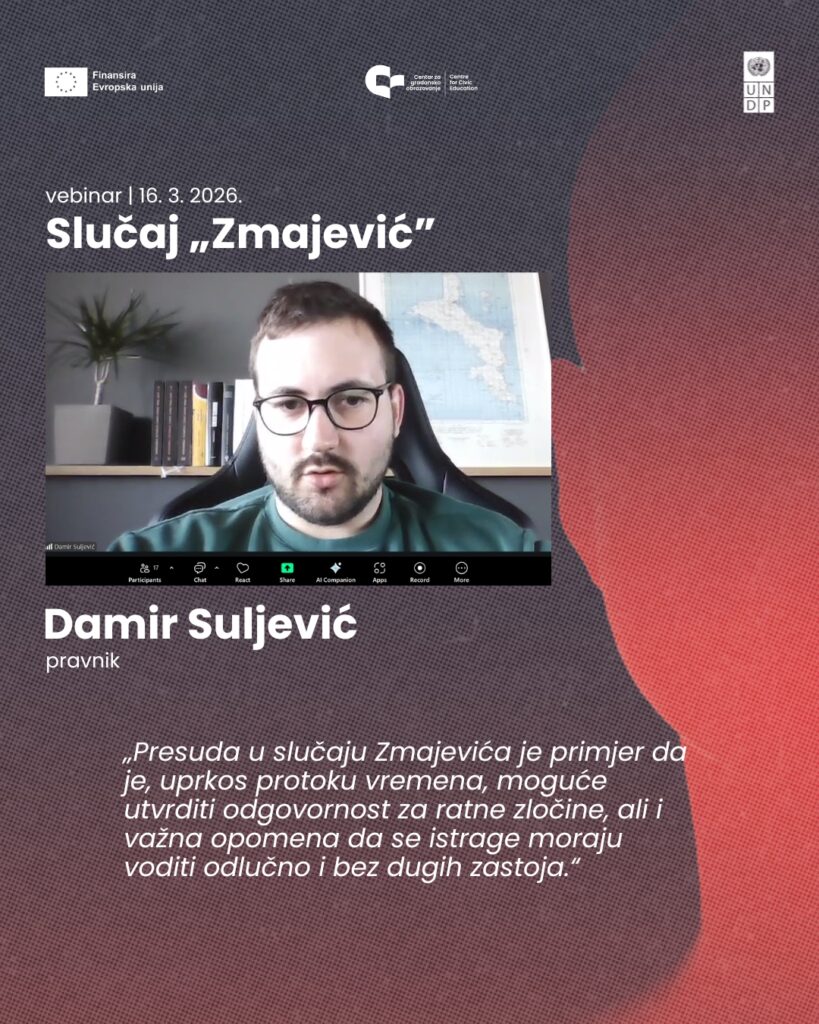
The verdict in the Zmajević case serves as an example that, despite the passage of time, it is possible to establish accountability for war crimes. It also serves as an important reminder that investigations must be conducted decisively and without prolonged delays, as emphasized during the fourth of seven educational webinars, this time on the “Zmajević” case, organized today by the Centre for Civic Education (CCE).
On March 30, 1999, during clashes between the Kosovo Liberation Army (KLA) and the Yugoslav Army (VJ) in the area of the villages of Žegra and Dunav, a war crime was committed against civilians of Albanian ethnicity. Vlado Zmajević, a soldier and volunteer of the III Infantry Battalion of the VJ, and a repeat offender previously convicted multiple times in Serbia and Montenegro, killed four civilians, thereby committing the criminal offense of a war crime against the civilian population. The Special State Prosecutor’s Office (SDT) filed charges against him in 2017, and the first-instance verdict was issued by the Special Panel of the High Court in Podgorica in 2019, finding Zmajević guilty and sentencing him to 14 years in prison. The same year, the Court of Appeals of Montenegro upheld the verdict, thus bringing the case to a final resolution.
“The verdict in the Zmajević case holds particular significance for the Montenegrin public because, as one of the few convictions for war crimes in Montenegrin courts, it confirms the importance of establishing individual accountability and reminds us that responsibility for such acts does not expire,” said lawyer Damir Suljević, who led today’s webinar.
Although the passage of time poses challenges for the judiciary, Suljević emphasizes that the fact the proceedings concluded with a conviction sends an important message that crimes from the 1990s cannot be forgotten. “Such verdicts are significant not only for the victims and their families but also for society as a whole, as they contribute to strengthening trust in justice and the process of confronting the past,” he highlighted.
Suljević also noted that numerous war crime proceedings in Montenegro in the past have been unsuccessful and sparked public controversy, including cases such as Morinj, Bukovica, Kaluđerski Laz or Deportation. “Following these cases, this verdict represents an important signal that it is possible to overcome numerous obstacles and establish accountability. At the same time, it serves as a warning that investigations must be conducted decisively and without lengthy delays so that justice is accessible within a reasonable timeframe and public trust in institutions is reinforced,” Suljević concluded.
Participants also addressed the issue of affected families and the process of reparations. “Regardless of the criminal conviction, the family has the right to seek financial compensation through civil proceedings. It is important that there is a final conviction for the criminal offense to initiate such a process. It is not known whether such a request has been filed in this case, but the possibility exists,” Suljević explained.
Participants agreed that this topic is less known to the public compared to other crimes, which Suljević attributes to the relatively efficient handling of the proceedings as well as limited media coverage. “Also, there was only one accused and therefore one convicted individual, and the victims are not from Montenegro, which likely contributed to the topic’s lower public visibility,” he said.
This webinar represents a practical follow up to the CCE manual “War Crimes of the 1990s in Montenegrin Judiciary Verdicts”, enabling deeper analysis and discussion of judicial rulings available in the publication “The Process of Confronting the Past in Montenegro: The ‘Zmajević’ Case”.
The webinar series aims to provide the interested public with access to verified information on war crimes through analysis of court verdicts, relevant evidence, testimonies, and the role of institutions. The next webinar, led by historian Igor Radulović on 23 March 2026, will focus on the “Štrpci” case.
The webinar series is conducted within the CCE project “Through Understanding the Past for Building Trust and Transitional Justice” as part of the regional program “EU Support for Trust-Building in the Western Balkans”, funded by the European Union and implemented by the United Nations Development Programme (UNDP). The content of this webinar is the sole responsibility of the authors and does not necessarily reflect the views of CCE, the EU, or UNDP.
Maja Marinović, Program Associate