
Non-governmental organisations Centre for Civic Education (CCE) from Montenegro and Association for Social Research and Communications (UDIK) from Bosnia and Herzegovina addressed an initiative yesterday to the Pension and Disability Insurance Fund of Montenegro to terminate the contract and withdraw the rehabilitation centre “Vilina Vlas” near Višegrad from the leisure and recovery programme that the PIO Fund offers to pensioners on favourable terms.
Pensioners in Montenegro have the opportunity to use rest and recovery in several facilities in the country and the region, which represents an important and socially responsible measure. However, UDIK and CCE believe that the selection of those partner facilities must be aligned with basic ethical principles, the culture of remembrance and respect for the victims of war crimes.
The spa and rehabilitation facility “Vilina Vlas”, located about 5 km from Višegrad, was during the war in BiH a place of detention, torture and systematic sexual violence against the non-Serb population. According to the report of a special United Nations Committee from 1994, during 1992 about 200 women were raped in that facility, some of whom were killed, while some committed suicide. Seventeen citizens of Bosniak nationality from the village of Sjeverin near Priboj, who in October 1992 were abducted by members of the paramilitary formation “Osvetnici”, led by Milan Lukić, were also abused and tortured there.
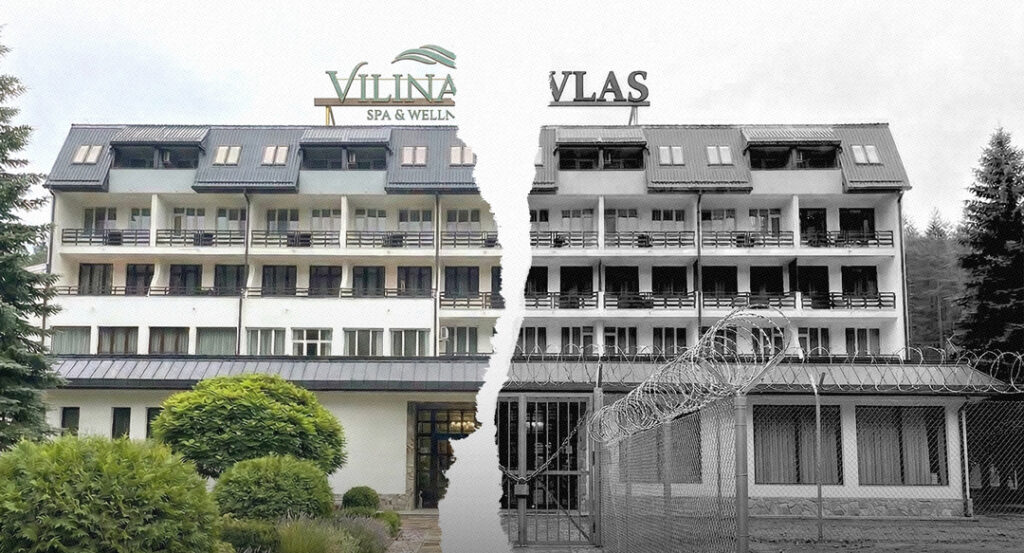
In one of the judgments of the Court of Bosnia and Herzegovina this facility is described as “a rehabilitation centre turned into a women’s camp into which women and girls were brought and systematically maltreated”. Unfortunately, only one of the perpetrators has been prosecuted – Željko Lelek, who was sentenced to 16 years’ imprisonment for crimes against humanity, including sexual violence committed in “Vilina Vlas”, while others were mostly convicted for other crimes they committed in Višegrad and surrounding areas.
After the war, “Vilina Vlas” continued to operate as a spa and rehabilitation facility. However, on the premises itself, nor in its official presentation, is there any information that during the war it was a place of detention, torture and rape. There is neither a memorial, commemorative plaque nor any marker that would alert visitors to those crimes. Thus, with the support of the authorities of that entity of Bosnia and Herzegovina, there is a systematic attempt to erase the facts about the committed crimes.
Promoting this facility for tourism and rehabilitation purposes, without context and reverence towards the victims, represents an example of denial and normalisation of crimes. Many guests who today come to “Vilina Vlas” are not aware that they are staying in a place where mass rapes and killings were committed three decades ago.
This practice was publicly condemned by the regional RECOM network for reconciliation, judging that this is a conscious choice to keep silent about the rapes and to erase the victims from public space. The Islamic Community in Bosnia and Herzegovina also reacted, emphasising that places of suffering must not be presented as tourist destinations without the truth about what happened in them.
The PIO fund, as a public institution of Montenegro, must take into account the ethical implications of its decisions and partnerships. Therefore, it is unacceptable to refer pensioners – among whom there may be persons who have survived war traumas or members of victims’ families – to a facility that symbolises systematic sexual violence and crimes against humanity. Such practice can also be interpreted as indirect acquiescence to revisionism and denial of crimes.
For that reason CCE and UDIK call on the PIO Fund to, in accordance with the principles of social responsibility and respect for victims, initiate the procedure to terminate the existing contract with the rehabilitation centre “Vilina Vlas”, and to introduce clear criteria when selecting future partners that include respect for the dignity of victims of war crimes and a responsible approach to the legacy of the past. UDIK and CCE regret that the management of the PIO Fund has not already done so, bearing in mind that this issue has recently been reactivated in Montenegro by parts of the media.
Terminating this contract would be a clear signal that Montenegro does not accept the normalisation of places of crime under the guise of tourism and rehabilitation, but that its institutions contribute to building a society that responsibly deals with the past and shows solidarity with the victims.
Centre for Civic Education (CCE)
Association for Social Research and Communications (UDIK)