
Centre for Civic Education (CCE) points out that the University of Montenegro (UoM) has still not corrected the mistake made when publishing its position on the Webometrics international university ranking list, despite being timely and well-intentionally warned about it, thereby misleading the Montenegrin public.
Namely, on that occasion UoM did not use the official Webometrics list, but instead presented data from a website containing fabricated and unreliable information.
CCE reacted to the publication of inaccurate information, initially believing it to be an unintentional oversight, and provided this institution with correct and official data. However, even nearly a month after being alerted to the error, UoM has not corrected the published claims. Thus, the inaccurate data remain available on its official website and Instagram pages.
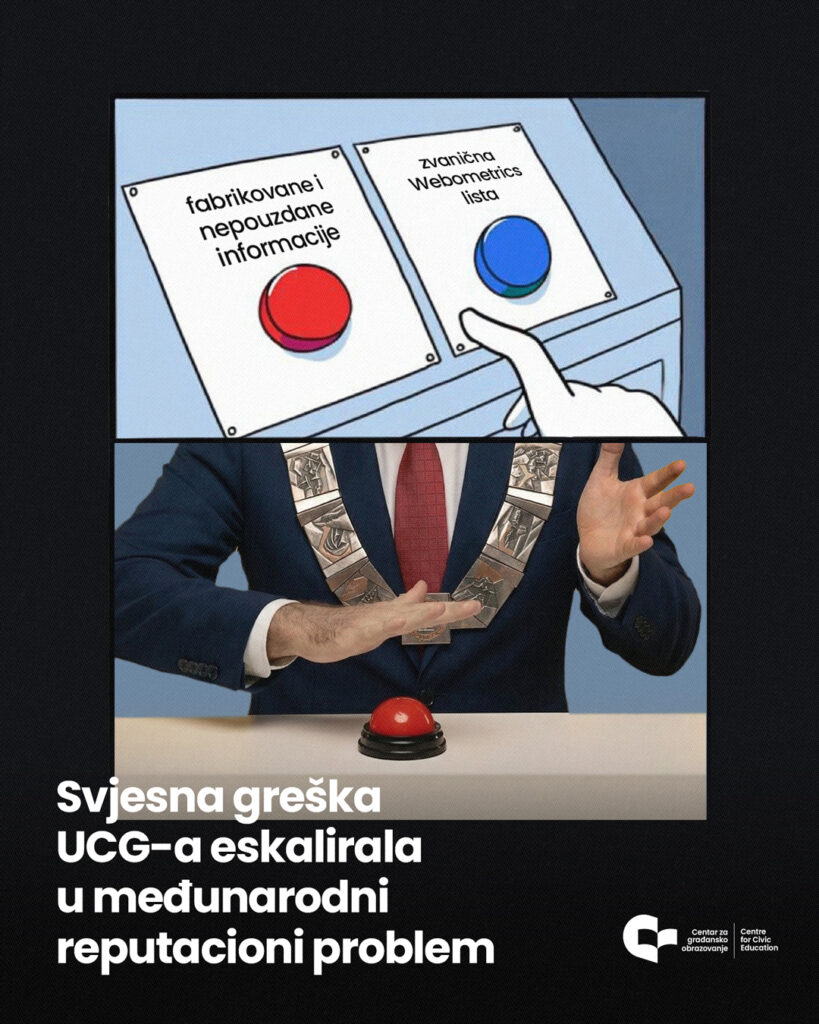
Meanwhile, this oversight has also been noted internationally, as it was mentioned in an article published by the renowned London School of Economics and Political Science. In the article “Predatory university rankings jeopardise the value of Webometrics”, authored by Vladimir Moskovkin, UoM is listed among educational institutions described as “being used to legitimise misleading metrics, thereby effectively turning commercial fraud into a tool for creating an illusion of institutional prestige”. This unpleasant situation could have been avoided had the rector and other UoM leadership not placed ego above the facts highlighted by CCE.
CCE considers that such an attitude by the oldest higher education institution in the country, which is also a significant beneficiary of state budget funds, towards the public both general and academic is unacceptable. In this way, by someone’s conscious decision, the integrity of this institution is undermined, as is the public’s right to be accurately and timely informed.
CCE once again calls on the rector and the UoM leadership to demonstrate responsibility and, without further delay, correct the inaccurately published information, with a clear notification to the public about the error made. This would, at least partially, mitigate the consequences of the misinformation and prevent further erosion of integrity and trust in this institution, which now has international implications.
Ivan Kašćelan, Project assistant