
Centre for Civic Education (CCE) points out that Accession of Montenegro to the European Union are proceeding at a visibly more dynamic pace than before, but that the key challenges remain the same – substantive reforms and their consistent implementation. At the same time, bearing in mind that Albania is being mentioned more frequently as one of Montenegro’s competitors on that path, as well as the possibility of Iceland resuming negotiations, the CCE considers it useful to compare the European paths of these countries.
Montenegro began its European path almost two decades ago and for a long time was considered the most serious candidate country for the next EU membership. The negotiations themselves, which were preceded by various phases of assessing the country’s readiness, were opened in 2012, with rapid initial progress. Namely, already in the same year one chapter was provisionally closed, and by the end of 2015 almost half of the chapters had been opened and one more provisionally closed. However, in the following years the pace slowed down, so it took almost eight years to open all chapters, and to date 14 chapters have been provisionally closed. By 2017, three chapters had been provisionally closed, and the changed geopolitical context, which returned enlargement high on the EU agenda, contributed to intensifying the process again and reactivating some chapters that had already been prepared to a solid extent. Thus, during 2024 three chapters were provisionally closed, in 2025 six, and two so far in 2026.
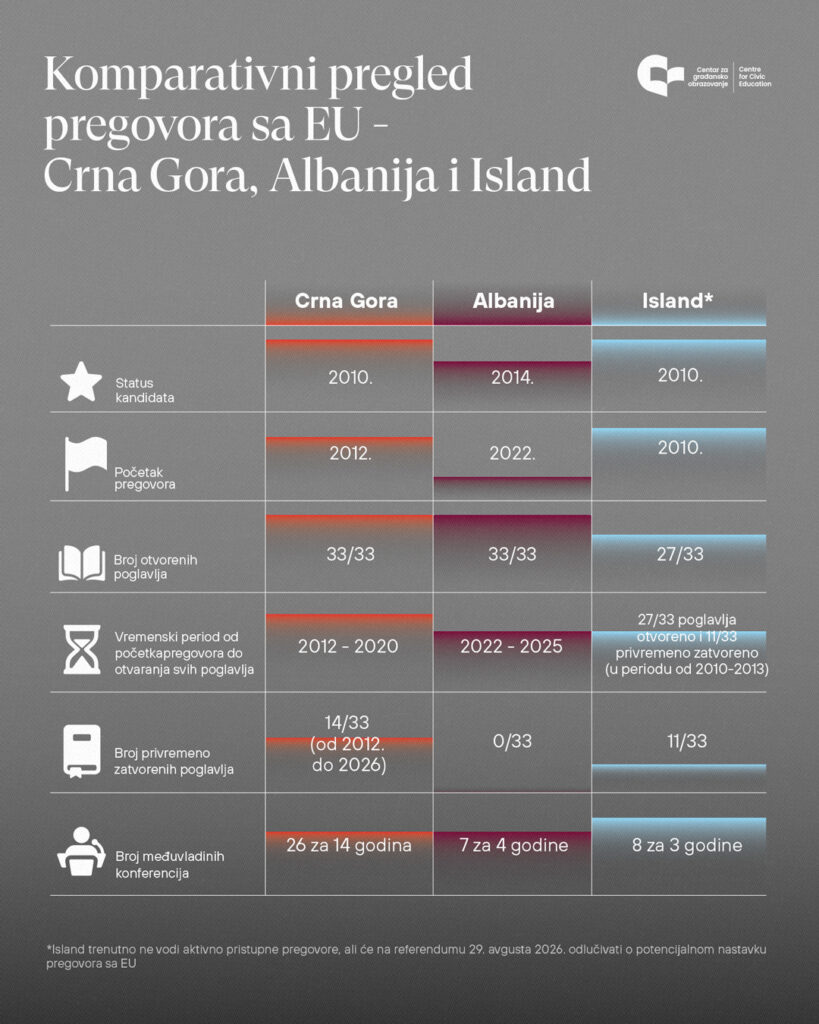
The same geopolitical developments have also been reflected in the dynamics of Albania’s European integration process, whereby Montenegro has gained competition. Unlike Montenegro, which needed almost eight years to open all chapters, Albania completed the same task in less than three years, from 2022 to 2025, with record speed in opening clusters, under which negotiation chapters are now devided. Such dynamics indicate strong political will, but at the same time raise questions about the quality and sustainability of reforms.
Although Montenegro still has a significant advantage – with 14 provisionally closed chapters compared to Albania, which has none closed yet – Albania’s accelerated progress is frequently highlighted, and in some statements by European officials it is positioned as the new “front-runner”, a term previously associated primarily with Montenegro, while European Commissioner for Enlargement Marta Kos described Albania’s progress as “unprecedented”. This is further supported by the perception of stronger economic ties between Albania and the EU in certain segments, as well as the existence of broader political consensus on European integration issues, and the absence of pronounced concerns about malign influence from countries with which the EU does not have developed cooperation.
An additional element of uncertainty is introduced by the possibility of Iceland returning to the negotiation process. That country began negotiations in July 2010, recording exceptionally rapid progress – in less than two years it managed to open 27 and provisionally close 11 negotiation chapters. However, after the change of government in 2013, the new Government of Iceland decided to freeze the negotiations, and in 2015 it formally requested the withdrawal of its candidacy. Nevertheless, the application remains formally valid, and a referendum announced for 29 August could open the way for the continuation of negotiations in 2026. It is important to note that Iceland, through its participation in the European Economic Area (EEA), the Schengen Area, and the European Free Trade Association (EFTA), is already deeply integrated into the European market and applies a significant part of the EU acquis. It also participates in numerous EU programs and agencies, which further indicates a high level of institutional and regulatory alignment. All this supports the assessment that Iceland, with additional efforts to reach an agreement in the field of fisheries, which was previously a stumbling block, could relatively quickly conclude accession negotiations.
In such a scenario, Montenegro’s position as the next member could be called into question, and several possible outcomes emerge. A more favourable scenario implies the parallel accession of several smaller states, while a less favourable one could result in Iceland becoming the next member before Montenegro.
The CCE emphasizes that this period represents a significant opportunity that Montenegro must not miss, but that accelerating the process must be accompanied by genuine progress in the area of the rule of law, strengthening institutions and consistent enforcement of laws, as well as greater inclusiveness and transparency, which are currently lacking.
Therefore, CCE calls on the ruling majority to intensify reforms without delay and demonstrate the necessary political responsibility, so that Montenegro can maintain its leading position and successfully bring EU negotiations to a close.
Ivan Kašćelan, Project Assistant