
Centre for Civic Education (CCE) strongly condemns the content aired in the TV Adria morning programme “Jutro” on 15 April 2026, in which Dragan Koprivica and Mitar Šušić made a series of false, discriminatory, homophobic, and manipulative claims about CCE’s publication “A Guide to LGBTIQ+ Topics for Primary and Secondary School Teachers.” In doing so, they reduced the important issue of protecting children and young people from violence to a crude ideological smear campaign. Instead of a responsible discussion on the safety of children and young people, the programme gave space to rhetoric that downplays and justifies homophobia and transphobia, normalises prejudice, and further endangers young people who are already exposed to ridicule, isolation, and fear in the school environment.
The Guide itself was not discussed on the basis of its actual content, but through deliberate and gross misrepresentation. During the programme, it was described as a “so-called LGBT culture, or anti-culture,” with claims that it “turns children into ideologically, morally, and culturally impaired individuals,” that it represents a “destructive approach,” and even that it leads to “general breakdown in society.” This is not legitimate criticism – it is open stigmatization and an attempt to portray the protection of human rights as a threat.
It is especially alarming that LGBTIQ topics were linked, in a nationally broadcast programme, to paedophilia, necrophilia, and the “destruction of the moral fabric of human beings.” Such claims are not only false and deeply offensive, but also reflect a well-established pattern of rhetoric that fuels hatred, stigma, and intolerance towards LGBTIQ people. When a vulnerable group is publicly associated with perversion, social collapse, and moral decline, it creates a hostile environment in which violence is more easily justified, ignored, or trivialised.
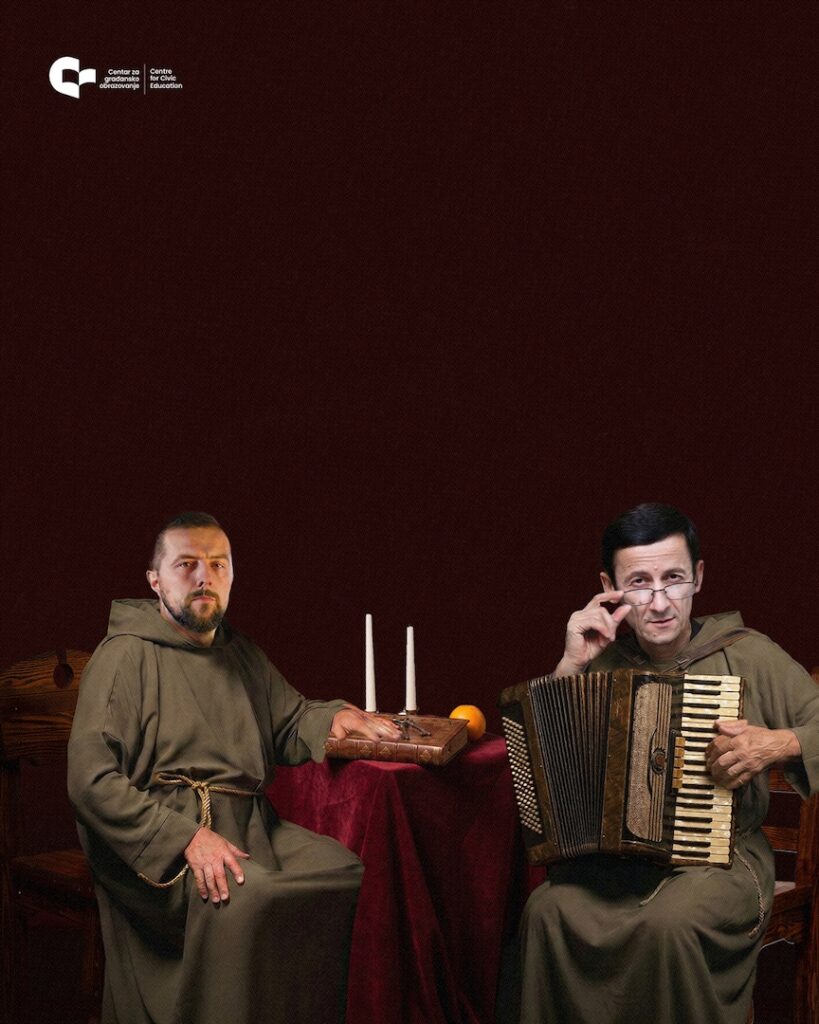
CCE stresses that this Guide is neither an “ideology” nor a tool for “imposing values,” as it has been misleadingly portrayed. It is a practical resource for primary and secondary school teachers, covering topics such as understanding homophobia, identifying homophobic peer violence, communicating with LGBTIQ+ students, cooperating with parents and institutions, and documenting cases of violence and discrimination. Its purpose is clearly protective and educational: to help schools recognise violence, respond in a timely manner, and safeguard the dignity, safety, and rights of every student.
It is deeply paradoxical that the same speakers claimed that “peer violence is widespread” and constitutes a “serious threat,” while suggesting that CCE should address this issue. CCE has been working for years to tackle peer violence and juvenile delinquency – something the speakers would know had they made even a minimal effort to inform themselves. We have extensive knowledge of both the causes and forms of peer violence, grounded in direct communication with victims, parents, teachers, and professional services across institutions.
While politicians in Montenegro have grown accustomed to commenting on virtually every issue without adequate knowledge or expertise, it is important to speak out when such conduct becomes harmful to society. In this case, Šušić and Koprivica attempted to portray efforts to protect students from violence as the “creation of a new problem,” thereby denying the reality in which some children and young people face difficulties on a daily basis simply because they are perceived as “different”.
Claims that something “unnatural” is being imposed on children are not grounded in any genuine understanding of the Guide. On the contrary, the Guide provides clear guidance for teachers on how to respond to hate speech, homophobic insults, the exclusion of students based on appearance or identity, and the avoidance of sensitive topics in the classroom. Ignoring such situations is not neutrality, it amounts to enabling violence.
It is therefore highly irresponsible to attack efforts aimed at equipping schools with the tools needed to prevent violence. Schools and society have a duty to protect children from humiliation, exclusion, and fear, not to create an environment in which such treatment is further encouraged. Any attempt to downplay violence sends a message that some children’s dignity matters less, which is unacceptable.
The media also have a responsibility not to turn the issue of child protection into a platform for spreading stereotypes and prejudice against LGBTIQ people. Public space must not be used to incite hostility against vulnerable groups or to portray human rights as a threat. Freedom of expression does not include the right to dehumanise others, and media outlets have an obligation to report on sensitive issues responsibly, based on facts and with professional integrity. Otherwise, they risk becoming conduits for manipulation and disinformation, with serious social consequences.
CCE stresses that the right to hold an opinion is not in question; what is in question is the degrading of others and the endangerment of the safety of children and young people. Protecting children from violence is not an ideology, but a social responsibility. Anyone who sees it as a threat is not speaking about the Guide, but about their own prejudices. CCE will continue to protect the dignity, safety, and rights of every child, without exception, while also using all available legal mechanisms to combat hate speech and discrimination.
Miloš Knežević, Development Coordinator