
The non-governmental organisations Centre for Civic Education (CCE) and Anti-fascists of Cetinje have submitted an initiative to the Municipality of Nikšić, the Municipal Assembly of Nikšić, and the Council for Naming Settlements, Streets, Squares, and Institutions, calling for the restoration of the bust dedicated to Đoko Pavićević, a veteran of the Balkan Wars and the First World War, the oldest National Hero of Yugoslavia, and one of the oldest participants in the National Liberation Struggle.
Đoko Pavićević was born in 1872 in Dol Pješivački, near Nikšić, into a family with a strong military tradition. He was an officer in the Montenegrin Army and participated in the Balkan Wars and the First World War, where he distinguished himself as a company commander in the Lovćen Brigade. He advocated for the unification of Montenegro and Serbia in 1918 and the creation of a joint Yugoslav state, expressing dissatisfaction with the rule of King Nikola. Due to the poor treatment of Montenegrin Army officers integrated into the Yugoslav Army by the new authorities, he retired at his own request.
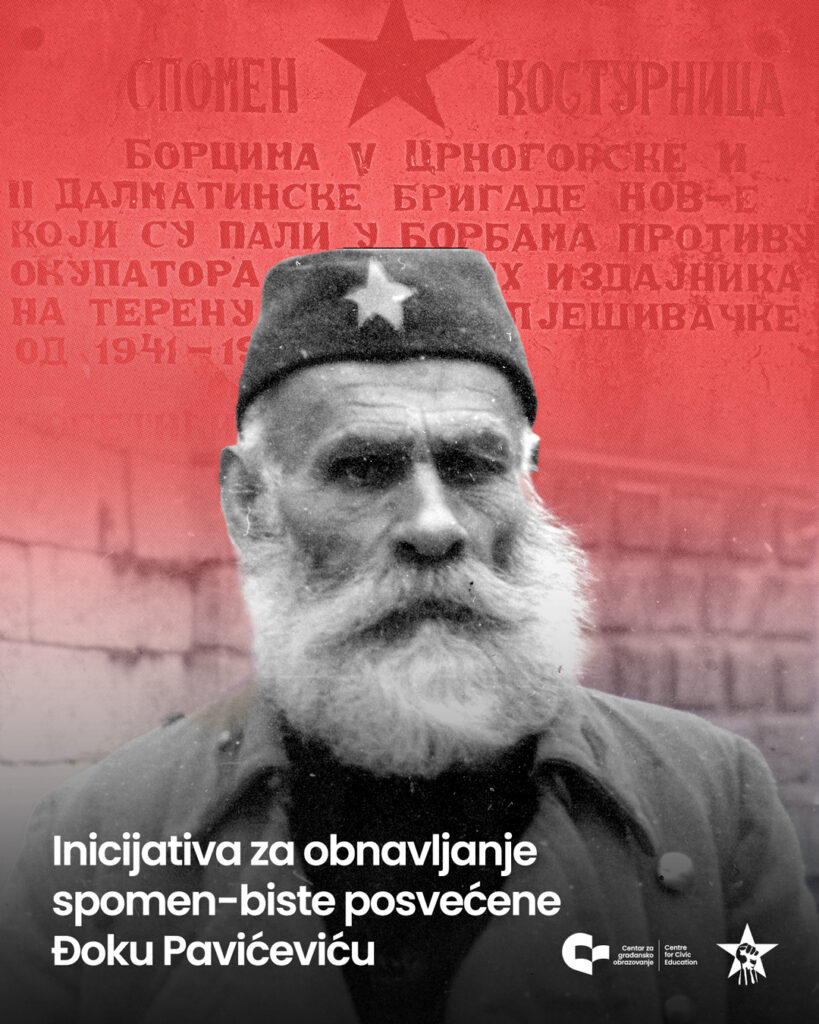
At the outbreak of the July 13 Uprising in 1941, he joined the Partisan movement together with his entire family, despite being 69 years old at the time. At the beginning of the war, he served as deputy commander of the Trebjesa Battalion of the Nikšić Partisan Detachment, taking part in battles around Nikšić and during the Third Enemy Offensive. From June 1942, he was a fighter in the Fifth Proletarian Montenegrin Brigade, where he acted as an advisor to the commander and participated in the breakthrough into Bosanska Krajina. He also served as an advisor to commanders in the Fourth Proletarian Montenegrin Brigade and the Third Shock Division in the later stages of the war. He took part in the Conference of Patriots of Montenegro, Boka, and Sandžak, held in June 1942 in Tjentište.
His striking presence was also noted by the writer Vladimir Nazor, who compared him to a mythical figure.
The writer Mirko Banjević published a report in late 1942 in the newspaper Partizanska riječ, describing Đoko Pavićević with the following words: “Only such an army, only such a struggle, can lead the people out of suffering onto the right path towards a better life. It is to people like these that the future belongs. Until now, my son, there has been no justice! No, none! So this hero of the old kind still insists today. Even now, he thinks about how he can help our struggle wherever he can. He also thinks of returning to his homeland. He is confident that his fellow countrymen will rise again.”
After the war, he retired with the rank of colonel and was elected as a member of the National Assembly of Montenegro. His elder son, Vojislav, was killed as a partisan, while his younger son, Branko, became the first president of the Montenegrin Academy of Sciences and Arts (CANU).
He was awarded the Partisan Commemorative Medal of 1941, and the Order of the National Hero in 1953, at the age of 81. He passed away in 1970 and was buried with the highest state honours in Nikšić.
Despite his significance, no street in Nikšić bears his name today. In Belgrade, however, there is a street named after Đoko Pavićević. The bust that once stood in front of the former JNA Hall in Nikšić disappeared during the 1990s and has never been restored, leaving the city without an important symbol of remembrance of one of its distinguished freedom fighters.
CCE and Anti-fascists of Cetinje believe that restoring the bust is not only justified, but necessary, and that it should have been done much earlier. A city aspiring to become a European Capital of Culture in 2030 should approach the restoration of this monument responsibly. This would not only honour Đoko Pavićević but also contribute to educating younger generations and enhancing Nikšić’s cultural and tourism offer. His life story represents a powerful symbol of Montenegro’s freedom-fighting tradition. We also believe that, following the example of Belgrade, a street in Nikšić should bear the name of Đoko Pavićević.
We call on the Municipality of Nikšić to finally restore the bust dedicated to Đoko Pavićević and thereby demonstrate a responsible approach to preserving the city’s freedom heritage.
Centre for Civic Education (CCE)
Anti-fascists of Cetinje