
The societies of the Western Balkans today remain fundamentally distant from the values symbolised by 9 May – Europe Day and Victory over Fascism Day. The growing revisionism, nationalism, and relativisation of crimes, accompanied by an increasingly weak institutional response to such phenomena, are deeply concerning, it was stated, among other things, during the programme Građanski ugao broadcast on TVE and hosted by the Centre for Civic Education (CCE). On this topic, Zvezdana Kovač, Director of Strategy and Communications at CCE, spoke with Sanja Orlandić, teaching associate at the Faculty of Montenegrin Language and Literature (FCJK) in Cetinje, Darko Brkan, Executive Director of the NGO Zašto ne from Sarajevo, and Aida Ćorović, civic activist from Belgrade.
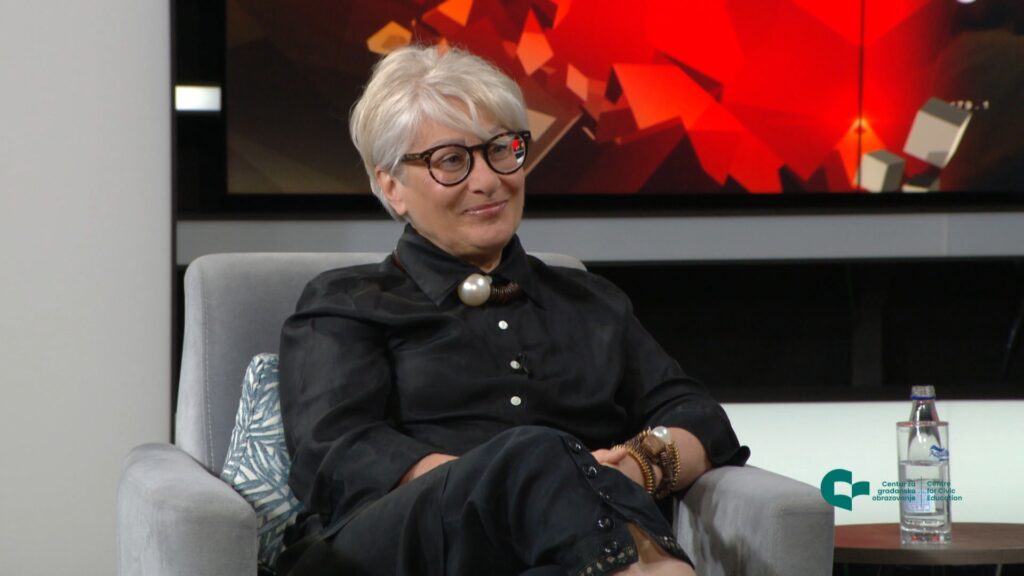
“Serbia is miles away from those values. Those currently in power are essentially the people who lost in 1945, and this is their revenge in full force. These are the same people who created and financed wars and who encouraged them in every possible way through the media, schools, and other channels. We are witnessing the complete normalisation of narratives that are contrary to fundamental European values,” stressed Aida Ćorović, expressing concern over the situation in that country. “In Serbia, it is easier to say that you are the Antichrist than an anti-fascist,” she added, illustrating the extent of the problem.
Sanja Orlandić assessed that the situation in Montenegro is not as dramatic, but warned of a fundamental issue in recognising contemporary forms of fascism. “Fascism no longer wears the same uniform it did in 1941. It seems that, as a society, we have learned to recognise the uniform rather than the ideas, which is why we fail to recognise it when it comes packaged in a different form,” she stated, emphasising that although formal elements of preserving the anti-fascist legacy still exist, serious deviations occur in practice. “We are witnessing attempts at reinterpretation. But this is not reinterpretation, it is open revisionism. We witnessed attempts to erect a monument to Pavle Đurišić, and the awarding of the 13 July Award to a poet who openly glorifies the Chetnik movement. That is the message institutions are sending,” she recalled.
Darko Brkan pointed to the specific situation in Bosnia and Herzegovina, where the problems are multilayered. “I come from a country whose Constitution incorporates discrimination, human rights violations, and discrimination against all those who do not belong to the constituent peoples. If we look at the legacy of 9 May and everything that happened during the anti-fascist struggle, we are living in complete contradiction to all of it,” he stated. “When it comes to Bosnia and Herzegovina, multiply everything said so far by three and add an incredible level of complexity, and you will get Bosnia and Herzegovina,” he further explained.

“You have a situation where 9 May is a public holiday, while at the same time parades featuring Chetniks and other symbols are taking place, with those groups falsely presenting themselves as anti-fascist fighters. That is the level of absurdity to which everything has been brought,” Brkan pointed out. “When we strip everything down, Bosnia and Herzegovina is a society of discrimination at the constitutional level, denial of war crimes, and everything that stems from that, and citizens feel it on their own skin every day,” he added.
The programme particularly highlighted the importance and necessity of resistance despite numerous challenges. “Fascism did not succeed because of those who supported it, but because of those who remained silent. We must not remain silent. Perhaps not all of us can speak publicly, but we can all act at different levels and within our capacities. As long as we can create pressure that leads to change, we must continue to resist and react whenever and wherever we can,” Orlandić stated firmly
Ćorović illustrated the price of such resistance through her personal experience. “That was not an act of courage, but an act of desperation. I was not thinking about the consequences; it was an inner impulse not to allow the image to remain that all Belgraders were on their knees and that a war criminal was a hero,” she recalled, referring to her widely known reaction to the mural dedicated to Ratko Mladić. “As individuals, we defended the Constitution, while the state that adopted the laws and undertook international obligations failed to react,” she emphasised, pointing to the absurdity of the institutional response.
She also drew attention to the transformation of contemporary fascism. “Fascism mimics and adapts itself; it is like cancer. Over the course of 80 years, it has changed its face. Today we see it dressed in expensive suits, in silk gloves, and in neoliberal capitalism,” Ćorović explained.
“We must understand that this is a process and that everything takes time. Just like in nature, nothing matures overnight,” Brkan noted, offering a broader perspective on the struggle for democratic values. “This is a battle of David against Goliath. We do not have equal positions, but we must celebrate small victories, because they show that change is possible,” he stated.
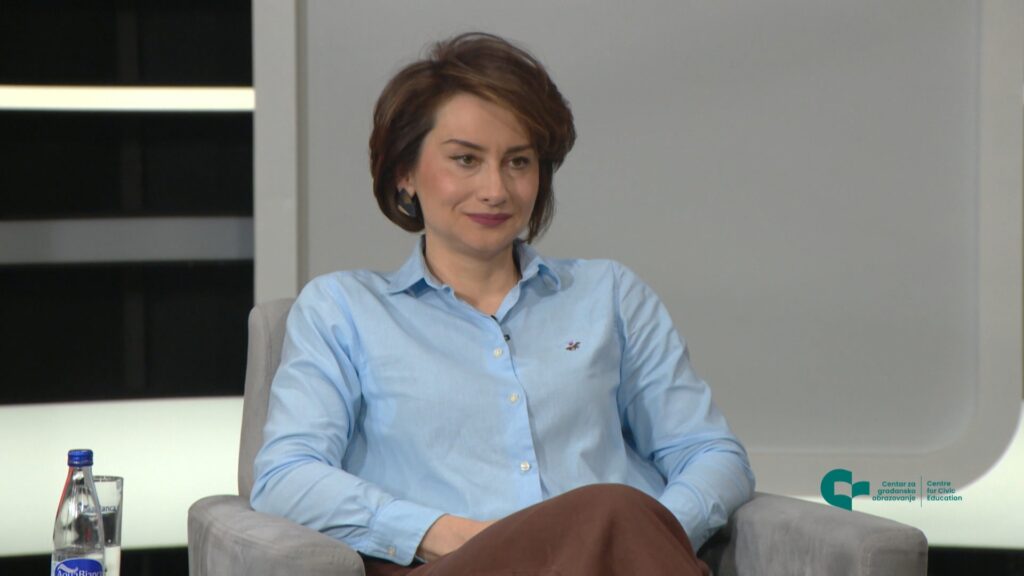
Speaking about global trends, Orlandić highlighted the specificity of the region. “When references are made today to 1941 and revisionism, it is not because of 1941, but because of 1991. If Chetniks from the Second World War are justified, then the crimes of the 1990s will also be justified,” Orlandić stated, pointing to the connection between historical narratives and contemporary political objectives.
Ćorović also problematised the concept of European values. “European values also include fascism and Nazism; these did not originate in the Middle East, but in Europe itself. That is why we must remain aware that such anti-values have not disappeared… There is no civilisation that is constantly progressing, there are waves, declines, and periods of reassessment,” she warned, emphasising the complexity and cyclical nature of social processes.
As concluded during the programme, the key to change lies in long-term work and engagement.
“We must not allow crimes to be portrayed as just another opinion,” Orlandić stressed, underlining the need for clear value-based positions. Brkan also highlighted the importance of understanding both limitations and possibilities. “We have never been fewer, but we have never been stronger, because now we know which battles we are fighting and how we are fighting them,” he stated.
The role of civil society was recognised as crucial, but also insufficiently supported. “The only space left to defend anti-fascism and European values is civil society,” Brkan stressed, while also warning about the complexity of the concept itself. “We must be careful about what we define as civil society, because there are also organisations that promote completely opposite values,” Brkan warned.
Ćorović pointed to additional challenges in Serbia. “For the past 14 years, there has been a campaign against civil society organisations. Whenever they want to discredit you, they label you a foreign mercenary and a domestic traitor. That narrative has become so deeply rooted that even well-intentioned people have started distancing themselves from civil society,” she recalled.
Despite the serious challenges, it was concluded at the end of the programme that there is still room for change, but that such change requires continuous resistance, social responsibility, and a clear commitment to the values of anti-fascism, democracy, and human rights.
The full programme is available at: https://www.youtube.com/watch?v=ujWSZvuvfro
The programme is part of the project “Shared Imprints of Diversity”, financially supported by the Fund for the Protection and Realisation of Minority Rights of Montenegro. The content of the programme is the sole responsibility of the guests participating in it.
Maja Marinović, Programme Associate