
Centre for Civic Education (CCE) has continuously warned of a serious risk of losing part of the financial resources that the European Union has allocated to Montenegro under the Growth Plan for the Western Balkans. Given that the disbursement of funds directly depends on the implementation of reform measures envisaged by the Reform Agenda 2024–2027, this risk is a direct consequence of delays and the failure to fulfil obligations within the established deadlines.
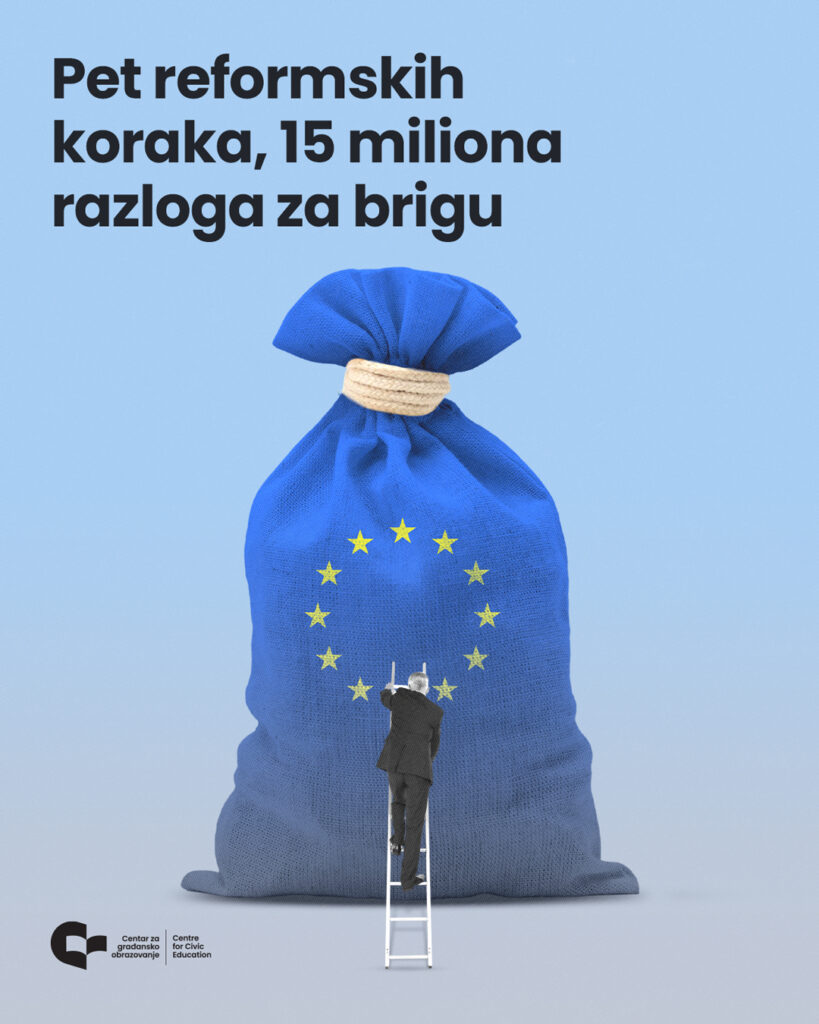
In addition to delays in the implementation of reform steps from all three reporting periods so far, particular concern is caused by the fact that five obligations from the second semi-annual period remain unfulfilled, with the final deadline expiring at the end of this month. Therefore, public interest in these issues is justified, but attention should also be drawn to various manipulations, which is why the CCE considers it especially important that the facts be presented clearly and in their full context.
For the second reporting period, 11 reform steps were envisaged, with a value of approximately €22.5 million. Montenegro has so far managed to implement six measures and thereby unlock only around €7.5 million, while more than €15 million remains uncertain, i.e. directly depends on the willingness of the competent institutions to fulfil all assumed obligations by the end of the month. Of the five outstanding steps – three fall within the area of business environment and private sector development, while two concern fundamental rights and the rule of law. In this review, the focus is placed on the three related to the business environment and private sector development.
One of these steps concerns corporate governance and accountability and entails amendments to the existing Company Law or the adoption of a new law, or secondary legislation, aimed at improving the rules and criteria for selecting management structures in state-owned enterprises and strengthening their transparency, oversight and operational efficiency. The competent authority is the Ministry of Finance, together with other line ministries. In the Second Semi-Annual Report, in which this reform step was addressed for the first time, the Government stated that the Draft Law on the Management of State-Owned Enterprises and the Draft State Ownership Policy had been prepared, but also noted that their adoption had been postponed due to an extended process of interministerial and interinstitutional harmonisation, while announcing that the new legislative framework would be adopted by the end of 2025.
Furthermore, in the Third Semi-Annual Report, the Government stated that mature drafts of both documents had been prepared and that the public consultation process had been completed. At its session held on 26 February 2026, the Government adopted the Proposal for the Law on the Management of State-Owned Enterprises, which is now in parliamentary procedure and could be adopted within the envisaged deadline. In the meantime, the final Draft State Ownership Policy has also been published. However, although it had previously been announced that the adoption of these two acts would be accompanied by the adoption of a Corporate Governance Strategy for State-Owned Enterprises, the Government has still not adopted that document.
Despite the fact that there are realistic prospects that the normative framework will be adopted within the envisaged deadline, it remains to be seen what the final assessment of the European Commission will be, as this will determine the release of approximately €4.6 million earmarked for this reform step. At the same time, the fact that efforts are being made to complete the implementation of obligations only when matters have reached a critical point indicates an inadequate approach to the Reform Agenda 2024–2027, as well as serious weaknesses in the planning, coordination and accountability of the competent institutions.
The second of the aforementioned reform steps concerns the improvement of the anti-corruption framework and entails the revision of the integrity and conflict-of-interest framework in the area of public procurement, together with the implementation of amendments following the adoption of the Law on Amendments to the Law on Prevention of Corruption. In the Second Semi-Annual Report from July 2025, the Government stated that the process of drafting the Proposal for the Law on Amendments to the Law on Prevention of Corruption had been completed and that the agreed text had been submitted to the European Commission for further consideration on 13 July 2025. Six months later, the Third Semi-Annual Report states that the opinion of the European Commission is still pending. This reform step was additionally expanded through the inclusion of amendments to the Public Procurement Law, with emphasis placed on the fact that this is also one of the obligations relevant to Chapter 5 (Public Procurement).
The Proposal for the Law on Amendments to the Law on Prevention of Corruption is currently in parliamentary procedure and there is a possibility that it may be adopted by 30 June. However, when it comes to amendments to the Public Procurement Law, more time will be required, bearing in mind that, according to available information, this act has not yet even entered parliamentary procedure. Nor would it be desirable for amendments to such important laws to be adopted hastily and without public consultation, as this is detrimental to democratic processes. Responsibility for implementing the reform step relating to the Law on Prevention of Corruption lies with the Ministry of Justice and the Agency for Prevention of Corruption, and approximately €2.3 million is linked to this step.
The third step within the area of business environment and private sector development concerns the improvement of the business entity registration system through a more precise definition of the status of active and inactive companies, the regular updating of registers, and the harmonisation of data between the business register and the debtor register of the Central Bank of Montenegro. Responsibility for this step lies with the Ministry of Economic Development, together with the Tax Administration, the Central Register of Business Entities and the Central Bank of Montenegro, and approximately €1.2 million is linked to it. The planned normative framework has been adopted, including the Company Law and the Law on Registration of Business and Other Entities, together with the accompanying secondary legislation, and their implementation began on 1 January 2026. However, the transition to the new Integrated Revenue Management System (IRMS), which is intended to provide technical support for the implementation of this reform step, has caused serious practical difficulties. Technical and normative issues have resulted in obstacles to the registration of new companies, as well as repeated extensions of deadlines for submitting tax returns and financial statements. Insistence on the rapid implementation of such complex reforms reflects an inadequately prepared process in which major systemic interventions are being carried out without sufficient time for stable and functional implementation.
The scale of the problem is further illustrated by the open letter sent by a group of accountants to the Tax Administration and the Ministry of Finance, which was supported by more than 500 professionals within a single day. The letter points out that, instead of simplifying tax procedures, the IRMS has merely generated a series of new problems. All of this calls into question the timely achievement of the final objective of this reform step, on which the disbursement of approximately €1.2 million depends.
It is important to emphasise that attempts to implement reform steps only immediately before the expiry of deadlines not only jeopardise the possibility of losing financial resources, but also the quality and sustainability of the reforms themselves. Reforms implemented through accelerated and improvised procedures can hardly provide stable and sustainable long-term solutions, particularly in areas that require serious institutional changes and careful planning.
Ivan Kašćelan, Project Assistant