
Over the past several months, the Centre for Civic Education (CCE) has repeatedly highlighted the lack of transparency in the management of public funds allocated to student organisations at the University of Montenegro (UoM) – from the absence of answers regarding the spending of more than EUR 2 million to the inconsistency of the Student Parliament of the University of Montenegro (SPUoM), which demands European standards of transparency from others while failing to apply them to its own operations. The findings of these investigations, together with a comparative overview of practices in the region and the European Union, as well as recommendations for improving the existing system, have been brought together in the CCE analysis “Autonomy Without Accountability – Public Funds, Student Organisations, and the Lack of Financial Oversight at the University of Montenegro”, authored by Jovana Radulović.
The analysis demonstrates that the problem does not lie in the negligence of individuals or the actions of a particular administration, but rather in the fact that the system has never been designed to enable genuine oversight of how student funds are spent. It is noteworthy that this has not changed in recent years, despite the fact that leadership positions at the University have been assumed by individuals closely aligned with the new authorities at the national level.
Three key shortcomings have been identified: there is no mandatory independent audit, no obligation to publish detailed financial reports, and the allocation of funds and oversight of their spending are entrusted to the same bodies, without a single independent supervisory mechanism.
The consequence of such a model is a serious structural vulnerability of the system. For the majority of more than EUR 2 million in public funds allocated to student bodies at the University of Montenegro between 2020 and 2025, it is impossible to determine whether the funds were spent for the purposes for which they were granted, as oversight depends on goodwill rather than on clear and binding rules. The analysis further shows that this pattern has persisted for years, regardless of changes in University management or generations of student representatives.
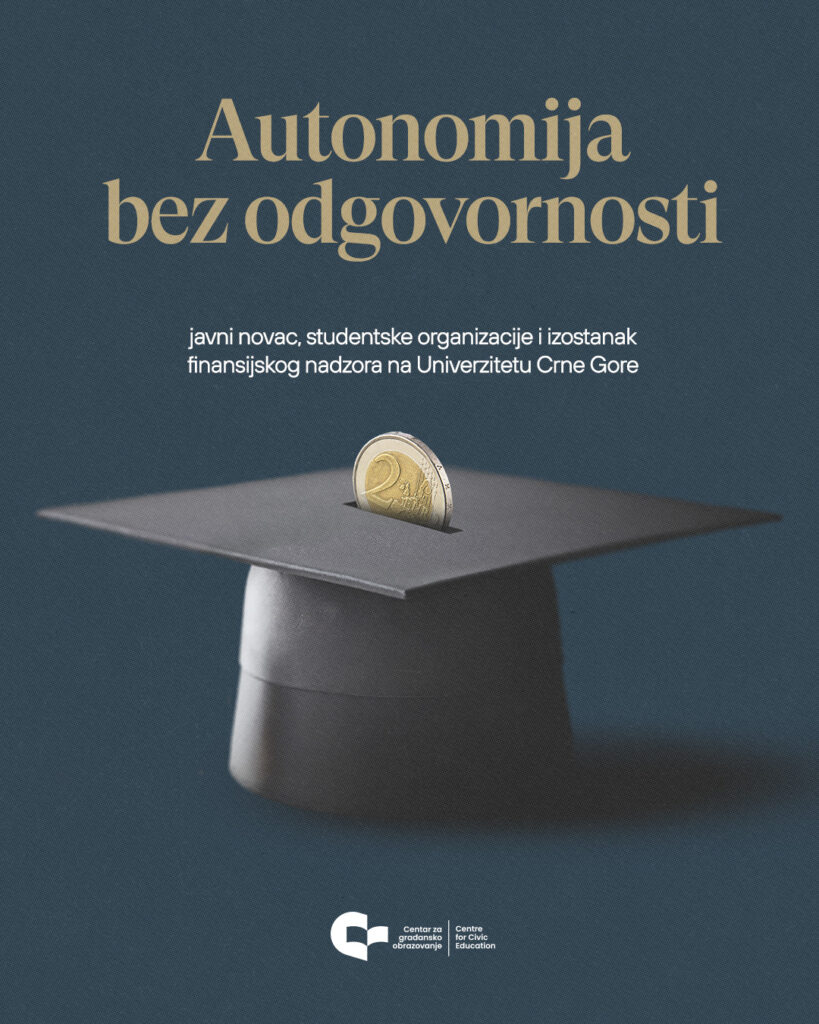
CCE does not question the autonomy of student organisations, which is a prerequisite for democratic university life. However, autonomy cannot serve as an excuse for the absence of accountability, and transparency and responsibility should be an integral part of its legitimacy. This is confirmed by the analysed experiences from the region (Serbia) and the European Union (Slovenia, Austria, Germany, and Croatia), where student organisations enjoy a high degree of autonomy but are subject to independent audits, external oversight, and clear financial reporting requirements. In contrast, Montenegro remains an outlier in this regard. This raises a legitimate question as to whether such a situation is the result of institutional negligence or the deliberate preservation of a system in which the absence of oversight benefits precisely those who manage public funds.
A particular value of the analysis lies in the concrete and practical recommendations it offers, enabling improvements to the existing system without waiting for lengthy legislative changes.
As a priority measure, CCE proposes that the University of Montenegro’s Board of Directors adopt a Rulebook on the Financing of Student Bodies. Under this framework, every disbursement of funds would be conditional upon the submission of an annual activity plan and a detailed financial plan, while subsequent instalments would depend on the submission of expenditure reports detailing spending by individual budget lines. This would, for the first time, establish a clear audit trail and make it possible to verify whether funds were used for their intended purposes. Such a solution already has a basis in the current Statute of the University of Montenegro, requires neither legislative amendments nor the consent of the Student Parliament, and would also cover student councils, which received approximately EUR 700,000 in public funds during the observed period.
CCE further recommends that the Student Parliament introduce mandatory and detailed public financial reporting, separate decision-making on the allocation of funds from oversight of their spending, and align its own practices with the standards it advocates as a full member of the European Students’ Union (ESU). This includes amending its Statute to require the publication of detailed annual financial reports containing breakdowns of revenues and expenditures by budget line, beneficiary, and purpose, as well as establishing mechanisms to prevent the same bodies from simultaneously allocating funds and overseeing their own decisions.
As a long-term systemic solution, CCE proposes the adoption of a dedicated Law on Student Organisation. Such legislation would regulate the status of student organisations, sources of funding, mandatory public financial reporting, independent oversight, and accountability for the misuse or non-transparent spending of funds. Similar legislation already exists in certain countries of the region and the European Union and would represent an important step towards establishing a system in which student autonomy and accountability go hand in hand, rather than one being achieved at the expense of the other.
CCE calls on the leadership of the University of Montenegro and the Student Parliament to seriously consider and adopt these recommendations, thereby demonstrating that public funds allocated to students are subject to the same principles of accountability, transparency, and oversight as any other public funds. Trust in student representation cannot rest on assumptions of responsibility, but must be built on clear rules and verifiable data.
The analysis and recommendations will be submitted to the University of Montenegro’s Board of Directors, the Rector, the Internal Audit Service, the Student Parliament, and other relevant institutions.
Rozana Vuljaj, Project Assistant