
Centre for Civic Education (CCE) warns that the appointment of Novica Đurić as a member of the jury for the 13 July Award continues the practice of compromising the integrity of Montenegro’s highest state honour.
In the early, turbulent 1990s, while serving as editor-in-chief of the newspaper Pokret, Đurić actively participated in disseminating wartime propaganda during the aggression against Dubrovnik.
The jury for this year’s 13 July Award was appointed by the Administrative Committee of the Parliament of Montenegro on 22 June 2026, with all of its members nominated exclusively by the ruling parties. The opposition had previously announced that it would neither participate in the process nor nominate candidates, following last year’s controversial decision to grant the award to Bećir Vuković for his book “Houses of the Homeless”. The Prosecutor’s Office is still investigating the case, while one of the laureates, renowned Montenegrin guitarist Miloš Karadaglić, refused to accept the award because of the scandal. In addition, the Agency for the Prevention of Corruption determined that Želidrag Nikčević, a member of last year’s jury, had violated the law due to a conflict of interest arising from his political and personal relationship with Bećir Vuković. However, that decision produced no institutional consequences.
According to media reports, this year’s jury is chaired by Trifun Savić, nominated by the Democrats. Its members areNovak Jauković, Andrija Radulović and Mitar Rakčević, nominated by the Europe Now Movement; Suljo Mustafić, nominated by the Bosniak Party; Novica Đurić, nominated by New Serb Democracy; and Ćazim Muja, nominated by the Albanian Forum. The Administrative Committee supported Đurić’s appointment with seven votes, while Ilir Čapuni, an MP from the Albanian Alliance, was the only member to abstain.
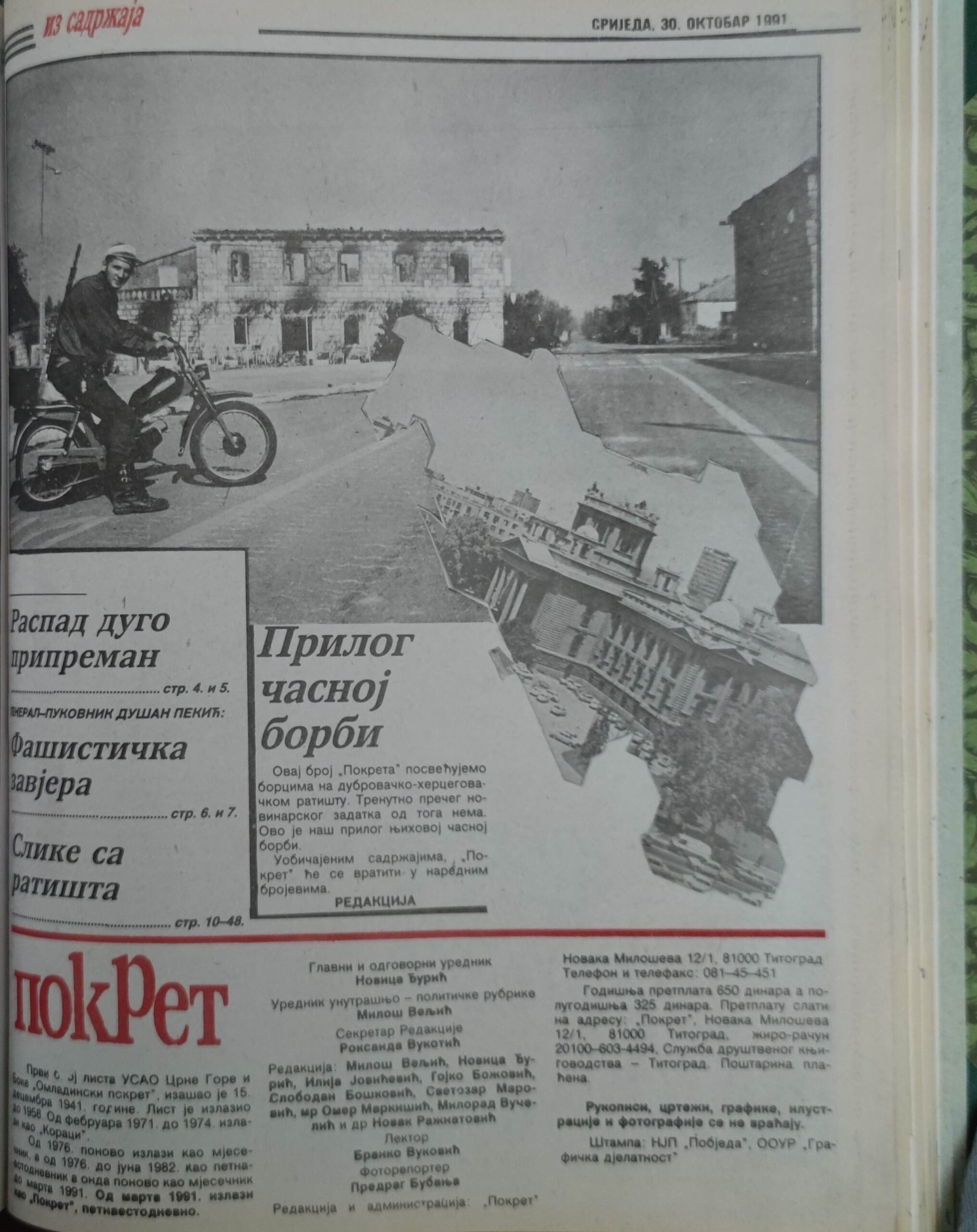
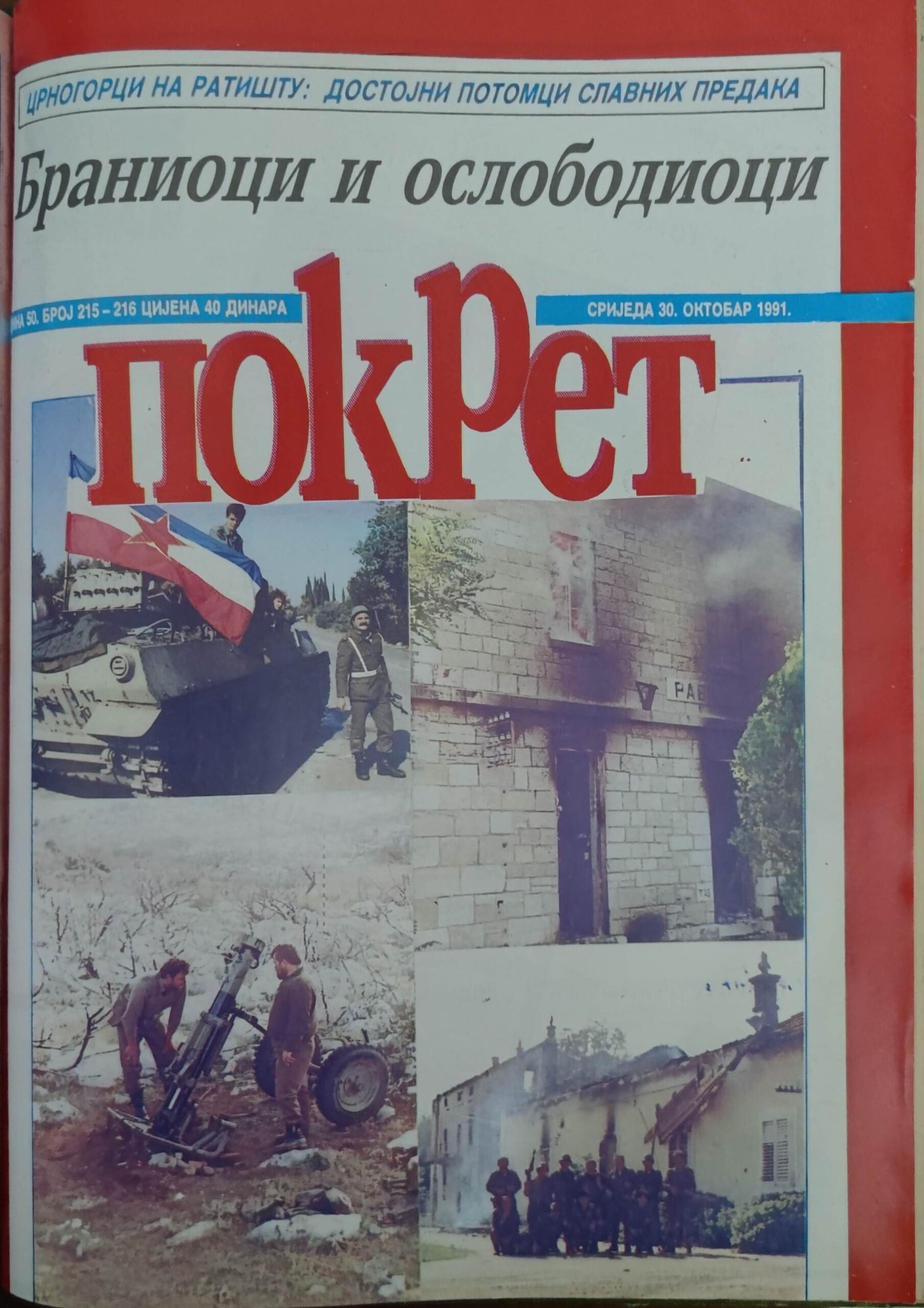
As editor-in-chief of Pokret, Novica Đurić was among the promoters of wartime propaganda during the aggression against Dubrovnik. The newspaper’s front page from October 1991 showed destruction in the area surrounding Dubrovnik and soldiers beneath the Yugoslav flag, accompanied by the headlines: “Montenegrins on the Battlefield – Worthy Descendants of Glorious Ancestors” and “Defenders and Liberators”. The issue of 30 October 1991 was described by the editorial board as “a contribution to an honourable struggle” and was dedicated to “the fighters on the Dubrovnik-Herzegovina battlefield,” with the assertion that “there is currently no more urgent task.”
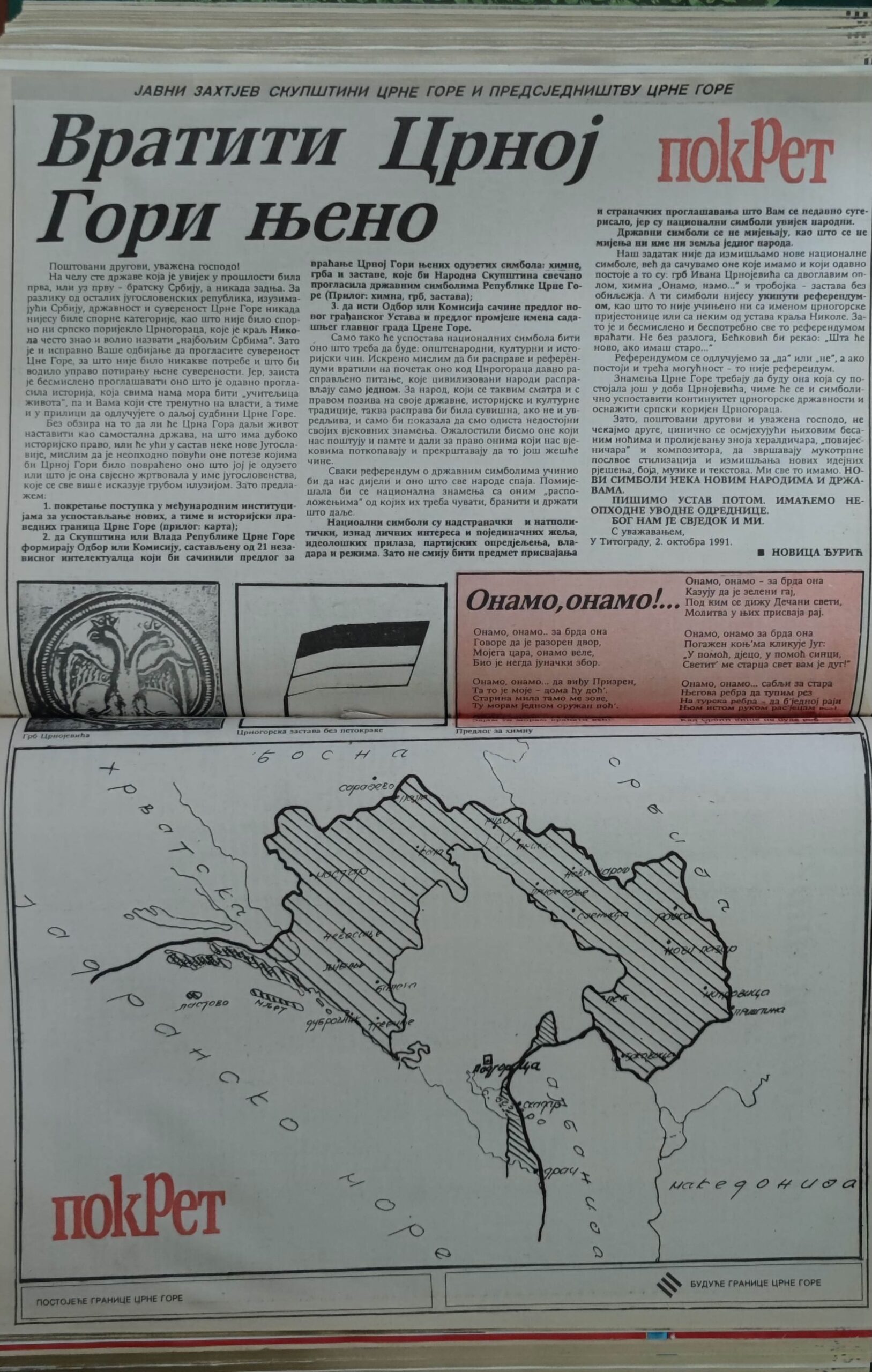
Even more striking was Đurić’s article “Return to Montenegro What Belongs to It”, published on 2 October 1991. In it, he called for proceedings to be initiated before international institutions with the aim of establishing what he described as Montenegro’s “historically just borders”. The article was accompanied by a map depicting parts of Croatia, including Dubrovnik; Bosnia and Herzegovina, including Mostar and Trebinje; Serbia, including Nova Varoš, Prijepolje and Sjenica; and Kosovo, including Peć, Đakovica and Mitrovica, as territories belonging to Montenegro.
Although Đurić received the “Miroslavljevo jevanđelje” Award last year, his official biographies now omit any reference to the role he played during the wars of the 1990s.
CCE recalls that Želidrag Nikčević, a member of last year’s jury who was also nominated by New Serb Democracy, took part in awarding a literary prize to Radovan Karadžić in 1993. The appointment of Novica Đurić therefore represents the continued rehabilitation and recognition of individuals who contributed to the nationalist and warmongering propaganda of the 1990s, during wars that claimed more than 100,000 lives. This appointment was supported by all ruling parties.
As Montenegro’s highest state honour, the 13 July Award symbolises the country’s anti-fascist and freedom-loving values and must not be compromised by appointments of this kind. Last year’s experience should have placed an additional obligation on the ruling parties to preserve the integrity of the award. Instead, all ruling parties acted in unison in supporting this appointment, sending the message that they continue to embrace the destructive ideologies and policies of the 1990s or not opposing them because of some benefits. Also, by voting for individuals associated with wartime propaganda, MPs are not only compromising the 13 July Award but also diminishing the significance of the anti-fascist legacy upon which modern Montenegro is founded.
CCE calls on decision-makers to urgently reconsider this decision and ensure that the process of awarding the 13 July Award is lawful, merit-based and commensurate with the significance of Montenegro’s highest state honour.
Sara Čabarkapa, Active Citizenship Programme Coordinator