
“The ‘Morinj’ camp is not only a military, but also a state issue, which is why accountability cannot be avoided,” was stated at the first of seven educational webinars, opened with the case of the „Morinj“ camp. The webinar was organised today by the Centre for Civic Education (CCE), with historian Miloš Vukanović as the lecturer.
The aim of the webinar series is to provide the interested public with access to accurate, verified, and reliable information on war crimes, through the analysis of court rulings, relevant evidence, testimonies, the role of institutions, and the broader context in which war crimes were committed.
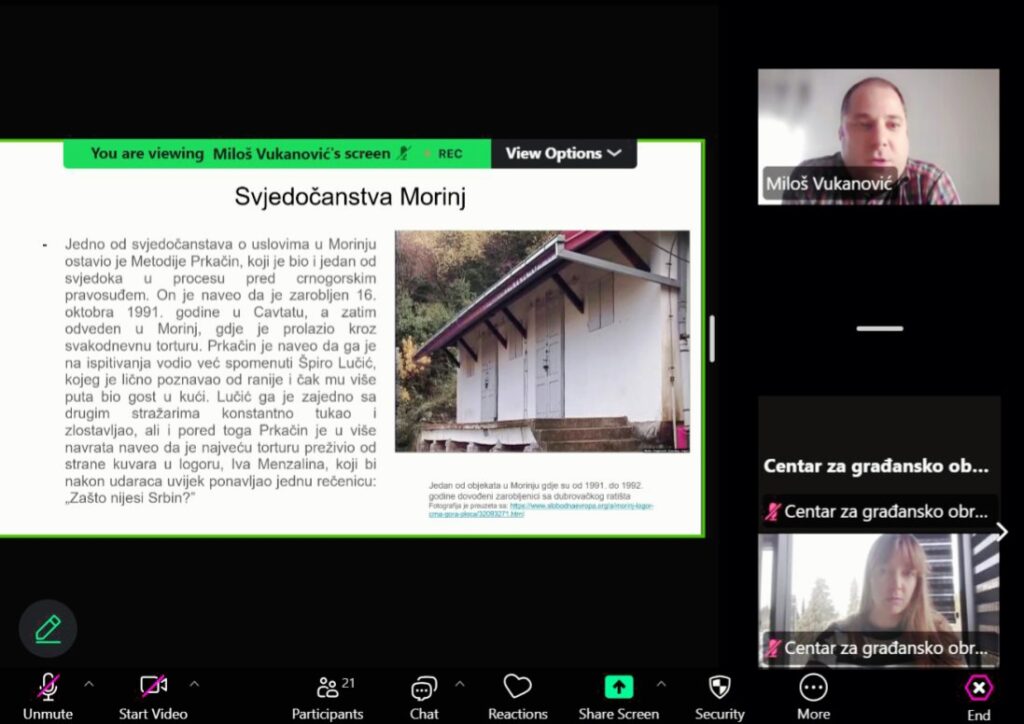
Speaking about the Morinj camp, Miloš Vukanović emphasised that the crime committed at this site has a multi-layered significance, primarily due to its direct connection with Montenegro’s interstate and interregional relations, but also as an important segment of Montenegro’s political and military legacy from the final decade of the twentieth century.
“The specificity of the Morinj camp, where approximately 270 Croatian citizens were detained and abused between October 1991 and August 1992, nearly half of whom were civilians, lies in its direct link to the broader military operations related to the attack on Dubrovnik. It is also analysed within the context of detention camps across the territory of the former Yugoslavia, which represent one of the gravest episodes of the wars of the 1990s,” Vukanović underlined.
He further noted that education about this crime contributes to a clearer understanding of the situation in Montenegro in 1991, particularly with regard to the devastating consequences of war propaganda, as well as the heavy and long-lasting legacy that detention camps have left on society.
Participants in the webinar pointed to the inadequate state of memorialisation and the culture of remembrance. One participant assessed that “the memorial structure in Morinj is made of plastic material, while the concrete base is inadequate, which does not contribute to quality memorialisation or the preservation of a culture of remembrance.”
The role of the state was also emphasised, as well as the absence of adequate prosecution of war crimes, which represents a legal issue at both the national and international levels, a challenge for European integration, and at the same time an additional source of deep social trauma. “The marginalisation of this topic in the public sphere complicates the process of memorialisation and dealing with the past,” it was stated during the discussion.
The issue of Montenegro’s legal obligations was also raised, including the payment of substantial reparations, the amounts of which continue to increase through compensation to released individuals, representing a serious legal and social challenge.
During the discussion, one of the topics addressed was the increasingly frequent comparison with the Lora camp, which Vukanović stressed is not justified. “Responsibility for prosecuting crimes committed in Lora lies with the Croatian authorities, while Montenegro has an obligation to insist on justice through institutional and diplomatic mechanisms where it believes that justice has not been served. Failure in one case cannot be used to delegitimise judicial proceedings in another, as these are separate cases, and the obligation of all is to seek justice for the victims to the very end,” it was concluded during the discussion.
This webinar, which gathered 20 participants, mostly young people, represents a practical extension of the CCE manual “War Crimes of the 1990s in the Judgments of Montenegrin Courts”, enabling deeper analysis and discussion of court rulings, specifically focusing on “The Process of Dealing with the Past in Montenegro – the ‘Morinj’ Case.”
The next webinar is scheduled for 16 February 2026 and will be dedicated to the “Kaluđerski Laz” case. The lecturer will be Velija Murić, lawyer and Executive Director of the Montenegrin Committee of Lawyers for the Protection of Human Rights.
The webinar series is implemented within the CCE project “Understanding the Past to Build Trust and Transitional Justice”, as part of the regional programme “EU Support to Confidence Building in the Western Balkans”, funded by the European Union and implemented by the United Nations Development Programme (UNDP). The content of this webinar is the sole responsibility of the author and does not necessarily reflect the views of CCE, the European Union, or UNDP.
Maja Marinović, Programme Associate