
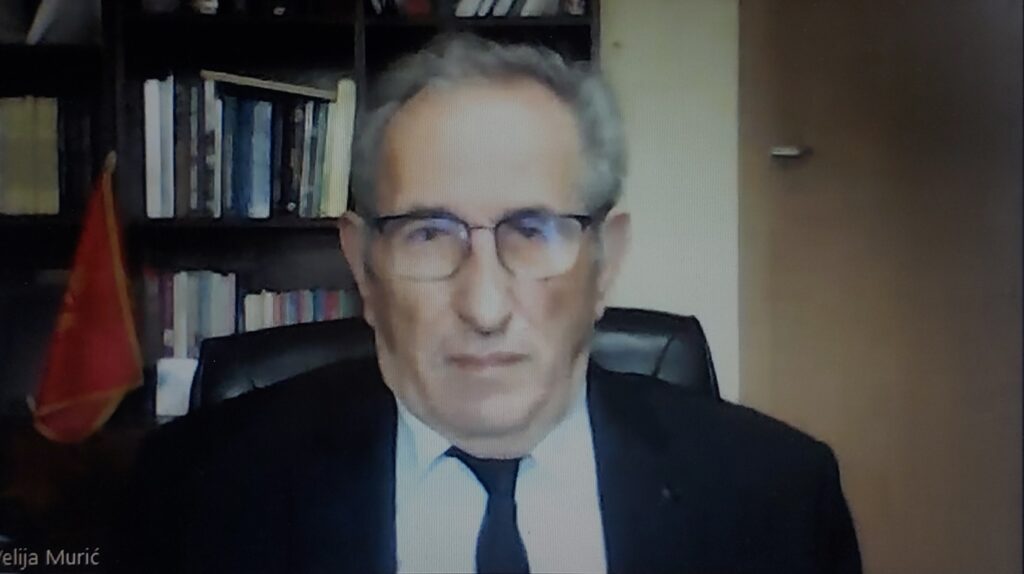
“The ‘Kaluđerski Laz’ case represents a paradigmatic example of institutional weaknesses in the prosecution of war crimes and demonstrates how incomplete transitional justice remains in Montenegro,” it was stated at the second of seven educational webinars organised today by the Centre for Civic Education (CCE), with Velija Murić, lawyer and Executive Director of the Montenegrin Committee of Lawyers for the Protection of Human Rights, as the lecturer.
“It is important to speak today about the ‘Kaluđerski Laz’ crime, because dealing with the past constitutes the foundation for building a democratic and just society,” said Velija Murić. Explaining that the crime was committed in 1999 in the area of Rožaje, he noted that it symbolises the suffering of civilians during the war in Kosovo and raises the issue of the responsibility of state structures of that period. “The victims were civilians attempting to flee the war, which gives this case additional weight. Court proceedings ended without final convictions, deepening the sense of injustice and impunity. In that sense, this case represents a paradigmatic example of institutional weaknesses in prosecuting war crimes and shows how incomplete transitional justice in Montenegro remains,” Murić stated.
The specificity of the “Kaluđerski Laz” crime lies in the fact that it was committed on the territory of Montenegro at a time when Montenegro was not formally a direct theatre of war. “This serves as a reminder that no society can build a stable future without truth, acknowledgement, and justice for victims. Speaking about ‘Kaluđerski Laz’ means affirming a culture of remembrance, respect for the victims, and the obligation of the state to unequivocally condemn war crimes,” Murić emphasised.
It was highlighted that the judiciary plays a key role in establishing individual criminal responsibility and ensuring fair trials, free from political influence and selectivity. Institutions, as stressed, are obliged to ensure access to archives, protection of witnesses, and transparency of proceedings, while the public bears responsibility for preserving the memory of victims and responding to attempts to deny or relativise crimes, in order to prevent future crimes and revisionism.
Responding to a participant’s question about the possibility of justice in repeated proceedings, Murić noted that it is not possible to initiate proceedings against those who have already been tried, but that the prosecution must seek other legal solutions. Nevertheless, he expressed optimism, emphasising the importance of a culture of remembrance and the documentation of facts.
“If judicial justice is not achieved, another form of justice will be. Aware of this, I have long since begun writing the book ‘Crime Without Punishment – From the Balkan Wars to Kaluđerski Laz’, which will serve as a mirror of truth based on facts. I felt an obligation to do so in order to leave a record, as a form of this other, human justice,” he stated.
Participants also addressed the issue of memorialisation and the initiative to erect a monument to the victims of this crime, which was submitted to the Municipality of Rožaje three years ago. “I renewed that request and submitted it to the Ministry of Culture. After the legally prescribed deadlines were not respected, the local administration put the matter on the agenda and approved the initiative. It is now up to the Ministry to give the green light for the monument to be erected at Kaluđerski Laz, on the road leading through the village towards Peć. The monument will bear the names of the victims and a message that the crime must never be repeated,” Murić concluded.
This webinar, which gathered 20 participants, represents a practical continuation of the CCE manual “War Crimes of the 1990s in the Judgments of Montenegrin Courts”, enabling deeper analysis and discussion of court rulings available in the publication “The Process of Dealing with the Past in Montenegro – The ‘Kaluđerski Laz’ Case.” The aim of the programme is to provide the interested public with access to verified information and facts about war crimes through the analysis of court rulings, relevant evidence, and testimonies.
The next webinar will be held on 23 February 2026 and will focus on the “Deportation” case, with activist Tamara Milaš as the lecturer.
The webinar series is implemented within the CCE project “Understanding the Past to Build Trust and Transitional Justice”, through the regional programme “EU Support to Confidence Building in the Western Balkans”, funded by the European Union and implemented by the United Nations Development Programme (UNDP). The content of this webinar is the sole responsibility of the author and does not necessarily reflect the views of CCE, the EU or UNDP.