
On the occasion of World Day of Social Justice, the Centre for Civic Education (CCE) assesses that social justice in Montenegro too often remains confined to promises, while the reality for many citizens is marked by insecure income, unequal access to public services, and limited opportunities for social mobility. Additionally, international recommendations – such as those of the UN Committee on Economic, Social and Cultural Rights – as well as key national documents in the field of poverty reduction, continue to be insufficiently implemented.
Although certain positive economic indicators are frequently highlighted, they do not reflect the quality of life nor the security of citizens’ employment and social status in Montenegro. According to data from the Statistical Office of Montenegro (MONSTAT), the unemployment rate in the third quarter of 2025 stood at 10.1%, while the employment rate was 56%. However, these figures do not capture the reality of many employed persons who work in precarious conditions, without stable contracts, with low wages amid rising inflation, and with limited rights, particularly in the areas of education, employment, healthcare and social protection. The average net salary in November 2025 amounted to EUR 1,018, but this average conceals significant disparities among sectors and regions, as well as the fact that many households still struggle to meet basic living needs, especially in the context of rising prices and housing costs. At the same time, vulnerable groups remain on the margins, often excluded from both social and political processes.
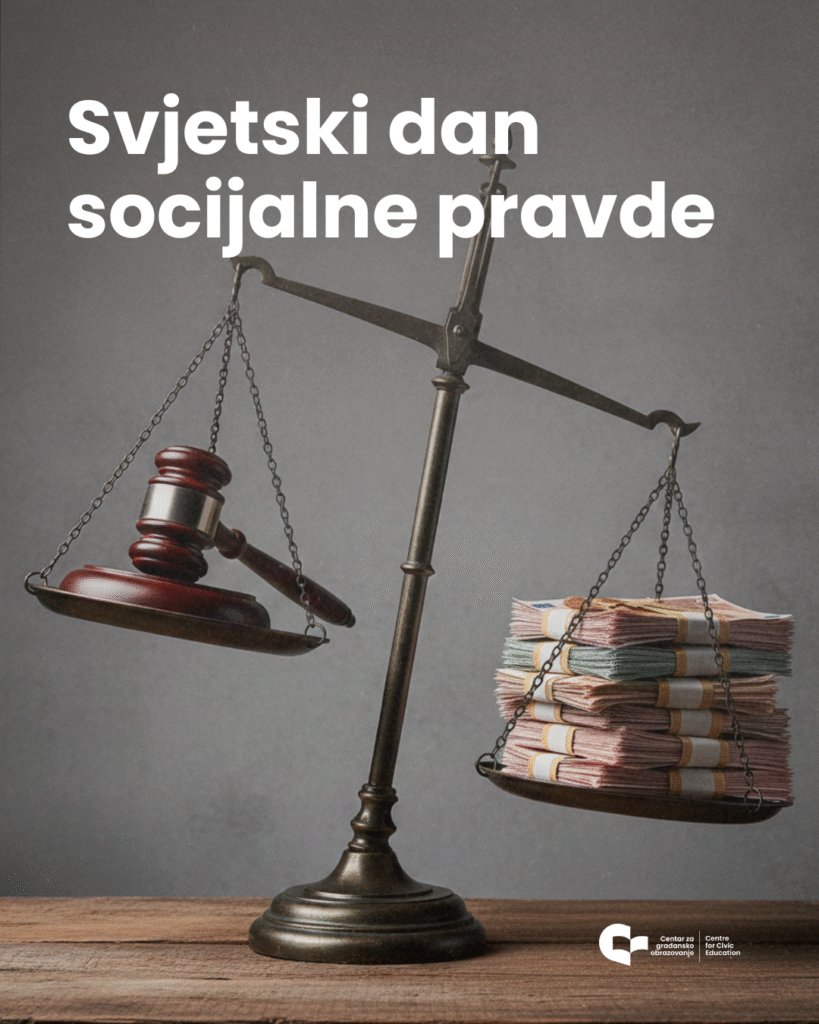
It is concerning that approximately 20% of Montenegro’s population is at risk of poverty, with children and young people among the most vulnerable. This serves as a warning that existing social policies are neither sufficiently systemic nor effective, but largely reduced to short-term and partial measures without lasting impact. Despite this, the Government of Montenegro has reduced the 2026 budget allocation for family financial assistance by EUR 500,000, further deepening the gap between declared social policy objectives and actual budgetary priorities.
CCE recalls that, pursuant to Article 1 of the Constitution, Montenegro is defined as a state of social justice. This entails an obligation for institutions to ensure, through concrete, measurable and sustainable policies, a dignified life, social security and equal opportunities for all, rather than allowing this constitutional principle to remain merely a norm on paper.
CCE calls on decision-makers and all relevant social actors to urgently initiate an open and substantive dialogue on reducing social inequalities, with clear objectives, responsibilities and timelines. The realisation of economic, social and cultural rights is not possible without responsible management of public resources, a resolute fight against corruption, and a strong and independent civil society.
World Day of Social Justice should serve as a reminder that social justice must be a measurable practice of institutions. CCE will continue to contribute to this goal through education, advocacy, research and the strengthening of democratic culture.
World Day of Social Justice, established by the United Nations in 2007, aims to raise awareness of equal opportunities, social inclusion and poverty reduction.
Rozana Vuljaj, Project Assistant