
Centre for Civic Education (CCE) notes that the Montenegrin Academy of Sciences and Arts (CANU) has not included any activities marking the 20th anniversary of the restoration of Montenegro’s independence in its 2026 Work Programme.
CCE submitted several requests for free access to information to CANU regarding the marking of Montenegro’s Independence Day, including all CANU activities in the period from 2007 to 2025. CANU referred CCE to the editions of its Yearbook, available through the CANU digital library. However, the editions are available only up to 2022, while those for 2023, 2024, and 2025 are not accessible.
Additionally, CCE requested information on planned CANU activities marking 20 years since the restoration of independence. In response, CANU referred CCE to its 2026 Work Plan, from which it appears that the Academy omitted this jubilee, as the document contains no activities that could be associated with it. CCE subsequently sent a letter to the President of CANU, Ljubiša Stanković, requesting clarification, but has not received a response to date. CCE still believes that this may be an inadvertent oversight and hopes that CANU will inform the public in a timely manner about activities marking this important anniversary.
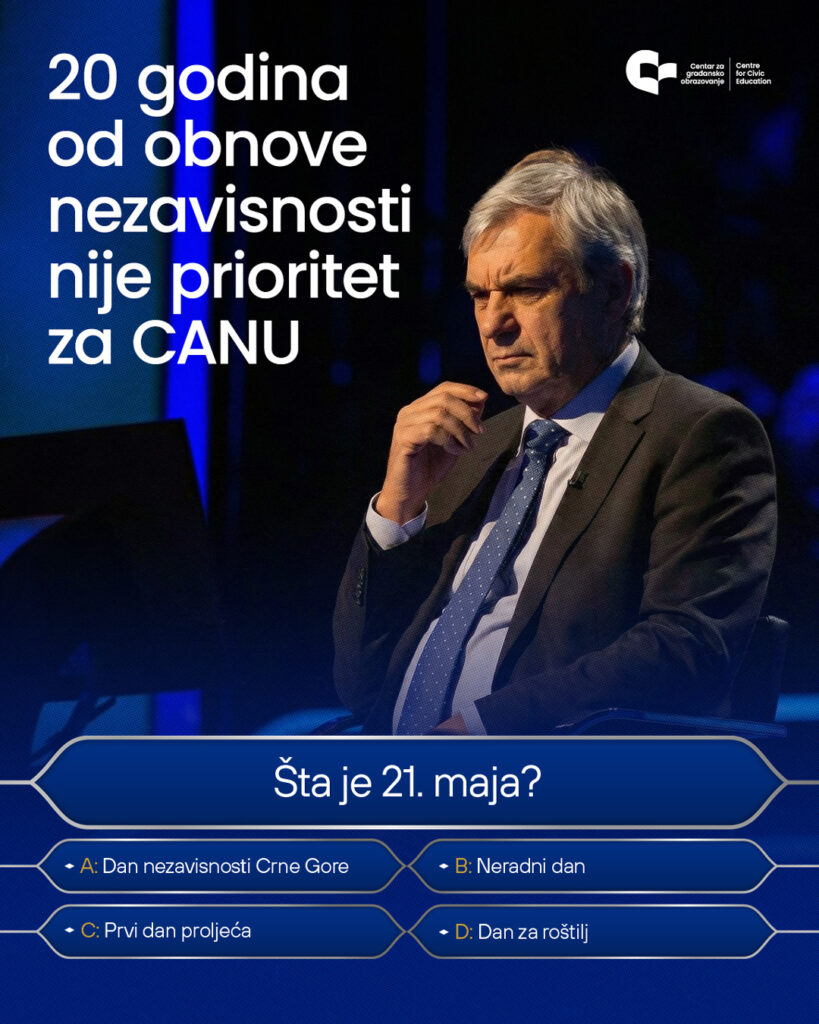
After reviewing the Yearbook editions, CCE notes that 21 May has not been a substantive focus of CANU, having been marked only twice so far through several symbolic activities — in 2011 and 2016.
In 2011, on the occasion of five years since the restoration of independence, CANU, through its Centre of Young Scientists and in cooperation with the National Academy of Sciences of Ukraine and partner institutions, organised an international scientific conference entitled “20 Years of Independence of Ukraine and 5 Years of Independence of Montenegro” on 20 September 2011 at CANU. This was the only activity that year dedicated to the restoration of independence.
On the tenth anniversary of the restoration of independence, in 2016, Academician Pavle Pejović and the Department of Arts of CANU organised an exhibition of artworks by CANU members on 15 November at the Centre of Contemporary Art, accompanied by a catalogue. The Yearbook notes that the exhibition was organised on the occasion of the 10th anniversary of the restoration of Montenegro’s independence and 45 years of CANU. Additionally, the first volume of the Dictionary of the Montenegrin Folk and Literary Language was published and “presented” to Montenegro on the occasion of the tenth anniversary of the restoration of its independence, described in the Yearbook as “a cultural event of special significance for Montenegro.” The promotion, held on 8 April, was attended by the highest state officials at the time. Finally, on 1 December of that year, Prof. Dragan Đukanović delivered a lecture entitled “The Foreign Policy Position of Montenegro Since the Restoration of Independence.”
According to the available information in the 2021 Yearbook, when Academician Dragan Vukčević served as President of CANU, there were no activities marking 15 years since the restoration of independence.
CCE believes that CANU, as the highest scientific and cultural institution in the country, should dedicate a certain number of activities each year to marking 21 May. This represents an opportunity for discussion of state development issues and topics relevant to modern Montenegrin society.
As an interesting note, it should be recalled that the importance of the 2006 referendum was recognised by the then President of CANU, Momir Đurović, who otherwise opposed Montenegro’s independence. In the 2006 Yearbook, his text “What Do We Expect to Change in the Montenegrin Academy of Sciences and Arts” reflects on the role of CANU in the upcoming period, stating that decision-makers must not marginalise it. “Those who make decisions in Montenegro should listen to what we know before deciding. Surely we will not support a society in which everyone wants to know and organise everything, even those entrusted by the people to govern,” he wrote, placing CANU above the legislative and executive authorities. Particularly noteworthy is Academician Đurović’s public hope that the space for civil society would be narrowed. “Also, and not insignificantly, the times when certain governmental, and especially non-governmental organisations were presented to us as possible correctives or partners in our work have passed. Those unpleasant times seem to be behind us,” he wrote twenty years ago.
Much has changed in Montenegro since 2006. Unfortunately, CANU has allowed itself to be marginalised through its own lack of initiative and clear positions. CCE hopes that today CANU better understands the importance of civil society and the need for more proactive engagement.
CCE once again calls on CANU to publish a programme of activities marking 20 years since the restoration of Montenegro’s independence. This jubilee should be an opportunity to present ideas and solutions of importance to society, ensuring continuity in marking one of the most important national holidays each year – a role that should undoubtedly be assumed by an institution bearing the adjective “Montenegrin” in its name.
Sara Čabarkapa, Active Citizenship Programme Coordinator