
Education system must teach youth critical thinking so they can understand the truth about the wars of the 1990s. In interpreting those events, media also play an important role and are obliged to place facts in the proper context and insist on accountability. These were some of the messages from the PROUDCAST of the Centre for Civic Education (CCE), in which Željka Zvicer, CCE’s Programme Associate, spoke with Jasmina Đorđević, co-author of the 9th grade History textbook, and Darko Šuković, editor of the Antena M radio and portal, about the role of the media during the 1990s, their responsibility today, and the importance of education based on facts.
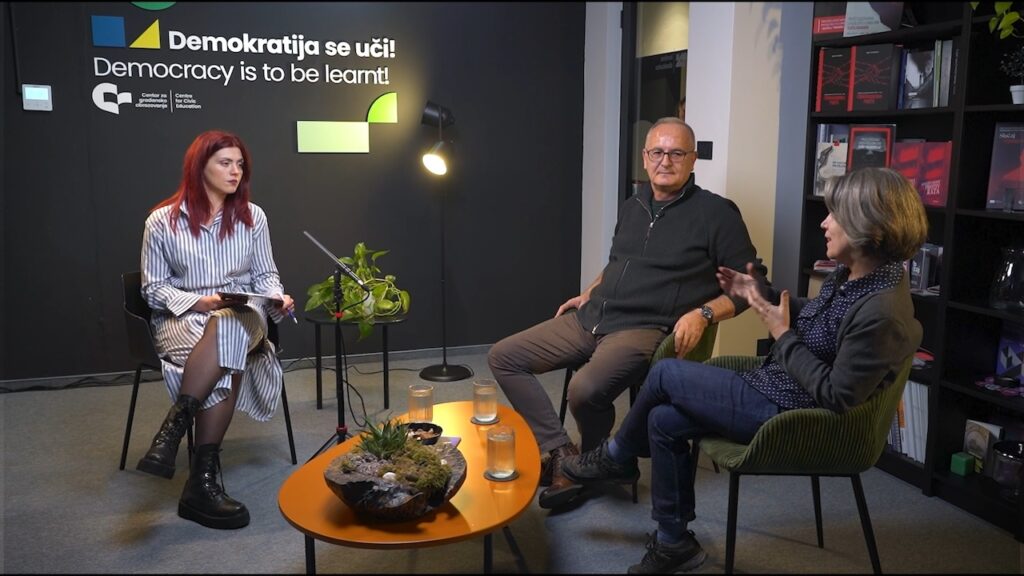
Šuković stressed that the media played a key role in justifying the wars and crimes of the 1990s, noting that the media landscape at the time was extremely limited. “At that time, particularly in the first half of the 1990s, there were only a few media outlets – Radio and Television of Montenegro (RTCG) and Pobjeda. Apart from them, there were no media with significant influence, nor did media outside Montenegro have much impact,” he explained.
Recalling that period, he assessed that it was not a matter of professional reporting but of propaganda. “From the way specific events were covered to the context in which they were presented, the media were one of the key pillars of the Greater Serbian project aimed at breaking up Yugoslavia and creating ‘Greater Serbia’. In such an atmosphere it was almost impossible to obtain complete and accurate information, as there were neither social networks nor the internet,” Šuković said. As an illustration, he recalled that in the early morning hours they would go to the petrol station near the football club Budućnost stadium to try to catch a weak signal from Radio Sarajevo and verify information.
Đorđević recalled the example of media reporting on the alleged burning of Serbian babies in Vukovar. “News was published claiming that doctors were burning Serbian babies, accompanied by a photograph and the claim that it showed a burned baby. People believed it, and not only the uneducated. This showed how even education can sometimes be powerless,” she said, also recalling public statements by Biljana Plavšić, a university professor, who put forward theses about alleged biological differences between peoples.
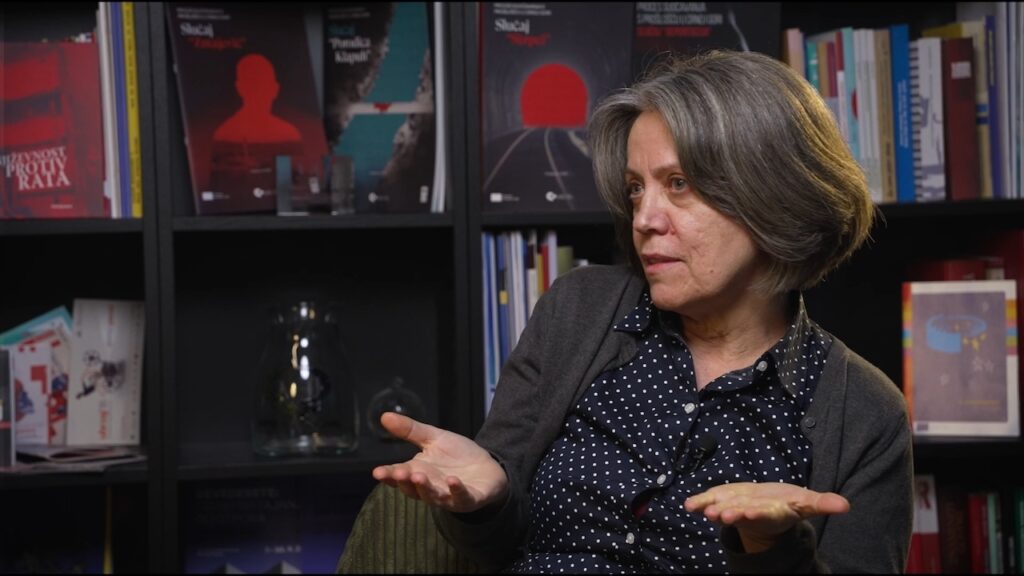
Because of such experiences, Đorđević notes that she is cautious when discussing the power of education to reveal the truth, stressing that work with children must be careful and thoughtful. Particular challenges arise with topics around which there is no broader social consensus. As an example, she mentioned the Resolution on Srebrenica adopted by the Parliament of Montenegro, around which there is still no agreement within society. “Students bring different interpretations into the classroom from their families, and even among teachers there is not always a unified position,” she explained.
An additional problem is that history textbooks devote very little space to the period of the 1990s. Because of final exams and external testing, some planned lessons are lost, while some teachers consciously avoid addressing these topics, especially in communities where serious crimes occurred. “In mixed communities, in places where very serious things happened, this is extremely sensitive. And the classroom, or the school in general, should not be the only place dealing with these issues,” Đorđević noted.
She sees the solution in developing critical thinking, which, she says, some teachers are already working on. “We do not have to immediately define Srebrenica, but we can teach children to read, analyse documents, examine arguments from different sides, develop empathy and the ability to construct knowledge,” she explained.
Also, she pointed to the history textbook from 2009, authored by Šerbo Rastoder, Dragutin Papović and Sait Šabotić, which listed crimes in which Montenegro participated. Although it passed all institutional procedures and received approval from expert and competent bodies, the textbook was suspended after reactions from outside that process. “The message was clear: anyone who wants to write textbooks must be very careful about how they do it,” Đorđević emphasised.
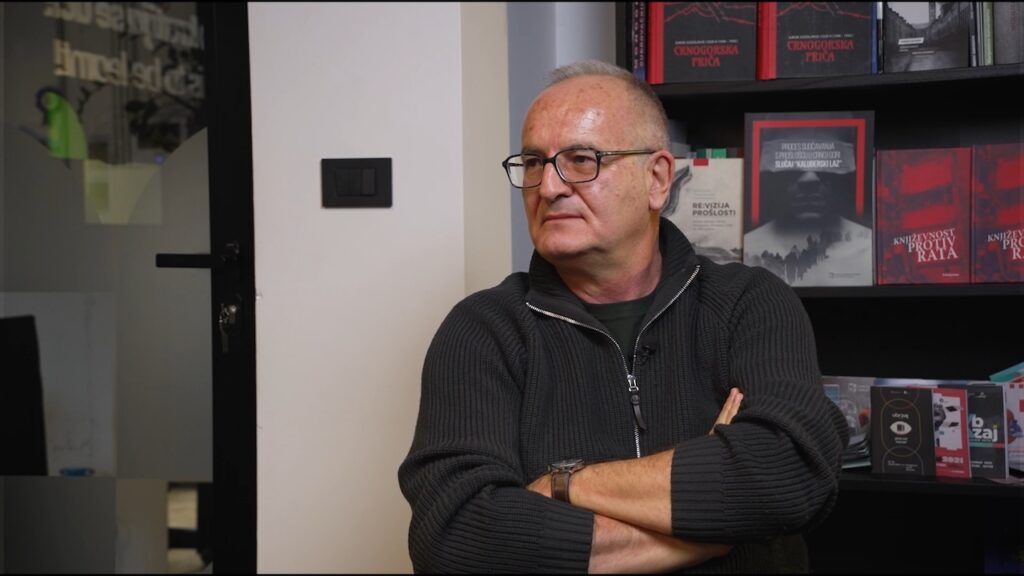
Šuković explained that the media have largely contributed to the fact that today there is no consensus on historical facts, because, as he says, they did not adhere to facts nor place them in the proper context. As an example, he cited the beginning of Operation Storm, when Italian television broadcast footage of the Knin fortress with the Croatian flag, while Television of Montenegro continued for days to report that Serbian forces were withdrawing to reserve positions.
Speaking about today’s media landscape, Šuković assessed that it remains problematic. “When you look at ownership structures and editorial policies, you see that the dominant media are either openly and proudly in the service of foreign interests. How is it possible that so many media outlets, so many journalists, show so little interest in facts? The problem is that we have never built a critical mass of viewers, listeners and readers who would react to this by boycotting it. You lie, I will not watch you. You lie, I will not listen to you. You lie, I will not read you. The main problem today is not only the media landscape but also the immaturity of public opinion that tolerates it,” Šuković assessed.
The interlocutors concluded that as a society we have not learned the key lessons from the 1990s.
“Children must learn to read and think critically. That is what school must teach them. Not only years, dates and numbers, but how to reason, how to understand and how to train themselves to look at things from multiple perspectives,” Đorđević said.
“If I had to choose one lesson we have not learned, it would be that it is important to be human. And because we have not learned it, today the main war agitators, the spreaders of hatred, the people whose journalism encouraged many either to lose their lives or to take someone else’s life, present themselves as the main moral authorities,” Šuković concluded.
The full PROUDCAST is available at the link: https://youtu.be/uO_8RHq0fsQ
This PROUDCAST was produced within the CCE project “Understanding the Past to Build Trust and Transitional Justice”, implemented through the regional programme “EU Support to Confidence Building in the Western Balkans”, funded by the European Union and implemented by the United Nations Development Programme(UNDP). The content of this programme is the sole responsibility of the interlocutors and does not necessarily reflect the views of CCE, the EU or UNDP.
Maja Marinović, Programme Associate