
“Bukovica shows us that we cannot speak of the rule of law without confronting the past, which also includes the proper prosecution of war crimes, especially today, when we are witnessing increasingly pronounced revisionism and denial of war crimes. When the gravest criminal offences, of which Bukovica has many, remain without final convictions, the public is sent the wrong message — that justice can be selective,” this was highlighted during the sixth of seven educational webinars, this time focusing on the case of “Bukovica”, organized by the Centre for Civic Education (CCE).
Bukovica is a rural area located about 60 kilometres from Pljevlja. In that part of Montenegro, between 1992 and 1995, ethnic cleansing was carried out: 24 villages were left deserted, and around 90 families, comprising approximately 270 members, were expelled or forced to flee. Six civilians were killed, two people took their own lives as a consequence of torture, 11 were abducted and taken to a prison in Čajniče, while nearly 70 civilians were subjected to physical torture.
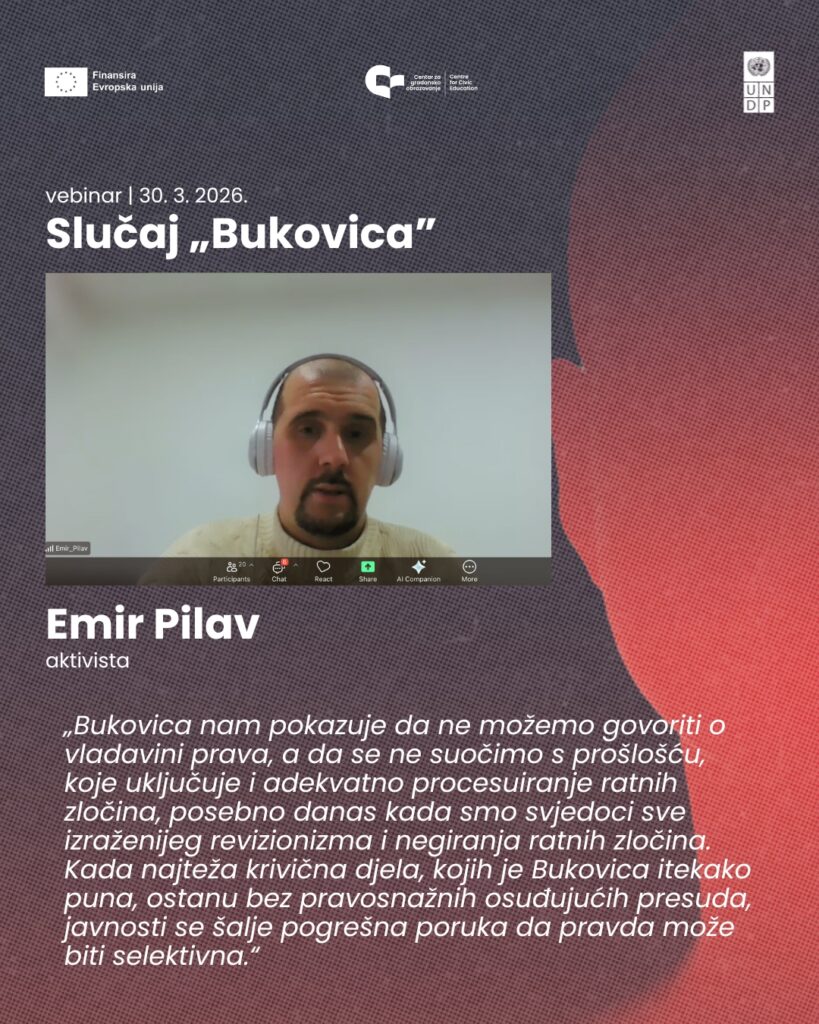
“What unfortunately does not contribute to resolving the Bukovica case is the factor of time. Delays in investigations and court proceedings greatly hinder the collection of evidence, weaken the evidentiary material, and further complicate the judicial process,” said activist Emir Pilav, who led the webinar. He also pointed out that, due to the passage of time — to which the excessive postponement of proceedings has also contributed — many key witnesses are no longer alive, which makes achieving justice for the victims even more difficult.
Speaking about the importance of fully uncovering the crimes committed in Bukovica, Pilav stressed that, in addition to identifying the direct perpetrators, it is also necessary to establish broader responsibility, including command and political responsibility. “Bukovica, like the other war crimes committed on the territory of Montenegro, must not be prosecuted in a way that leaves room for someone to be excluded or ‘saved’. Through testimonies, records and materials — of which there is a great deal — all those responsible for this crime must be prosecuted,” said Pilav, adding that a further injustice lies in the fact that many individuals associated with these crimes still move about freely today, and some even speak publicly on social media, which, as he noted, constitutes an additional humiliation for the victims of Bukovica and their families.
Reflecting on the responsibility of institutions, Pilav assessed that it must be consistent and adequate, and that it cannot be reduced merely to the question of who is guilty, but must also address what was omitted or neglected, and what must be undertaken today. He recalled that the activities of the Special State Prosecutor’s Office (SDT), including the adoption of an action plan, as well as amendments to the Criminal Procedure Code allowing the use of evidence obtained before the Hague Tribunal and the International Residual Mechanism, represent an important step, even though they come belatedly. “The essence is that institutional responsibility is not only retrospective — it is also present-day. What they do or fail to do today in relation to Bukovica will be the measure of their true commitment to justice and the rule of law,” Pilav concluded.
“Older generations are often unwilling to re-examine and acknowledge the mistakes of their own generation, while young people know very little about that period, and even that knowledge is often fragmented and shaped through subjective narratives. An additional problem is the fact that a large number of young people, not only in Pljevlja, are involved in political parties, where these topics are often instrumentalized in line with party interests,” participants noted during the discussion, emphasizing the generational gap in attitudes toward the 1990s.
Participants also expressed scepticism regarding the willingness of the ruling structures to confront the past, explaining this by the fear among political elites of losing support, office, or influence.
“Although these issues are occasionally raised, most often by the opposition, this is usually done in the context of anniversaries or certain political moments, which leaves room for suspicion that the topic is being used to collect political points and manipulate the public, rather than for a sincere confrontation with the past,” said Pilav.
Despite all the challenges, participants agreed that giving up is not an option, because confronting the past is necessary not only for achieving the goals of transitional justice, but also for building a stable future.
This webinar represents a practical extension of the CCE handbook “War Crimes of the 1990s in the Judgments of the Montenegrin Judiciary,” enabling a deeper analysis and discussion of court judgments available in the publication “The Process of Dealing with the Past in Montenegro: The Case of ‘Bukovica’”.
The aim of the webinar series is to provide the broader public with access to verified and reliable information on war crimes, through an analysis of court judgments, relevant evidence, testimonies, and the role of institutions. The next webinar will be led by historian and publicist Edin Smailović on 6 April 2026, and will be dedicated to the case of the Klapuh family.
The webinar series is being implemented within the framework of the CCE project “Understanding the Past to Build Trust and Transitional Justice”, through the regional programme “EU Support to Confidence Building in the Western Balkans,” funded by the European Union and implemented by the United Nations Development Programme (UNDP). The views expressed in this webinar are those of the authors and speakers and do not necessarily reflect the views of CGO, the EU, or UNDP, nor can they be considered their official positions.
Maja Marinović, Programme Associate