
Centre for Civic Education (CCE) notes that there is still no publicly available assessment of the performance of members of the Government of Montenegro, despite repeated announcements by Prime Minister Milojko Spajić. Such an assessment would be particularly important given that this is the largest government to date, where the performance of a significant number of members remains modest and without track record.
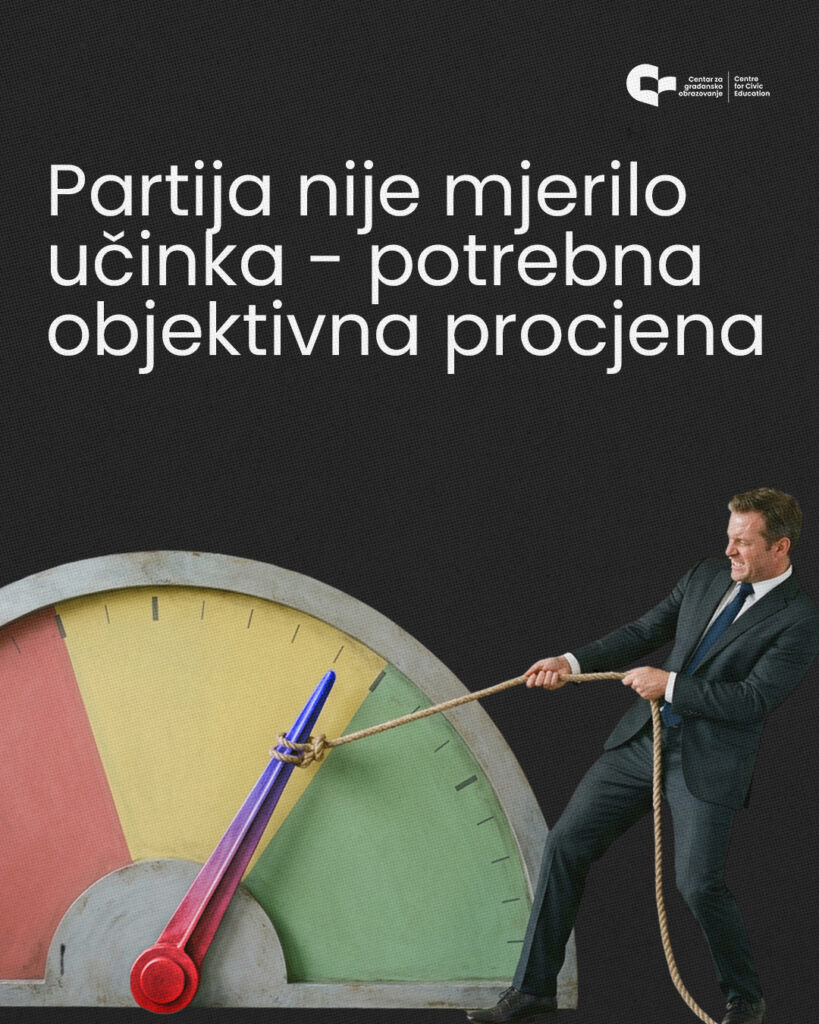
CCE considers it essential to assess concrete results, especially in light of the announced personnel changes.
CCE recalls that the 44th Government of Montenegro consists of the Prime Minister, six Deputy Prime Ministers, 25 ministries, and one minister without portfolio, making a total of 32 members. This number is expected to remain unchanged even after the announced reconstruction, given that in January the then Deputy Prime Minister Milun Zogović and Minister of Transport Maja Vukićević resigned, while representatives of the coalition party – New Serbian Democracy (NSD) are expected to take over their positions.
Nearly a year ago, the CCE provided its first overview of the performance of certain Government members, including then Deputy Prime Minister Milun Zogović, assessing his engagement as largely formalistic and protocol-driven. An analysis of activities published on the Government’s website shows that over 18 months in office, Zogović held a limited number of meetings, including with diplomatic representatives of the United Kingdom, European Union, China, Russia, Turkey, and France, as well as representatives of several international organisations and investors from Egypt and Azerbaijan. He also made one working visit to the municipality of Žabljak, while his other recorded activities, apart from numerous congratulatory messages, expressions of condolence, and statements condemning the genocide in Velika, included participation in the “Belt and Road” conference, the opening of the European Chess Championship, and the opening of the Europe House in Bijelo Polje. In addition, he led Montenegro’s delegation to the United Arab Emirates, participated in the Investopia CEE Forum, appeared in several TV programmes, visited final works on a road junction in Plav, and attended the signing of an agreement between CEDIS and the EBRD on financing the CEDIS SCADA project.
For such engagement, without measurable results, Zogović received a monthly salary of approximately EUR 1,800, used an official vehicle, and generated additional costs related to fuel, representation, and travel. He also had two advisers, whose combined monthly costs were close to EUR 3,000. However, CCE was unable to obtain full insight into the total costs of his work, as the General Secretariat of the Government persistently refuses to act in accordance with the Law on Free Access to Information.
On the other hand, the performance of former Minister of Transport Maja Vukićević is significantly more measurable, including a notable contribution by the ministry she headed to the EU integration process. In 2025, the Ministry closed all remaining closing benchmarks under Chapter 21 (Trans-European Networks), which led to its provisional closure in March 2026. Although this was achieved during her mandate, her contribution has not been adequately recognised, as her name was not mentioned in official Government statements issued before or after the Intergovernmental Conference.
Additionally, the ministry led by Vukićević, which had a budget allocation of EUR 333,558,790.45 for the previous year, achieved a 93.3% implementation rate of the activities planned under the Government Work Programme for 2025, significantly above the Government’s overall average.
Among the activities presented on the Government’s website, it should be highlighted her working visit Belgrade, in which was also Zogović, then to Budapest, where she participated in a meeting of transport ministers and held a bilateral meeting with the Minister of Transport of Albania. She also took part in a meeting of transport ministers in Slovenia and met with the Ministers of Tourism and Transport of Bulgaria in Sofia. Furthermore, she participated in the 2025 International Transport Forum Summit in Germany, led Montenegro’s delegation to the Global Connectivity Forum in Istanbul, and attended the 42nd Assembly of the International Civil Aviation Organization (ICAO) in Canada.
In addition to numerous meetings with representatives of the diplomatic corps, international and regional organisations, and local governments, she worked intensively on improving Montenegro’s air connectivity. During her mandate, several agreements aimed at developing transport infrastructure were signed, thereby laying the groundwork for the implementation of important road and railway projects.
This comparative insight into the work of two former Government members from the same political party further demonstrates how important it is to establish objective mechanisms for measuring performance. Without such an approach, a distorted picture is created in which individuals are classified according to party affiliation rather than evaluated based on track record, and that difference is particularly evident in the cases of Vukićević and Zogović. This is precisely why transparent monitoring and evaluation of the work of public officials is essential for building an accountable and credible public administration.
Nikola Đurašević, Programme Associate