
“The state has not done nearly enough to achieve even a minimum level of justice. When it comes to war crimes, Montenegro is characterised by the fact that it does not deny crimes and is willing to pay compensation, yet there are no convictions for those crimes. The situation is similar in the case of the Klapuh family – verdicts exist, the perpetrators are known, but they have not been effectively prosecuted or imprisoned,” stated historian and publicist Edin Smailović at the final, seventh educational webinar dedicated to the “Klapuh Family” case, organized by the Centre for Civic Education (CCE).
The “Klapuh Family” case refers to the killing of three members of the Klapuh family – Hasan, Ferida, and their daughter Sena – on 6 July 1992, on the “Obrad Cicmil” bridge in Plužine, between the Piva Hydropower Plant dam and the border crossing at Šćepan Polje. The brutality of this crime lies not only in the killing of three innocent family members, but also in the fact that it was committed by those whom the victims trusted to safely escort them to the territory of Montenegro.
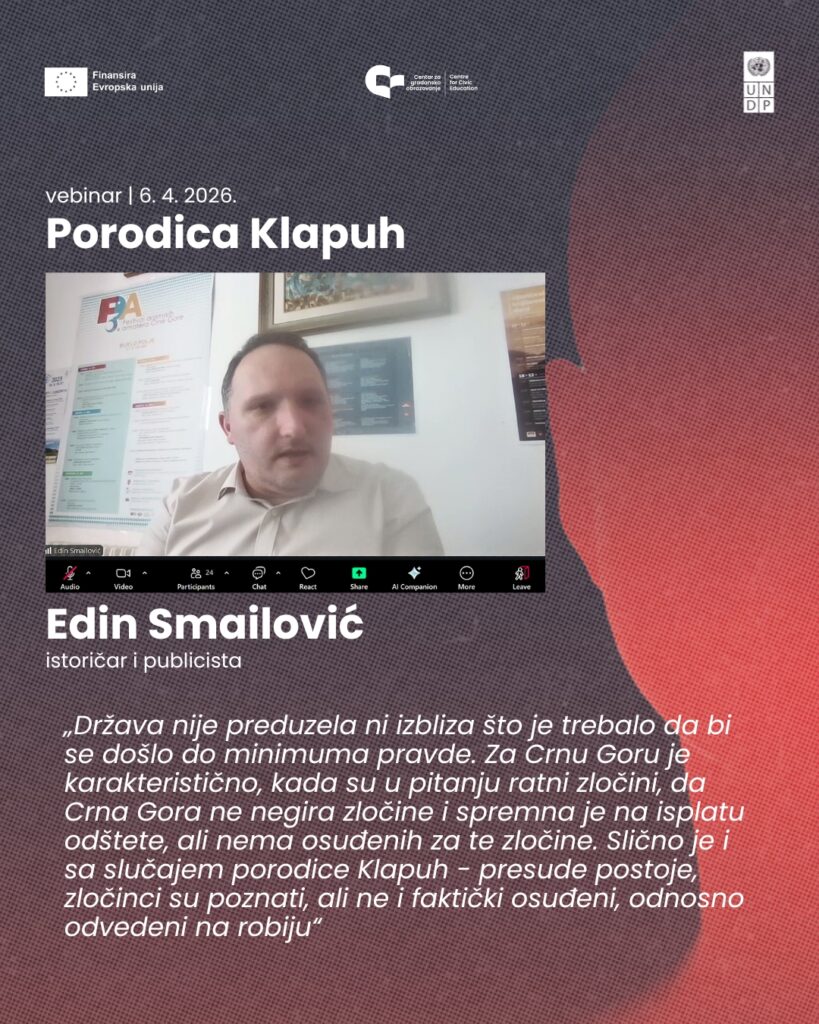
“What distinguishes this case is that the trial of those responsible was conducted relatively quickly. Although Montenegro supported war policies in Bosnia and Herzegovina at the time, the crime was so evident that even the judiciary of that period, despite its shortcomings, could not deny it. It was also the first verdict for a crime committed on the territory of Montenegro. However, the key issues are not related to the verdict itself, but to its implementation. Only one person was punished, and that for failure to report the crime, while the direct perpetrators were never brought to justice,” said Smailović, emphasising the lack of political will to fully prosecute the case and and that he believes some of the perpetrators are currently in Bosnia and Herzegovina and Serbia.
“Now, 34 years later, the question of justice remains open. Members of the Klapuh family were buried in a degrading manner as unidentified persons in Nikšić, without proper exhumation and burial in accordance with Islamic tradition. The state should have compensated the surviving family members, issued an official apology at the highest level for the events of the 1990s, and ensured a remembrance – by naming the bridge where they were killed after the Klapuh family, which would serve as a lasting reminder of this crime and a systemic contribution to education,” stated Smailović.
“Everything we do today in confronting the past, from including fact-based educational content on war crimes into textbooks to developing culture of remembrance, is done for ourselves and future generations. It is a fundamental precondition for building a healthy society that upholds social justice and values and protects every individual,” he stressed.
He also pointed to deeper issues from the 1990s. “What happened then is an example of the manipulation of people. I regret that certain journalists and religious figures were not held accountable before the courts. That was a major failure of that period, as they indirectly caused more harm than those who committed killings on the ground – it was a poisoning of the human spirit that ultimately led to what we witnessed in the 1990s,” he explained.
During the discussion, participants reflected on the consequences of failing to confront the past, placing them within a broader social and global context. “I believe that there is currently no real potential for new large-scale destructive conflicts in the Balkans, primarily due to the economic and social exhaustion of these societies. However, it is concerning that processes of fascisation are often used for political mobilisation and to justify unjust social orders,” Smailović noted in response to questions.
“ We should be concerned about the coming of age of new generations who will, with justification, be dissatisfied. This society does not offer them role models or institutions they can trust. There is a risk that they will seek validation through hate speech against minorities, which may become a means of social affirmation,” it was further highlighted during the discussion.
This webinar represents a practical continuation of the CCE handbook “War Crimes of the 1990s in the Judgments of Montenegrin Judiciary”, enabling a deeper analysis and discussion of court rulings, in this case based on documentation presented in the publication “Dealing with the Past in Montenegro: The ‘Klapuh Family’ Case”.
The aim of the webinar series was to provide the interested public with access to verified and reliable information on war crimes, through the analysis of court judgments, relevant evidence, testimonies, and the role of institutions, while emphasising the importance of establishing a culture of remembrance.
The webinar series is implemented within the CGO project “Understanding the Past to Build Trust and Transitional Justice”, as part of the regional programme “EU Support to Confidence Building in the Western Balkans”, funded by the European Union and implemented by the United Nations Development Programme. The views expressed in this webinar are those of the authors and speakers and do not necessarily reflect the views of CCE, the EU, or UNDP, nor can they be considered their official positions.
Maja Marinović, Programme Associate