
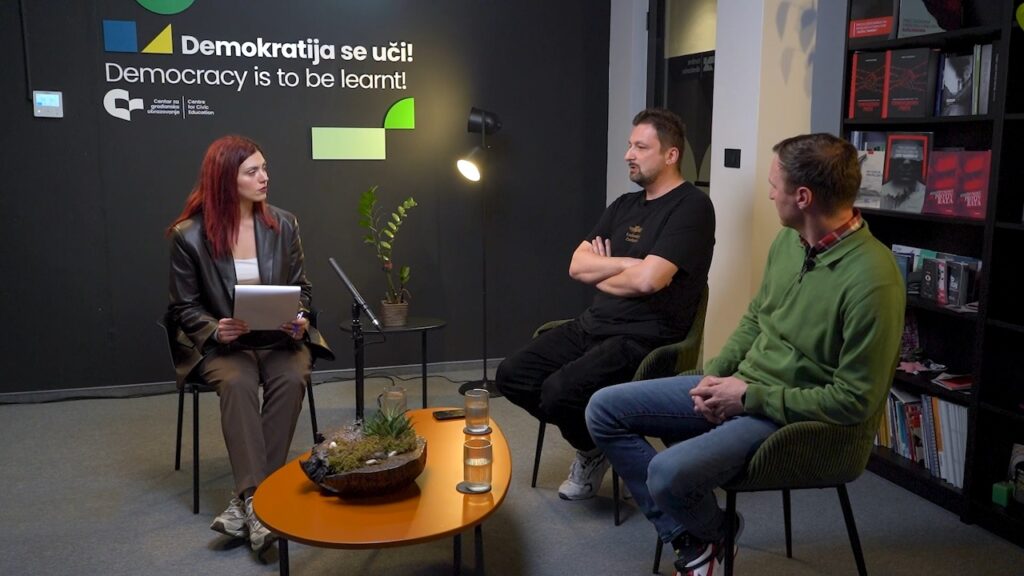
State institutions are responsible for preventing the relativisation and denial of war crimes, and they are not doing so effectively in the region. Confronting the past has never been on the agenda of political parties, and formal education fails to fill that space because it is sparse and often biased. These are the key assessments from the new PROUDCAST of the Centre for Civic Education (CCE), in which Željka Zvicer, Programme associate in CCE, spoke with Edvin Kanka Ćudić, coordinator of the Association for Social Research and Communications (UDIK) from Bosnia and Herzegovina, and Igor Radulović, history teacher from Montenegro.
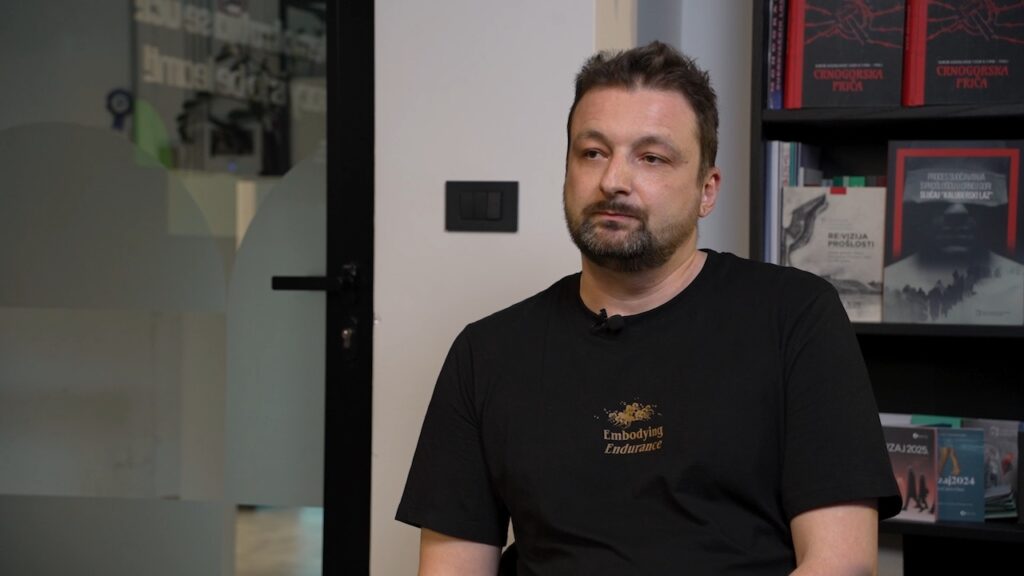
Kanka Ćudić pointed out that in B&H today war crimes of the 1990s are openly denied and minimised, and that this is not accompanied by any sanctions, because, as he said, that suits the political elites. “When you make a mural of Ratko Mladić in Banja Luka, then the prosecutor’s office cannot identify who is on that mural, although it is clear that it is Ratko Mladić. Or, if there is a memorial plaque in Sarajevo that mentions Ratko Mladić, the prosecutor’s office will say that that plaque was erected before he was convicted of genocide. In that sense, you are given free rein to manipulate the facts about what happened,” Kanka Ćudić explained.
“Relativisation of crimes sometimes comes subtly. The Bosniak side will never be clear about the crimes committed by the Army of the Republic of B&H, instead they will try to call them incidents. So those are Trusina, that is Grabovica, that is Uzdol, those are the Kazani… For example, when it comes to the Kazani in Sarajevo, where Serbs suffered, primarily at the hands of members of the X Mountain Brigade of the Army of the Republic of B&H, Sarajevo will say: yes, it happened, but you know, it was wartime and siege. So you will end up in a situation where if there had been no siege, there would have been no killings at the kettles,” he added.
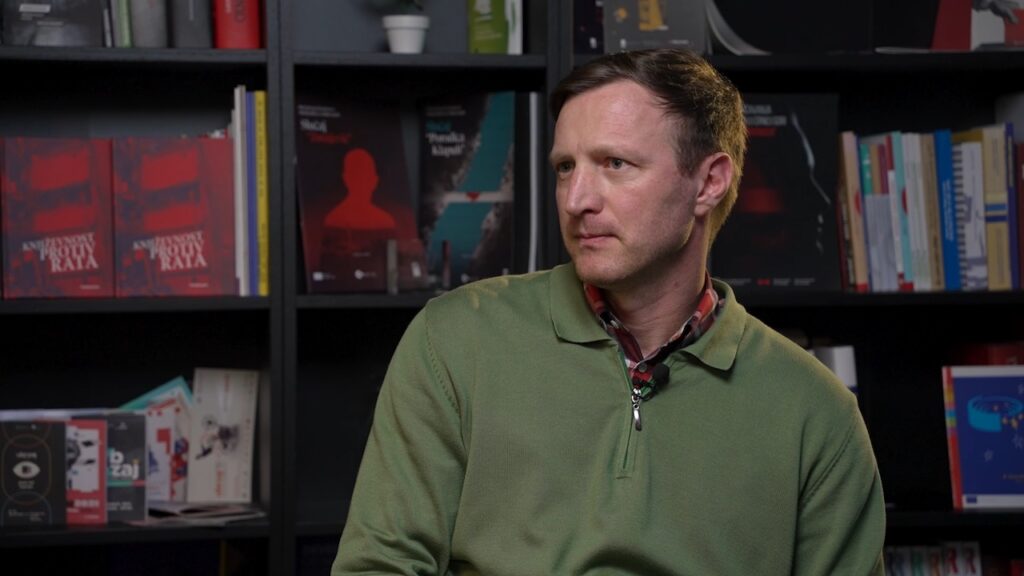
The space for manipulation is also given by formal education which, according to Igor Radulović, is sparse and biased, depending on the state in the region. “If you just took textbooks in B&H from three completely different environments you would see that the interpretation of those events is completely different. On the other hand, for example, in a textbook from Serbia, when Srebrenica is mentioned, it says that it is a grave crime that cast a blot on the struggle of the Army of the Republika Srpska, which until then ‘had been grandiose’. So, based on textbooks you cannot conclude how it all started, what happened, what the consequences were, and the role of international courts is completely neglected, because their verdicts are not mentioned at all in the textbooks,” Radulović explained.
Kanka Ćudić believes that the state can prevent the relativisation and denial of crimes. As an example he cites the reduced number of denials of the Srebrenica genocide after the High Representative in B&H, Valentin Inzko, imposed a ban on denial through amendments to the Criminal Code of B&H. Radulović emphasises that this is not the case in Montenegro where those who deny genocide go unpunished, and it often happens that they reverse the situation. “You know how? When you mention a certain crime committed against members of a certain nation or against members of certain nations, it is viewed as a reaction to some other crime. And if we talk about crime X, someone will say: yes, but crime Y happened, as a direct implication of this crime. Or, which is even stranger, some parallels begin to be drawn about which crime is worse and greater where more people died, which is nonsense,” Radulović emphasised.
In support of that thesis Kanka Ćudić highlighted the problem of self-victimisation in the region, that is the situation in which all ethnic groups want to be the greatest victims. “Near Bosanski Šamac there is a village called Obudovac. There is a large monument there on which it roughly said: From the Uprising of priest to the present day. And you have on that monument names carved from the last 200 years. Or, for example, you have near Prnjavor a village where a monument has been erected to all Serbian victims killed in the 20th century. And you have Chetniks, partisans, the Karađorđe crown, the star… And that is a mix of that self-victimisation where the real goal is to be a victim,” he noted.
Radulović emphasises that even the verdicts of international courts on the crimes of the 1990s have not been properly incorporated into public discourse. “On one hand, you try to emphasise that the crimes someone committed in your name are overstated in terms of court verdicts, while the crimes committed against you have not been adequately prosecuted. At the same time, the wars of the 1990s are probably the best documented wars. That will always be our ailment – people do not consider the facts, but extract certain parts that suit them or do not suit them,” he states.
“The issue of transitional justice, confronting the past and peace education has for 30 years rested on the shoulders of civil society. It has never entered educational institutions. It has never been part of the political agenda of any political party. No political party in these parts has advocated for confronting the past. And I would say that as much as civil society succeeds in that story to go on and persist, this story will…” Kanka Ćudić assesses.
Radulović does not believe that such an educational system can help much. “Why? Because you have textbooks that are nationally heavily coloured, with a black-and-white picture. Essentially you teach younger generations that those on the other side are actually the villains. And then, when we discussed this with colleagues from the region, we encountered certain blockages. We had situations where experienced teachers would tell you – be careful, we cannot talk about these topics properly and teach pupils for x reasons,” Radulović warned.
The interlocutors agree that a stable and functional democracy cannot be built without confronting the past, and their key message to younger generations is to be open-minded.
“History is not black-and-white. Some events should be discussed, different perspectives should be considered, understand why people sometimes interpret history and those historical events differently and only then will young people be properly engaged in dialogue. Because this now is not dialogue, this is a kind of dictate,” said Radulović.
“As a journalist I was taught to never read one newspaper, but three different ones, because only then can you draw a conclusion about what the truth is. And only in that way can you research. And more involvement in civil society, because now in civil society you can only learn the truth about what happened,” Kanka Ćudić concluded.
The full episode of PROUDCAST is available at the link: https://youtu.be/SSGy1XokEEE
This PROUDCAST was produced within the CCCE project “Understanding the past to build trust and transitional justice”, as part of the regional programme “EU support to confidence-building in the Western Balkans”, funded by the European Union and implemented by the United Nations Development Programme (UNDP). The views expressed in this episode belong to the interlocutors and do not necessarily reflect the views of CCE, the European Union or UNDP, nor can they be considered their official positions.
Maja Marinović, Programmes associate