
The Centre for Civic Education (CCE), in relation to the opinion of the Protector of Human Rights and Freedomsregarding a joke about police officers in the textbook “Montenegrin Language for the Second Grade of Gymnasium”, which has attracted significant public attention due to the claim that the use of offensive speech constituted a violation of the rights of police officers, considers that this opinion is not in line with the purpose of human rights protection, nor was it preceded by a thorough examination encompassing both procedural and substantive aspects.
With regard to the procedural aspect, it is important to emphasise that the textbook in question was developed in line with all recommendations of pedagogical, methodological, and philological experts. The editor of the textbook is Lida Vukmanović-Tabaš, and the reviewers include Prof. Dr Jakov Sabljić and Mr Čedomir Drašković(representing the academic community), Zoja Bojanić-Lalović and Biljana Ćulafić (representing teachers), as well as Branka Martinović (representing psychologists and pedagogues). These professors, teachers, and educational experts confirmed with their signatures that the textbook is suitable for use in the education system. Furthermore, the Ombudsperson himself notes that “the textbook in question has passed all procedures prescribed by law”, which clearly indicates its quality and readiness for use without the risk of stereotyping or stigmatising any profession.
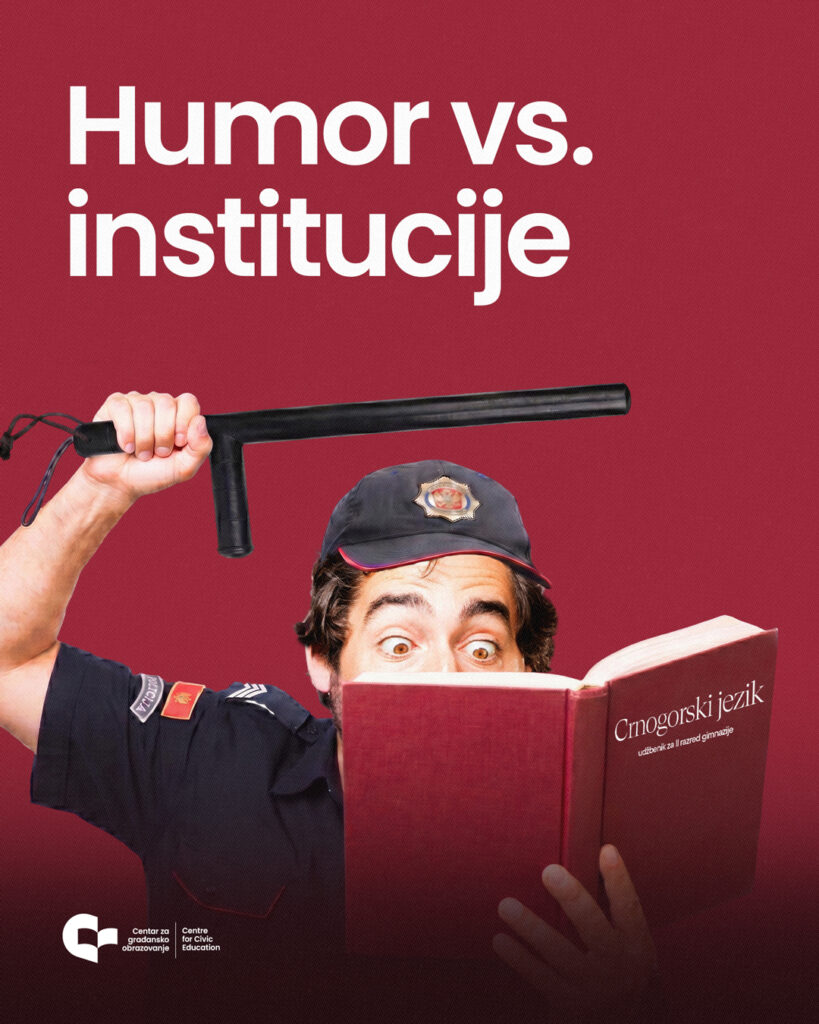
From a substantive perspective, the Police Directorate Trade Union argued that the disputed joke expresses hatred and contempt towards the police uniform and portrays police officers as incompetent and uneducated. However, this interpretation lacks merit. The joke, in which police officers discuss linguistic dilemmas, in fact illustrates that police officers are individuals who face everyday uncertainties, just like all other citizens. Additionally, it shows that police officers are not untouchable, impersonal representatives of a repressive apparatus, but rather individuals who reflect on their knowledge and work. The ultimate message to secondary school students and the wider public, should jokes about police officers be prohibited, would be that the quality of their work must not be questioned. This would be an incorrect approach, as humour about professions demonstrates that even holders of important public functions may have minor uncertainties and doubts. It is also important to recall the author’s position: “Police officers are not portrayed as unintelligent, but as resourceful, and they are not portrayed as uneducated, because uneducated individuals are not aware of orthographic dilemmas. The pedagogical objective is clear – to demonstrate, through humour, that all professions encounter language-related questions on a daily basis.” Therefore, it is evident that this is a matter of humour.
Taking into account both procedural and substantive aspects, the CCE warns that the Ombudsperson’s opinion is inadequately reasoned. It also fails to consider that the textbook has been in use for 15 years without complaints of this kind, nor are there any relevant studies indicating that such content constitutes offensive speech or has a negative impact on the attitudes of secondary school students. If such practice were to continue, numerous literary works could also become targets, such as Sumnjivo lice and Narodni poslanik, which satirically depict state authorities and public officials.
In this specific case, it appears that the Ombudsperson’s opinion invokes, without sufficient grounds, the right to protection of dignity, reputation, and professional integrity of police officers. Unfortunately, this is not the first time we have witnessed state authorities in Montenegro being protected to a greater extent than is necessary in a democratic society, thereby undermining the very purpose of human rights and providing momentum to radical forces seeking to erode the concept of the rule of law. The aim of the rule of law is to limit state power while preserving the spheres of individual freedoms to the greatest possible extent. In this particular opinion, the inviolability of state authorities is protected, while freedom of expression is restricted.
The CCE expresses concern over such an approach by the Ombudsperson, who, for the first time, has offered such an interpretation on any issue. This is particularly concerning given that, according to the case law of the European Court of Human Rights, freedom of expression also encompasses humour, satire, and sarcasm, especially when directed at public functions and institutions – an aspect that has not been adequately taken into account in this case. More precisely, in this instance, a police officer is being protected from a joke that is not offensive, which cannot be the purpose of human rights protection.
While it is undisputed that the Ombudsperson’s opinions should serve as guidance for the work of state authorities, they must also be open to critical scrutiny. Therefore, the CCE calls on institutions to respect earlier opinions of the Ombudsperson that have contributed to advancing human rights protection in various areas, including the protection of children with developmental difficulties, persons with disabilities, and issues of delayed action by competent authorities. The CCE also calls on the Bureau for Textbooks and Teaching Aids not to act upon the Ombudsperson’s recommendation in this case, given the numerous procedural and substantive arguments indicating that there is no basis for doing so. Finally, the CCE calls on the Ombudsperson to approach such matters with greater professionalism, in order to further strengthen the institution.
Petar Đukanović, Programme Director