
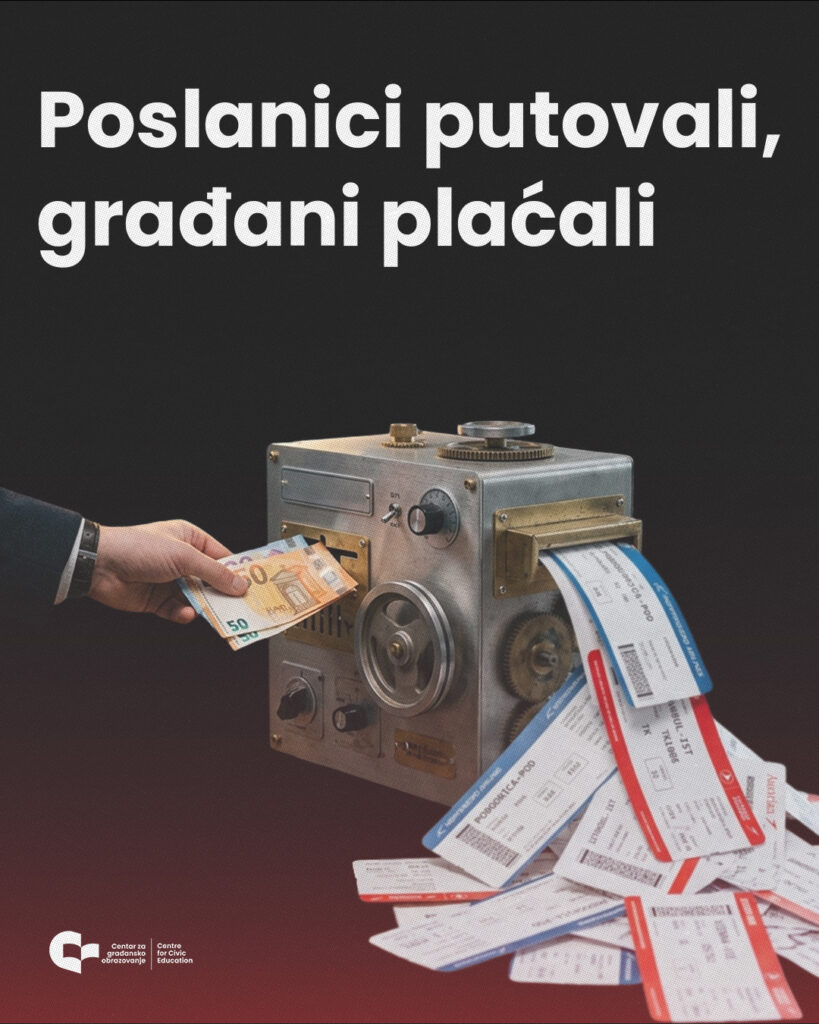
A total of EUR 798,134.83 was spent on official travel by MPs of the 28th convocation of the Parliament of Montenegro over less than two and a half years, from the constitution of this parliamentary term on 27 July 2023 until 31 December 2025, according to one of the key findings of the analysis conducted by the Centre for Civic Education (CCE).
The data, obtained through requests for free access to information, show that official travel represents a significant budgetary expenditure for the Parliament, but also reveal considerable differences in the number of individual trips among MPs, and consequently among parliamentary groups.
During the analysed period, a total of 707 official trips funded by taxpayers were recorded. Among those who travelled most frequently, as well as among those whose trips generated the highest costs, representatives of the parliamentary majority were particularly prominent.
In terms of the number of official trips, during the analysed period, independent MP Jevrosima Pejović ranked first with a total of 36 trips. She was followed by the President of the Parliament of Montenegro, Andrija Mandić (New Serbian Democracy – NSD) with 29 , Nikolla Camaj (Albanian Forum) with 26, Gordan Stojović (Europe Now Movement – PES) with 23, and Zdenka Popović (Democrats) and Amer Smailović (Bosniak Party) with 21 official trips each.
In terms of total costs, the official travel of Gordan Stojović generated the highest expenses for the citizens of Montenegro amounting to EUR 55,729.12, followed by Jevrosima Pejović with EUR 50,448.35, Duško Stjepović with EUR 33,334.69, Admir Adrović with EUR 32,793.06, and Zdenka Popović with EUR 27,837.36.
The analysis also shows that 13 MPs had no recorded official travel funded by taxpayers, either throughout their entire mandate or during the period in which they held office. These include Milan Knežević from the Democratic People’s Party (DNP), Dušan Raičević, Elvir Zvrko, and Nela Savković Vukčević from the Democratic Party of Socialists (DPS), as well as Nikola Janović, who currently serves as an independent MP. Also among them are Armen Šehović and Dragana Vučević from PES, Milena Vuković and Zoran Mikić from GP URA, Ilir Čapuni from the Albanian Alliance and Vladimir Dobričanin from United Montenegro, both members of the Special Parliamentary Group, as well as Bogdan Božović from the Socialist People’s Party (SNP) and Mehmed Zenka from the DUA and HGI Parliamentary Group.
CCE assesses that these findings raise questions regarding the justification, purposefulness, and concrete effects of official travel by MPs, particularly given that nearly EUR 800,000 in public funds had already been spent by the end of 2025 alone, while intensive travel activities during 2026 are not covered by this analysis. High costs, as well as the concentration of a large number of trips among a limited number of MPs, require much clearer explanations of the public interest behind each individual trip, especially when financed with taxpayers’ money.
Additionally, significant differences in the number of trips and the level of expenses indicate the need for more precise rules, better planning, and stronger oversight of this type of expenditure. Official travel must not become a privilege of public officials, but rather an activity that must have a measurable contribution to the work of the institution, international cooperation, the legislative process, or the representation of Montenegro’s interests.
Viewed by parliamentary groups, the highest amount of funds for official travel was spent by PES – EUR 197,958.70 for a total of 156 trips, with almost 30% of that amount related to the travel of Gordan Stojović. It was followed by the Bosniak Party with EUR 108,450.31 for 87 trips, of which around 30% related to Admir Adrović’s travel expenses. The Democrats spent EUR 96,737.81 on 68 trips, with almost 30% attributed to Zdenka Popović, while DPS recorded 86 trips and expenses amounting to EUR 94,150.95, of which nearly 20% related to Nikola Rakočević.
Within the parliamentary group For the Future of Montenegro – New Serbian Democracy, 105 trips and expenses amounting to EUR 75,627.56 were recorded, with around 30% related to the travel costs of Andrija Mandić. The Special Parliamentary Group recorded 48 trips and expenses of EUR 58,588.43, of which more than 85% related to Jevrosima Pejović. At the same time, EUR 50,429.94 was allocated for the travel of GP URA MPs for 28 trips, with over 30% related to the travel of Miloš Konatar. The For the Future of Montenegro – DNP parliamentary group recorded 31 trips with expenses amounting to EUR 34,173.91, of which more than 45% related to Maja Vukićević.
MPs from the Albanian Forum recorded 32 trips and expenses amounting to EUR 28,428.65, with more than 90% related to Nikolla Camaj, while the European Alliance recorded 34 trips and expenses amounting to EUR 25,169.90, of which around 50% related to Nikola Zirojević. For the SNP-CIVIS parliamentary group, 24 trips and expenses amounting to EUR 19,387.01 were recorded, with over 65% attributed to Slađana Kaluđerović, while the DUA and HGI Parliamentary Group recorded eight trips and expenses amounting to EUR 9,094.66, entirely related to Adrijan Vuksanović.
CCE points to the need for continuous improvement of transparency within the Parliament of Montenegro regarding the spending of budgetary funds, including official travel by MPs. This implies the regular and proactive publication of data on destinations, duration and purpose of trips, as well as individual costs related to transportation, accommodation, daily allowances, and other expenses, which is unfortunately currently lacking. It would also be useful for these data to be accompanied by information on the concrete outcomes of such trips, that is, their actual contribution to the work of Parliament, international cooperation, and the representation of Montenegro’s interests.
Transparency in the spending of public funds must not depend on requests for free access to information, but should instead represent a standard of democratic and accountable institutional work. This is a prerequisite for strengthening citizens’ trust in the Parliament, as well as for ensuring more rational and responsible management of public money in Montenegro.
Nikola Đurašević, Programme Associate