
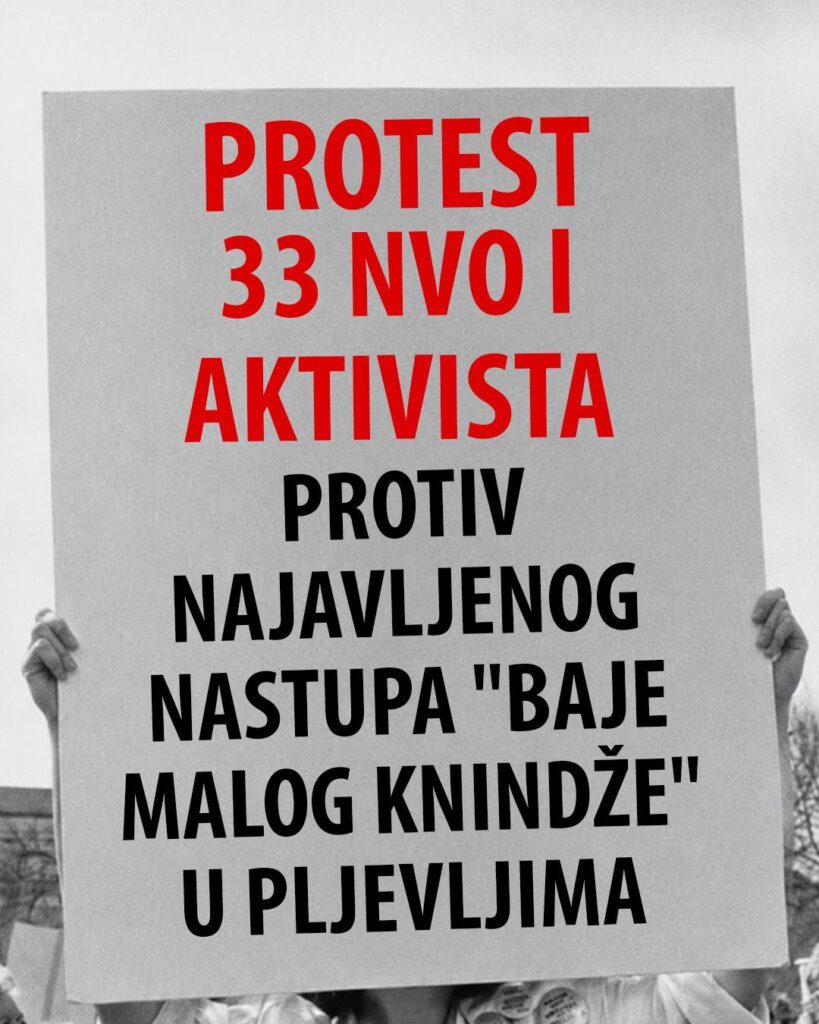
Our non-governmental organisations and activists are protesting against the public performances and promotion of the singer Mirko Pajčin, alias Baja Mali Knindža, whose songs contain nationalist, chauvinistic and war-mongering messages that glorify war crimes and war criminals and incite ethnic and religious hatred.
His performances have been banned in Croatia and the Federation of Bosnia and Herzegovina, because the lyrics of his songs are considered hate speech.
The announcement of Baja Mali Knindža’s performance in Pljevlja is deeply concerning, particularly if this were to be supported by the authorities through funding from the municipal budget. It is unacceptable that the money of all citizens of Pljevlja, including more than 4,000 citizens of the Islamic faith (17% of the population), should finance a performer whose songs incite hatred towards Bosniaks and Muslims, and deeply offend all those who uphold civic and anti-fascist values.
His songs glorify Ratko Mladić and Radovan Karadžić, who were convicted of genocide and other war crimes committed during the war in Bosnia and Herzegovina. His lyrics contain overt messages of ethnic and religious hatred, as they support war crimes, as confirmed by songs such as: “I Do Not Like You, Alija, Because You Are a Balija”, “One day you will remember Vukovar, the town of Knin and old Mostar, Kupres Gate will hurt you too, there are no Croats left there anymore”, as well as “Srebrenica has fallen, and Žepa will fall too, Republika Srpska, oh how beautiful you will be.”
For example, in the song “ Oh Alija, the water carried you away”, he systematically lists towns in which documented war crimes against Bosniaks were committed – Prijedor, Bijeljina, Brčko, Višegrad and Zvornik – in a manner that glorifies those crimes. The reference to the River Drina is a direct allusion to the documented criminal practice of killing civilians and throwing their bodies into that river, while the lyric about “new Sarajevo” glorifies the siege of the city which claimed more than ten thousand lives. This constitutes an absolutely unacceptable glorification of war crimes against specific victims, whose families, in addition to Bosnia and Herzegovina, also live in Montenegro. A particular example of such criminal discourse is also found in the song “My father is a war criminal”, in which the chorus “My father is a war criminal, do your best and convict him, no one has the b*s to take him to court”** directly mocks the judiciary and the victims of war crimes.
Such content goes beyond the boundaries of artistic expression and contributes to the normalisation of hate speech and war-mongering narratives in the public sphere, with already known and documented tragic consequences throughout the region.
We remind that the public glorification of convicted war criminals itself constitutes the criminal offence of inciting hatred and intolerance, punishable by imprisonment from six months to five years. In addition to the Criminal Code of Montenegro, hate speech is also prohibited by the Law on the Prohibition of Discrimination and the Law on Public Order and Peace.
Pljevlja is a multi-ethnic town with a long tradition of mutual respect and coexistence.
For this reason, we demand that the Municipality of Pljevlja refrain, now and in the future, from organising performances by Baja Mali Knindža, and that the competent authorities examine any potential criminal or other liability in the event of insistence on organising such an event, but also that all political actors who invoke civic and European values do not allow the organisation of this and similar events.
We call on the citizens of Pljevlja and Montenegro to support this protest.
Both Pljevlja and the rest of our country require the nurturing of a culture that unites instead of encouraging hatred.
Human Rights Action (HRA), Tea Gorjanc Prelević
Centre for Investigative Journalism of Montenegro (CIN CG), Milka Tadić Mijović
Centre for Civic Education (CCE), Daliborka Uljarević
Association Spektra, Jovan Džoli Ulićević
Centre for Women’s and Peace Education ANIMA, Ervina Dabižinović
Centre for Democracy and Human Rights (CEDEM), Nevenka Vuksanović
Ipso Facto, Milena Popović Samardžić
Montenegrin Media Institute (MMI), Olivera Nikolić
Montenegrin Publishers Association, Prof. Dr Vladimir Vojinovi
Queer Montenegro, Staša Baštrica
Eduko Plus, Almedina Dodić
Antifascists of Cetinje, Filip Kuzman
Safe Women’s House, Budislavka Saveljić
Prima, Aida Perović
Montenegrin Women’s Lobby, Aida Petrović
Centre for the Development of Non-Governmental Organisations, Zorana Marković
Dr Martin Schneider-Jacoby Association (MSJA), Zenepa Lika
Civic Initiative 21 May, Rade Bojović
Štrpci Association – Against Forgetting, Demir Ličina
Montenegrin Committee of Lawyers for the Protection of Human Rights, Velija Murić
Juventas, Ivana Vujović
Association of LBTQ Women “Stana”, Ana Dedivanović
SOS Podgorica, Biljana Zeković
Centre for Monitoring and Research (CeMI), Zlatko Vujović
Centre for Women’s Rights, Maja Raičević
Paula Petričević, civic activist
Dina Bajramspahić, civic activist
Emir Pilav, civic activist
Sabina Talović, civic activist
Nikoleta Đukanović, civic activist
Dušan Pajović, civic activist
Milica Kankaraš Berber, civic activist
Milena Bešić, civic activist