
Centre for Civic Education (CCE) points to a serious inconsistency in the work of the Student Parliament of the University of Montenegro (SPUCG). Namely, as a full member of the European Students’ Union (ESU), SPUCG supports demands for financial transparency at public universities, while at the same time, as an organization that has managed millions of euros in public funds over the years, it fails to apply those same principles to its own operations.
On 12 December 2025, the European Students’ Union adopted a Resolution on Financial Transparency at Public Universities, in which it clearly warns that non-transparent financial management represents a structural weakness that undermines public trust, limits democratic oversight, and hinders evidence-based policymaking. ESU emphasizes that, without clear, comparable, and publicly accessible financial information, universities cannot be held accountable, nor can students meaningfully participate in decision-making processes that shape their academic future. Among ESU’s specific demands are improved public access to budgetary data, standardized financial reporting that is understandable to the wider public, and mandatory public financial reports that enable external oversight and reduce the risk of mismanagement.
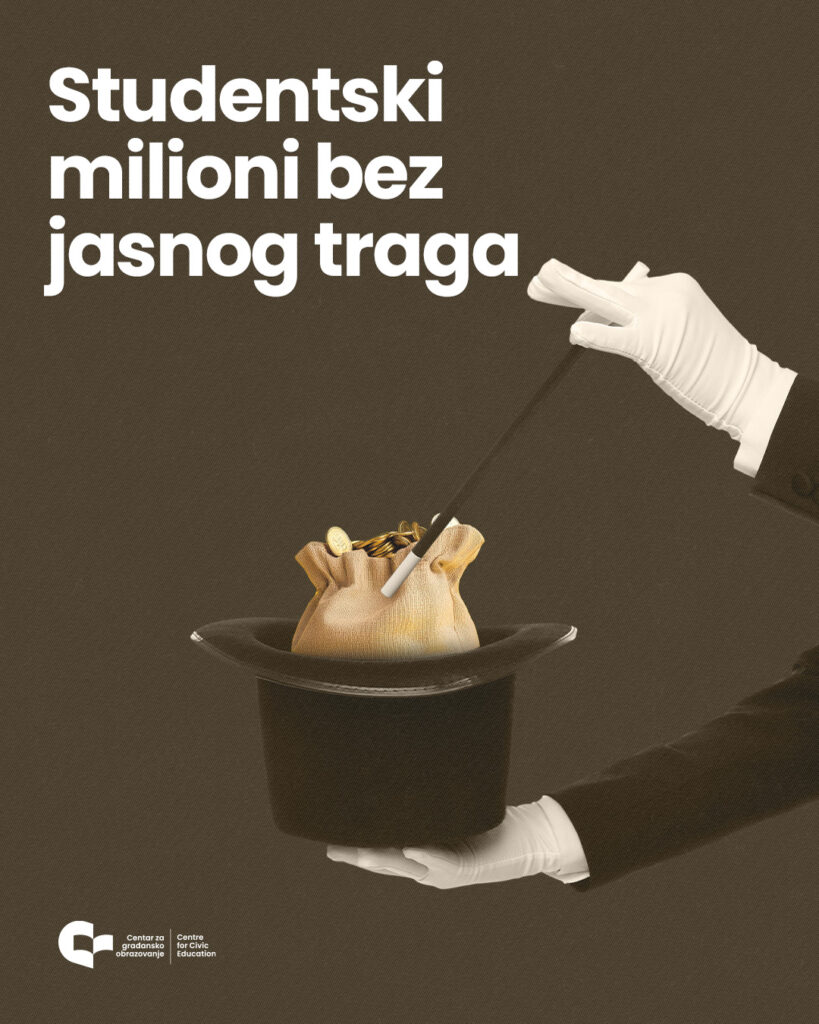
The principles that student representatives rightly demand from university administrations through ESU are precisely the principles that SPUCG persistently avoids applying to itself. A student organization that manages public funds has an equal, if not greater, obligation to be transparent toward the students on whose behalf that money is spent. One cannot credibly demand transparency from others while keeping one’s own financial operations beyond public scrutiny.
We recall that CCE has already pointed out that, from 2020 to November 2025, more than €1.35 million was allocated from UCG funds for the financing of SPUCG, plus an additional €75,000 for operating/material expenses, while 15 faculties and academies paid more than €670,000 to student councils and organizations during the same period. This amounts to more than €2 million in public funds for which there is no documentation that would make it possible to determine what the money was specifically spent on.
Instead of leading by example as an ESU member in the implementation of European standards, SPUCG, together with the Rector of UCG, continues to avoid submitting the requested documentation. Even more than two months after CCE submitted its request under the Law on Free Access to Information, no substantive response has been provided regarding the purpose and expenditure of these funds. Instead of the requested documentation, the public is witnessing a shifting of responsibility between the Rector and SPUCG, while the key information remains unavailable.
Moreover, the document that SPUCG presents as its financial report does not meet even the minimum standards advocated by ESU itself. The report is reduced to a single page of aggregate figures, without any explanation of how the funds were spent. For example, the largest individual item – transfers to student organizations and individuals, amounting to €276,592.75 – is presented as one aggregate expense, without information on who received the funds, on what grounds, and for what purpose. In other words, for nearly 80% of the money spent by SPUCG in 2025, the report makes it impossible to determine where and how it ended up. This is precisely the type of minimal and non-standardized reporting that ESU recognizes as an obstacle to students and the public understanding how public money is being spent.
The root of the problem also lies in SPUCG’s own governing acts. Namely, its Statute stipulates that the allocation of funds is carried out by the Executive Board, while oversight of that allocation is performed by the SPUCG Assembly. The Executive Board consists of the President, the student commissioner at UCG, and five members elected by the Assembly from among its own ranks. This creates a closed system in which the same circle of people manages public money, oversees its expenditure, and is not genuinely accountable to anyone outside its own structure, while no independent external audit exists.
Examples from the region and Europe show that different solutions are possible. In Slovenia, student organizations are legal entities governed by public law, subject to regulations on access to information of public importance, public procurement, integrity, and the prevention of corruption, while their operations are audited by the Court of Audit of the Republic of Slovenia. In Croatia, funds are allocated through mandatory public calls, with institutional oversight of their expenditure. In Austria, as one of the most regulated models, student bodies are required to adopt an annual budget and final account, with mandatory independent audits and public publication of these documents before adoption.
CCE therefore calls on SPUCG to act in accordance with the values of the organization of which it is a member and, as a first and urgent step, to publicly disclose its financial reports and the acts on the basis of which funds are allocated and spent, and to finally submit the documentation requested under the Law on Free Access to Information. At the same time, CCE calls on the Rector of UCG to stop hiding behind the autonomy of SPUCG and to initiate the establishment of binding mechanisms by the institution that allocates and disburses this money to control how it is spent.
Membership in the European Students’ Union is not a status symbol, nor is it a platform for international promotion. As long as SPUCG calls on others to apply European standards while failing to apply those same standards to its own management of more than €2 million in public funds, SPUCG continues to fall short of its obligation of transparency toward the students on whose behalf these funds are spent.
Jovana Radulović, Programme Assistant