
Centre for Civic Education (CCE) points out that silence has become a recognizable pattern of conduct by the University of Montenegro (UoM) when it comes to serious and uncomfortable issues brought to public attention. Whether it concerns the unlawful appointment of a demonstrator, the risk of a conflict of interest in the case of Vedran Vujisić, the control and transparency of public spending, or the inaccurate presentation of international rankings, the response of the UoM remains the same – waiting for the problem to gradually disappear from public attention.
The disputed case of demonstrator Ivan Jeknić at the Faculty of Political Sciences (FPS) most clearly illustrates such an approach. Instead of determining responsibility and correcting the unlawful actions, the competent authorities chose to remain silent and wait for the disputed engagement to expire. This justifiably raises the question of whether the same scenario will be repeated in the case of Vedran Vujisić, regarding whom the CCE had previously warned of a risk of conflict of interest. Vujisić simultaneously performs teaching, student representative, and management functions — as a teaching associate at the FPS, a student representative in the Faculty Council, and a member of the Governing Board of the UoM. The recently held elections for the student representative at the FPS could result in this issue also being “resolved” solely through the passage of time and the termination of one of the functions, without any substantive assessment of whether the problem existed and what consequences it produces for the integrity of university governance. In this way, the existence of a conflict of interest is not established, nor are mechanisms created to prevent similar situations in the future.
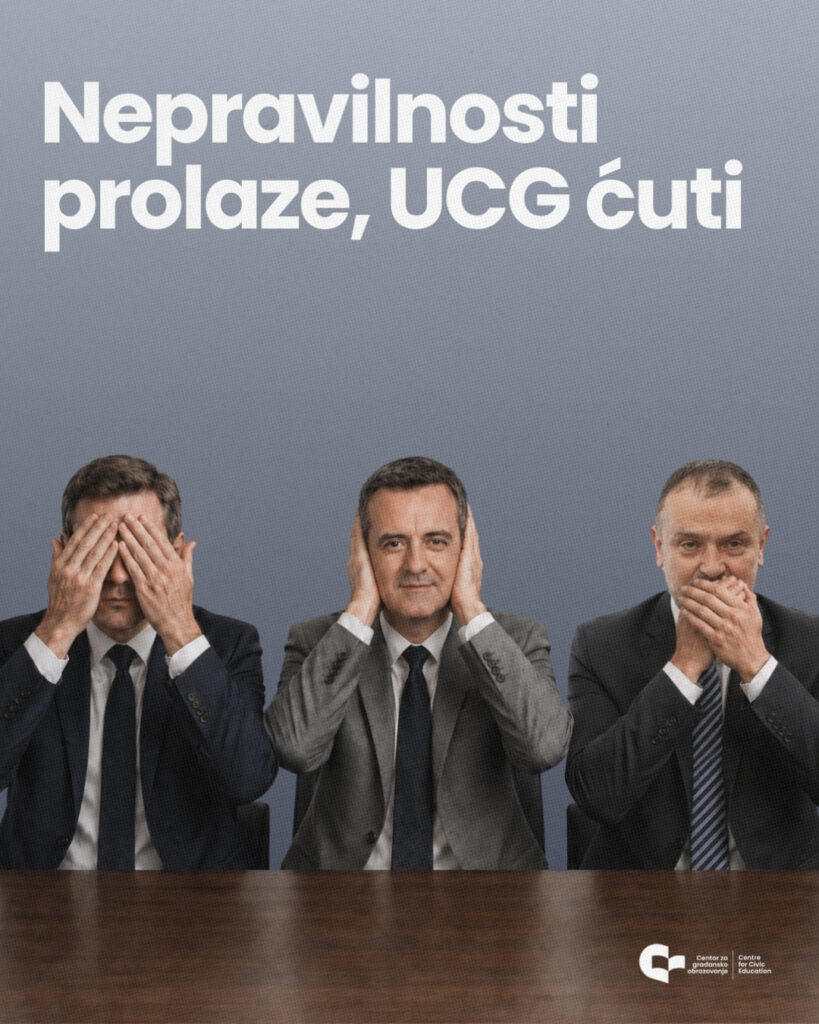
We recall that, as early as 17 January 2026, CCE submitted to the Governing Board of the UoM an initiative to improve the normative framework in the area of preventing conflicts of interest, with concrete proposals to which no response has been received to date. At the same time, in the case of Vedran Vujisić, the UoM bases its position on the existence of normative gaps and the fact that there is no explicit prohibition on simultaneously performing the aforementioned functions. Such an approach sends a worrying message that the UoM will tolerate even potentially problematic situations as long as they are not expressly prohibited, instead of being guided by the principles of good governance, institutional integrity, and the prevention of conflicts of interest.
For all these reasons, we publicly ask the Rector of the UoM, Prof. Dr Vladimir Božović, and the President of the Governing Board of the UoM, Prof. Dr Milivoje Radović: how much more silence can the UoM afford, and for how long will open issues continue to be addressed by waiting for disputed situations to simply expire?
CCE expresses the hope that the competent bodies of the UoM will finally demonstrate readiness to deal substantively with the problems brought to their attention, instead of leaving them to the passage of time. It is precisely the task of the UoM to shape an academic community that responds to observed irregularities with facts, arguments, and accountability, rather than with silence. After all, we can already see that the current practice is having a negative impact on student leaders and their way of working, their attitude toward transparency and the public, while part of the problem also lies in the fact that they lack a good role model within the UoM.
Jovana Radulović, Programme Assistant