
The wars of the 1990s left deep and lasting consequences across the region. Yet, more than three decades later, there is still no shared understanding of many of the terms used when discussing responsibility, justice, human rights, remembrance, and dealing with the past. The way we interpret the past remains burdened by different narratives, emotions, and political interpretations, while some facts are silenced, relativized, or deliberately distorted. In such an environment, familiarity with the basic concepts that shape discussions about the past becomes an important prerequisite for a more informed, responsible, and meaningful public dialogue.
With this in mind, the Centre for Civic Education (CCE) has released “Glossary of Dealing with the Past”, a publication that explains, in an accessible and understandable manner, 19 key concepts in the fields of transitional justice, human rights, the culture of remembrance, and dealing with the past.
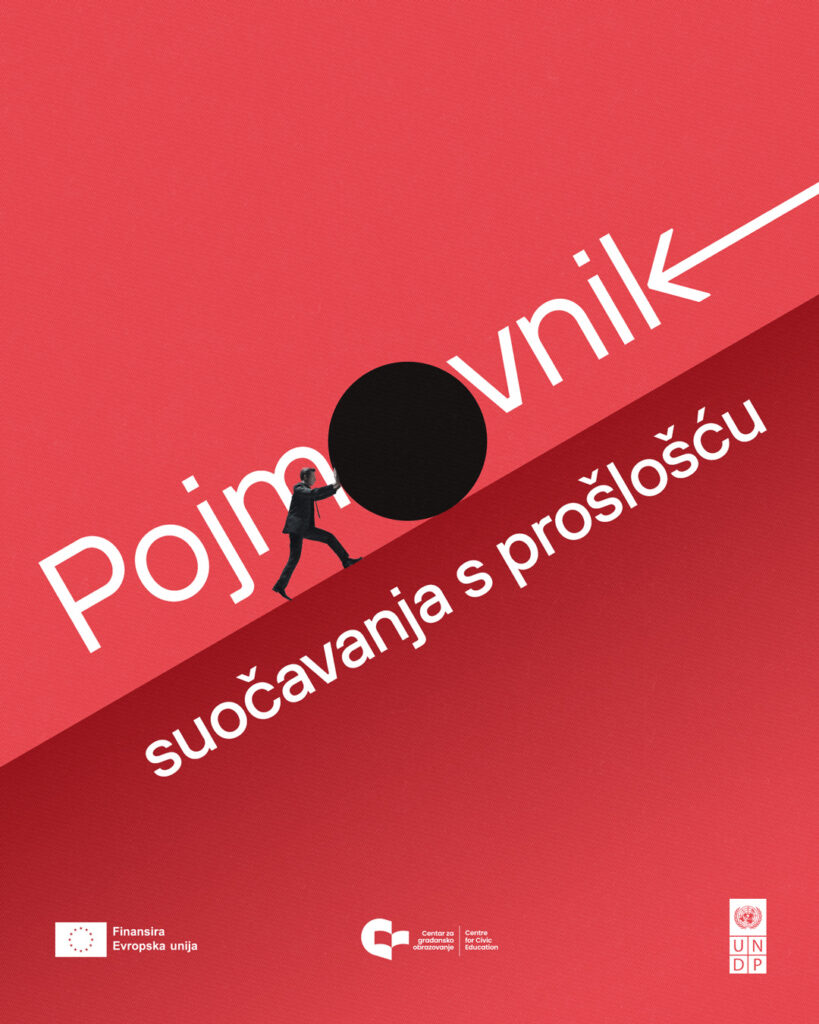
This glossary was created out of the need to gather in one place and make more accessible the concepts that are frequently used in the public sphere, but whose meaning is not always sufficiently known or precisely understood. These are terms that do not belong only to expert debates and analyses, but are also part of the everyday language through which we speak about wars, victims, responsibility, justice, collective memory, and our relationship with the past. As stated in the introduction to the publication, “this is not merely a matter of theory, but of the language used to describe real events, experiences, and dilemmas that continue to shape our society today.” Precisely for this reason, understanding these concepts goes beyond the academic framework and becomes an important tool for building a culture of dialogue, responsibility, and critical reflection on the past.
The publication covers terms such as transitional justice, the right to truth, reparations, memorialization, truth commissions, RECOM, historical revisionism, nationalism, collective memory, and other concepts essential for understanding the process of dealing with the past. Each term is presented through a clear and concise explanation of its meaning, significance, and context, along with recommendations for further reading and research.
The glossary is intended for a broad audience – secondary school and university students, teachers, journalists, civil society activists, researchers, as well as all citizens who wish to better understand topics that continue to strongly influence social and political processes in Montenegro and the region.
CCE has previously addressed issues of the culture of remembrance, dominant narratives, and attitudes towards the wars of the 1990s through the publication “How Much Do We Know, and How Much and Why Do We Forget the Nineties?”, which pointed to the challenges in understanding and interpreting events from that period among young people in Montenegro.
“Glossary of Dealing with the Past” is an adaptation of the publication of the same name by the Youth Initiative for Human Rights Croatia, adjusted to the Montenegrin context. The authors of the publication are Margareta Blažević, Eve Jones, and Senna Šimek, while the editorial team consists of Senna Šimek and Margareta Blažević. The Montenegrin edition was edited by Zvezdana Kovač and Iris Knežević. This edition thus becomes part of a broader regional exchange of knowledge and experience, while contributing to making the topics of transitional justice and the culture of remembrance more accessible in the Montenegrin language.
The publication is part of the CCE project “Understanding the Past to Build Trust and Transitional Justice”, implemented within the regional programme “EU Support to Confidence Building in the Western Balkans”, funded by the European Union and implemented by the United Nations Development Programme (UNDP). The views expressed in the publication are those of the authors and editors and do not necessarily reflect the views of CCE, the European Union, or UNDP, nor can they be considered their official positions.
Aleksandra Mihaljević, Project Assistant