
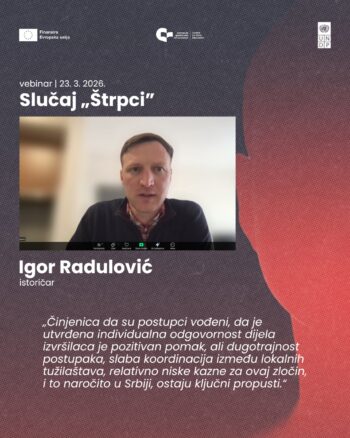
“The fact that proceedings were conducted and that individual responsibility of some perpetrators was established represents a positive step. However, the lengthy duration of the proceedings, weak coordination between local prosecutors’ offices, and relatively low sentences for this crime – especially in Serbia – remain key shortcomings,” it was stated during the fifth of seven educational webinars, this time dedicated to the “Štrpci” case, organised by the Centre for Civic Education (CCE).
Train number 671 departed on 27 February 1993 from Belgrade to Bar in Montenegro. After stopping in Užice, it was supposed to pass through part of the railway in Bosnia and Herzegovina without stopping. However, armed members of the Army of Republika Srpska (VRS) seized the station and forced the train dispatcher to stop the train. Twenty passengers of non-Serb ethnicity were identified and taken to a school in the village of Prelovo near Višegrad, where they were robbed and beaten. They were then transferred to the village of Mušići, near Višegradska Banja, where they were killed. The oldest victim was 59, and the youngest 17 years old.
“It is absolutely clear that, in this as in many other cases, justice has not been fully achieved. Despite the verdicts issued, the fact remains that a large number of individuals involved in the crime have never been prosecuted, while command responsibility has practically not been established,” emphasised historian Igor Radulović, who led the webinar.
Radulović recalled that Montenegro was among the first countries to initiate proceedings for this crime, but in a very limited scope. “This resulted in only one direct perpetrator, Nebojša Ranisavljević, being convicted before the High Court in Bijelo Polje, and sentenced to 15 years’ imprisonment. The proceedings were almost exclusively focused on him, while the court did not address the broader structure of responsibility, which casts a certain shadow over the prosecution of this crime in Montenegro,” Radulović stated.
He also pointed to the outcomes of judicial proceedings conducted in the region. “In Bosnia and Herzegovina, the most extensive trial was held, in which seven former members of the VRS were sentenced to a total of 91 years’ imprisonment, with the court establishing that this was an organised crime involving military and paramilitary structures. In Serbia, proceedings were initiated significantly later and lasted nearly a decade – in a retrial in 2025, three defendants were sentenced to a total of 25 years’ imprisonment, with the right to appeal as the process has not yet been concluded, while two defendants died in the meantime,” Radulović explained, adding that the lengthy proceedings, weak coordination among local prosecutors, and relatively low sentences- especially in Serbia remain key shortcomings.
Participants also raised the issue of how the wars of the 1990s are addressed in primary and secondary schools in Montenegro, Serbia, and Bosnia and Herzegovina, concluding that there is a need for more space for facts, critical thinking, and a multiperspective approach in history teaching. “It is important that teachers have reliable and professionally grounded materials that help them address sensitive topics from the 1990s in a responsible and fact-based manner. The CCE manual ‘War Crimes of the 1990s in the Judgments of the Montenegrin Judiciary’ is a good example of how such an approach can be applied in teaching, and it is particularly significant that some teachers have already recognised its value and started using it,” it was noted during the discussion.
Special attention was also given to the memorialisation of the Štrpci crime in public discourse in Montenegro, with the assessment that the culture of remembrance is still not adequately developed. It was emphasised that the problem does not concern only this crime, but reflects a broader lack of a systematic and responsible approach to dealing with the past.
“There is no adequate memorialisation when it comes to war crimes of the 1990s. Often, there is a systematic attempt to sweep certain issues under the rug, even though they represent one of the most important segments of historical memory. Memorialisation is necessary, but here it is often reduced to erecting general monuments to all victims of wars, thereby avoiding the essence—that every crime must have its own memorial, as a reminder, a warning, and an important educational tool for future generations,” Radulović explained.
This webinar represents a practical upgrade of the CCE manual “War Crimes of the 1990s in the Judgments of the Montenegrin Judiciary,” enabling deeper analysis and discussion of court rulings available in the publication “Dealing with the Past in Montenegro: The ‘Štrpci’ Case.”
The aim of the webinar series is to provide the interested public with access to verified and credible information about war crimes, through the analysis of court judgments, relevant evidence, testimonies, and the role of institutions. The next webinar will be led by activist Emir Pilav on 30 March 2026 and will be dedicated to the “Bukovica” case.
The webinar series is implemented as part of the CCE project “Understanding the Past to Build Trust and Transitional Justice”, within the regional programme “EU Support to Confidence Building in the Western Balkans”, funded by the European Union and implemented by the United Nations Development Programme (UNDP). The content of this webinar is the sole responsibility of the author and does not necessarily reflect the views of the CCE, the EU, or the UNDP.
Maja Marinović, Programme Associate