
On the occasion of the 27th anniversary of the beginning of NATO’s bombing campaign of the Federal Republic of Yugoslavia (FRY), the Centre for Civic Education (CCE) pays tribute to the victims of this tragedy.
The NATO bombing of the then FRY began on 24 March and lasted until 10 June 1999, for a total of 78 days. This intervention was preceded by a deep crisis within Yugoslav society that led to wars and suffering, the consequences of which have not yet been fully overcome. Following the Dayton Agreement, armed conflicts did not cease, but were followed by an escalation of tensions between Kosovo Albanians and Serbian security forces. Negotiations mediated by the international community, including those held in Rambouillet and Paris, failed to yield results, while serious human rights violations and ethnic cleansing of the Albanian population in Kosovo were cited as key reasons for the intervention.
During the bombing, civilians, members of the army, and police forces were killed, and the consequences affected the entire region. An official and final record of victims has never been established, and the number of casualties varies across sources. According to the Humanitarian Law Center, which has systematically and individually documented victims, the deaths of 756 persons have been confirmed, including at least 451 civilians, while some other sources cite higher figures. In Montenegro, nine people were killed, including seven civilians and two members of the Yugoslav Army and the Ministry of Interior. Among the civilian victims in Montenegro were Paška Junčaj, Miroslav Knežević, Olivera Maksimović, Julija Brudar, Vukić Vuletić, Milka Kočanović, and Manojlo Komatina. A particularly significant place in collective memory is held by the bombing of Murino at the end of April 1999, when six civilians, including children, were killed and eight people were injured.
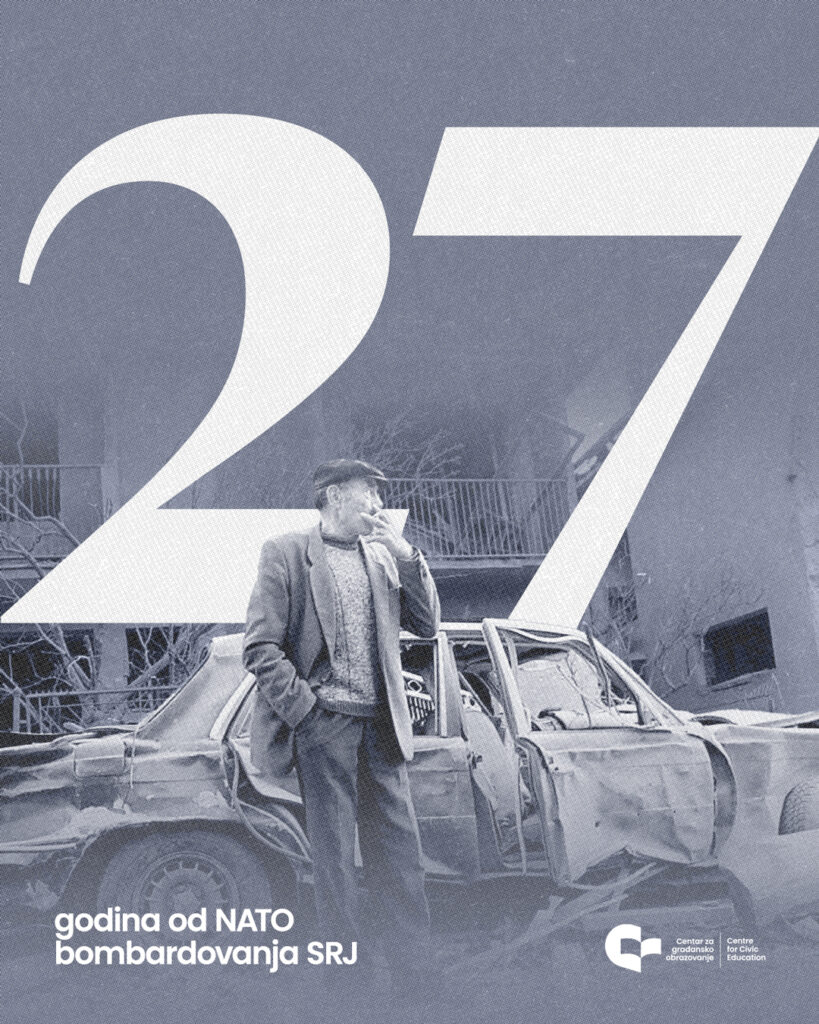
CCE recalls that no one has been held accountable for the deaths of civilians. The families of victims from Murino filed lawsuits against the state of Montenegro, claiming that the population had not been warned of the danger, although NATO had informed the authorities in advance about the targets. The lawsuit was dismissed as time-barred. Only after more than two decades the families of the Murino victims were granted the status of civilian victims of war through amendments to the Law on Veterans’ and Disability Protection, and a decision was made to provide them with one-off compensation. While this represents an important step, it cannot replace the absence of justice, nor the need for the state to develop a consistent policy of remembrance for all victims.
The importance of establishing the facts and respecting the dignity of victims is also reflected in the fact that 24 March is marked as the International Day for the Right to the Truth concerning Gross Human Rights Violations and for the Dignity of Victims, established by the United Nations in memory of Archbishop Óscar Arnulfo Romero, who was killed on 24 March 1980 for his advocacy of human rights and the dignity of the most vulnerable. The purpose of marking this day is to underline the obligation of states to establish the facts about crimes, ensure justice for victims, and foster a culture of remembrance based on truth.
Establishing the truth must be grounded in verified, judicially and scientifically established facts and serve the preservation of collective memory, as well as the prevention of politically motivated revisionism.
In the context of preserving the truth, it is particularly concerning that the education system in Montenegro still does not devote sufficient attention to the wars of the 1990s, as confirmed by CCE’s research. In order to better inform young people, CCE produced a video lesson on the NATO intervention in 2021.
War crimes and suffering, regardless of the nationality, religion, or political affiliation of the victims, must not be forgotten nor subject to selective remembrance or political interpretation. Establishing the full truth is both the right of victims’ families and an obligation of a society committed to learning from the past, honouring those who suffered, and preventing the recurrence of such crimes.
Maja Marinović, Programme Associate