
Centre for Civic Education (CCE), on the occasion of 18 April – the day when in 1999 six people were killed and five injured in Kaluđerski Laz, while in the days that followed another 11 people were killed pays tribute to the victims and calls on the Supreme State Prosecutor’s Office (SSPO) to demonstrate determination and genuine willingness to bring the perpetrators of this war crime to justice.
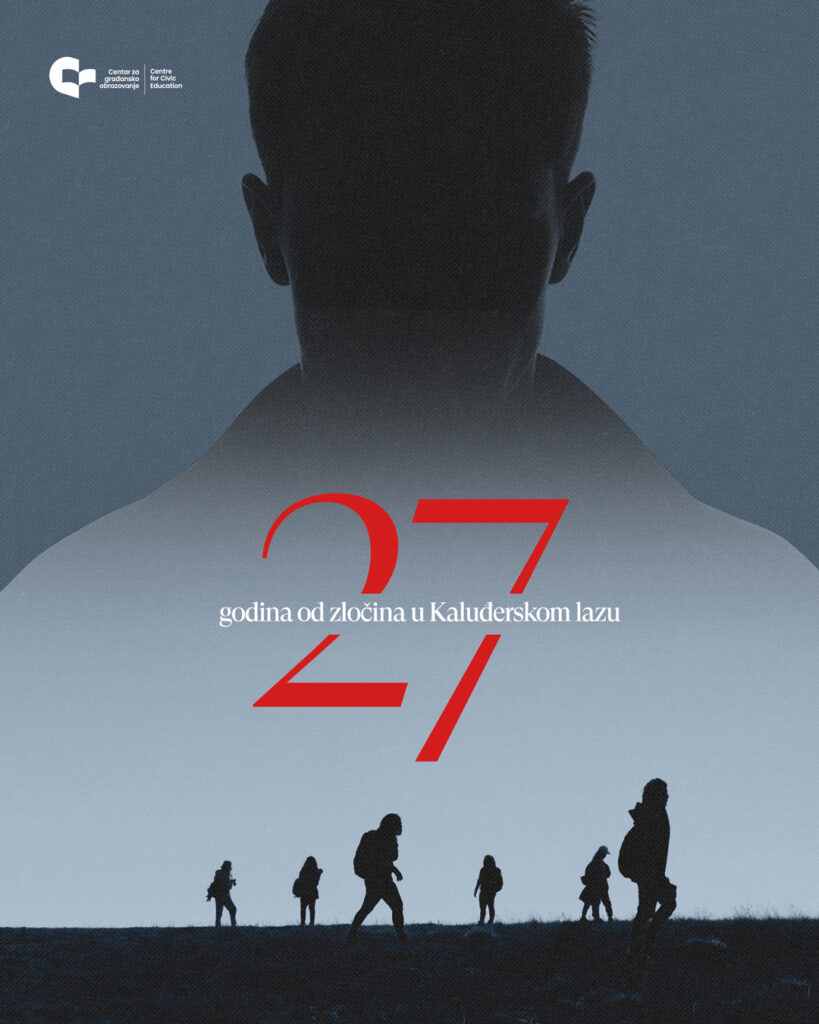
We recall that during the NATO bombing of the Federal Republic of Yugoslavia in 1999, around 100,000 refugees from the then Autonomous Province of Kosovo entered Montenegro seeking refuge from the war. Although most crossed the border safely, in several instances the Yugoslav Army opened fire on refugee columns within the area of responsibility of the Podgorica Corps, resulting in civilian casualties. According to the indictment, on 18 April 1999 six people were killed and five injured, while between 18 April and 21 May 1999, at multiple locations, a further 11 people were killed. Statements from legal representatives of the injured parties indicate that the total number of victims was 21. All victims were of Albanian ethnicity, including minors, women, and elderly persons. The entire case was named after the village of Kaluđerski Laz, where the most severe incident occurred, although not all killings took place at that location.
The “Kaluđerski Laz” proceedings began with the filing of an indictment on 30 July 2008 against eight members of the Yugoslav Army (reservists and a unit commander), and concluded with a ruling by the Court of Appeal on 8 December 2014. After seven years of proceedings and the dismissal of part of the indictment, all defendants were acquitted.
The Montenegrin judiciary has an obligation to re-examine this case thoroughly, particularly given that the investigation was slow, ineffective, and lacked the necessary resolve. Numerous issues remained unresolved during and after the proceedings, including differing data on the number of victims and the timing of the killings, as well as allegations of irregularities in the handling of evidence, all of which further call into question the judicial outcome to date. It is an undisputed fact that, to this day, no one has been held accountable for the killing of at least 15 civilians, including children, women, and elderly persons, who perished while attempting to find refuge in Montenegro.
The prosecution must intensify efforts that could lead to the filing of new indictments and the identification of those responsible. Although the passage of time complicates criminal prosecution, establishing accountability for war crimes remains essential. In this context, it is important that the SSPO has taken over the “Kaluđerski Laz” case and announced an analysis of the existing and potentially new evidence to assess possibilities for further action, despite the case having been legally concluded. Progress in this case would be crucial not only for justice for the victims but also for strengthening trust in institutions and advancing Montenegro within Chapter 23 (Judiciary and Fundamental Rights).
According to lawyer Velija Murić, who filed the criminal complaint in this case, the victims’ families initiated compensation proceedings before the Basic Court in Podgorica, where first-instance rulings were in their favour. Although in one case the High Court upheld such a decision, the Supreme Court, upon revision, rejected the claims as unfounded and ordered the return of funds to the state, thereby further deepening the injustice towards the victims’ families.
The dignified marking of the site of the crime and the memorialisation of the victims is still lacking. An initiative to erect a memorial, launched three years ago by lawyer Velija Murić, envisages a location near Kaluđerski Laz, on the road towards Mount Štedim – the route taken by the victims. It is expected that the Ministry of Culture will finally approve the construction of the monument, thereby preserving the memory of those who perished and paying due tribute to the victims.
As part of its edition on the process of dealing with the past in Montenegro, the CCE has published a document compiling case materials related to “Kaluđerski Laz”, providing a comprehensive insight into the course and outcomes of the trial for this war crime.
The CCE assesses that concrete progress in the work of the prosecution is of key importance not only for the victims’ families, but also for society as a whole and for the improvement of good neighbourly relations in the region. Despite the passage of time, establishing accountability and ensuring justice remain imperative, as only consistent and impartial action can restore trust in Montenegro’s judicial system, based on fundamental principles.
Maja Marinović, Programme Associate