
Centre for Civic Education (CCE), as part of its monitoring of the work of the Parliament of Montenegro, analysed the relationship between the plenary activity of MPs and parliamentary groups, measured by the duration of their speeches, and official travel financed from public funds. The data show that the most active MPs in plenary sessions are not necessarily those who make the greatest use of official travel, while some MPs with minimal participation in debates recorded a high number of trips and significant costs financed by citizens.
The analysis covers the 28th convocation of the Parliament of Montenegro, with data on plenary speeches referring to the period from 27 July 2023 to 31 March 2026, while data on the costs and destinations of official travel cover the period from 27 July 2023 to 31 December 2025. Although the timeframes are not fully identical, the findings clearly point to different approaches to the parliamentary mandate.
Andrija Nikolić, MP of the Democratic Party of Socialists (DPS), recorded the highest speaking time in plenary sessions – 30 hours, 24 minutes, and 5 seconds, alongside two official trips to Washington costing EUR 4,535.02. Boris Mugoša from the European Alliance spoke for 24 hours, 20 minutes, and 49 seconds and had 13 official trips (Kotor, Budva, Kolašin, Brussels, Strasbourg, Madrid, Luxembourg, Billund, and Paris), which cost EUR 10,904.20.
DPS MP Mihailo Anđušić recorded 18 hours, 4 minutes, and 3 seconds of plenary speeches, alongside four official trips (Brussels, Budapest, Budva, and Yerevan, with the Yerevan trip cancelled but still generating costs) amounting to EUR 3,769.16. DPS MP Aleksandra Vuković Kuč spoke for 16 hours, 25 minutes, and 30 seconds, while one planned official trip (Budapest) was cancelled at a cost of EUR 1,338.91. Her party colleague Aleksandra Despotović recorded 15 hours, 35 minutes, and 26 seconds of plenary speeches and eight official trips (Tivat, Budva, Tirana, Athens, New York, Strasbourg, Vienna, and Beijing) costing EUR 7,832.15 in total.
Milan Knežević from the parliamentary group “For the Future of Montenegro” – Democratic People’s Party (DNP) spoke for 14 hours, 39 minutes, and 24 seconds in plenary sessions and had no recorded official travel. Vasilije Čarapić from the Europe Now Movement (PES) recorded 14 hours, 31 minutes, and 43 seconds of speeches and seven official trips (Budva, Paris, Strasbourg, and London) costing EUR 6,610.12.
On the other hand, a striking imbalance between participation in debates and the costs of official travel was recorded among certain MPs with the lowest levels of plenary activity.
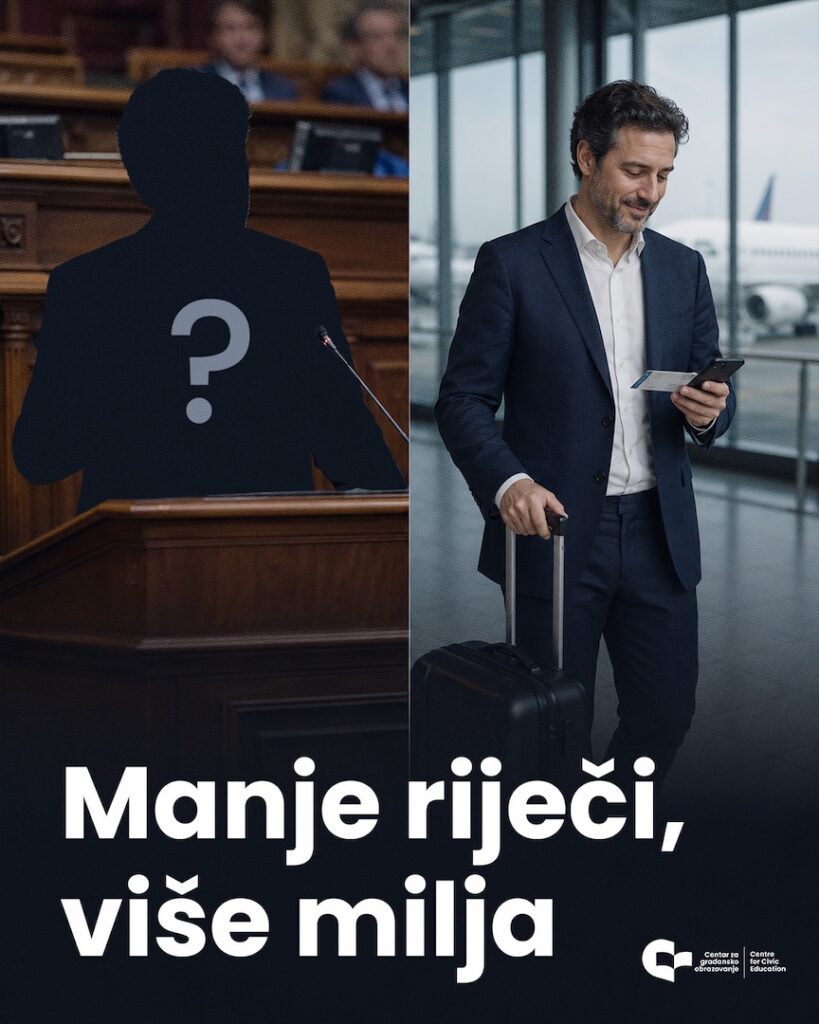
The most illustrative example is PES MP Gordan Stojović, who spoke for only 15 minutes and 14 seconds in plenary sessions over nearly three years, while recording 23 official trips over two and a half years, amounting to EUR 55,729.12 in total costs. Stojović therefore stands out as the least active MP in plenary sessions, while simultaneously generating official travel costs exceeding the combined costs of the seven most active MPs. Namely, the seven most active MPs, with approximately 134 hours of plenary speeches in total, recorded 35 official trips costing around EUR 34,989.56 altogether, while Stojović alone generated around 60% higher travel costs. He also had 11 times more official trips and as much as 12 times higher travel costs than the most active MP in plenary sessions.
Milena Vuković from the United Reform Action (URA) spoke for 16 minutes and 20 seconds (noting that she assumed office less than a year ago), without any recorded official travel. Vladimir Bakrač from PES recorded 34 minutes and 26 seconds of speeches, alongside one cancelled official trip costing EUR 488.35. Jelena Kljajević from “For the Future of Montenegro” – DNP spoke for 47 minutes and 50 seconds and had four official trips (Budva and Brussels) costing EUR 305.31.
Artan Čobi from the Albanian Forum spoke for 50 minutes and 45 seconds and recorded six official trips (Brussels, Strasbourg, Ljubljana, Helsinki, and Tirana) costing EUR 2,511.08 in total. Vladimir Dobričanin from the Special Parliamentary Group spoke for 56 minutes and 38 seconds, without any recorded official travel.
The six MPs with the lowest participation in plenary debates spoke for a combined total of around three hours and 41 minutes, yet recorded 34 official trips – only one fewer than the seven most active MPs, with total costs amounting to approximately EUR 59,033.86, or around 70% more than the travel costs of the most active MPs. Approximately 95% of that amount relates to the travel of Gordan Stojović.
Similar patterns are visible at the level of parliamentary groups.
The most active parliamentary group in plenary sessions was the DPS Parliamentary Group, with a total of 201 hours, 29 minutes, and 34 seconds of speeches, alongside 86 official trips costing EUR 94,150.95. It was followed by the Europe Now Movement, with 80 hours, 29 minutes, and 57 seconds of plenary speeches, but as many as 156 official trips costing EUR 197,958.70. PES is therefore second in terms of plenary engagement, but by far first in the number and costs of official travel.
The Democrats recorded 64 hours, 24 minutes, and 54 seconds of speeches, alongside 68 official trips costing EUR 96,737.81. URA recorded 41 hours, 18 minutes, and 53 seconds of speeches, 28 official trips, and costs amounting to EUR 50,429.94.
The parliamentary group “For the Future of Montenegro” – New Serbian Democracy recorded 39 hours, 22 minutes, and 3 seconds of speeches, but also 105 official trips costing EUR 75,627.56. The Bosniak Party spoke for 33 hours, 39 minutes, and 57 seconds, alongside 87 official trips costing EUR 108,450.31.
The European Alliance recorded 33 hours, 1 minute, and 42 seconds of speeches and 34 official trips costing EUR 25,169.90, while the parliamentary group “For the Future of Montenegro” – DNP recorded 27 hours, 4 minutes, and 25 seconds of speeches, 31 official trips, and costs amounting to EUR 34,173.91.
Significant travel costs were also recorded among parliamentary groups with the lowest speaking time. The Special Parliamentary Group recorded less than 14 hours of speeches, but also 48 official trips costing EUR 58,588.43. The SNP-CIVIS parliamentary group recorded 11 hours and 45 minutes of speeches and 24 official trips costing EUR 19,387.01. The DUA-HGI Parliamentary Group recorded slightly more than six hours of speeches and eight official trips costing EUR 9,094.66, while the Albanian Forum, with 3 hours, 57 minutes, and 24 seconds of speeches, recorded 32 official trips costing EUR 28,428.65 in total.
Viewed comparatively, CCE’s analysis shows that plenary activity and the use of official travel are often not proportional, raising questions regarding the understanding of the parliamentary mandate itself and the priorities in exercising it. A parliamentary mandate does not imply only international visibility and travel, but above all active participation in debates, oversight of the executive branch, and representation of the interests of citizens within Parliament.
While some MPs and parliamentary groups record a high level of parliamentary engagement alongside moderate official travel costs, others display almost symbolic participation in plenary debates combined with exceptionally high travel expenses financed by public funds. CCE therefore assesses that official travel must have a clear institutional effect and measurable results, particularly when used by MPs whose plenary engagement is almost invisible. Otherwise, the legitimate question arises as to whether official travel has become merely a privilege without clear accountability towards the citizens who finance it.
Nikola Đurašević, Programme Associate