
Centre for Civic Education (CCE) points out that the persistent refusal of the University of Montenegro (UoM) to correct inaccurate claims regarding its position on the international Webometrics university ranking is receiving increasingly strong resonance in international research and academic circles.
Following the article published on the website of the prestigious London School of Economics and Political Science (LSE), to which the CCE had already drawn attention, the same researcher, Vladimir Moskovkin, also published an extensive analysis on the use of fabricated and unreliable data in academic rankings, in which the UoM case received a dedicated chapter.
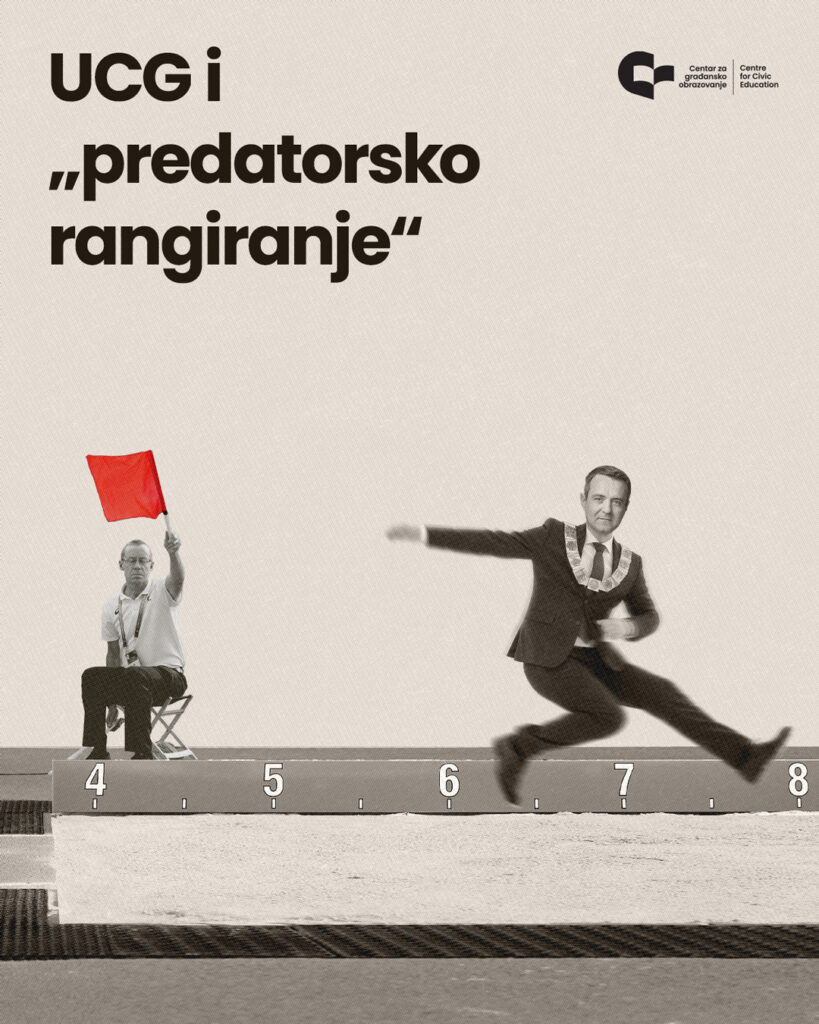
The text entitled “The Pandemic of ‘Predatory’ Rankings: Why Does Academic Integrity Fail the Test of Resilience?”, initially published on the Preprint platform and subsequently made available on relevant academic platforms, such as Research Gate and Scilit, addresses the crisis of academic integrity caused by the increasingly frequent use and distribution of unreliable and fabricated data disseminated by a network of “predatory” websites, through the misuse of the names of established and credible international rankings. Among them is Webometrics.org, whose data were used and distributed by UoM, while the author points out that some of these rankings also offer “position improvement services” for fees reaching up to EUR 5,000.
Particular attention is drawn to the chapter “Is Montenegro Officially Institutionalising ‘Predatory Ranking’?”, which analyses the dissemination of disputed data through media and institutions in Montenegro, beginning with their promotion by the UoM leadership. The author states that the peak of this process was recorded on 2 and 3 March 2026, after the CCE published accurate information, and UoM responded with a rebuttal based on data that did not originate from the official Webometrics ranking. It is also emphasised that, among approximately 200 analysed media articles and official statements from 29 countries worldwide, the CCE’s response was recognised as a unique example of insisting on the use of credible and verifiable data.
Following the publication of the results of this research, the author of the original Webometrics ranking, Isidro Aguillo, announced sanctions against universities that use or distribute fabricated data. In addition to Montenegro, universities and media outlets from Indonesia, Turkey, Ukraine, the Philippines, South Africa, Egypt, Kosovo, Moldova, Spain, Poland, Iraq, Bangladesh and other countries have also been affected by the negative effects of the dissemination of such data.
The CCE once again calls on UoM to correct without delay the inaccurately presented data regarding its international ranking, in order to prevent further misleading of the domestic public and additional reputational damage to the integrity of the most important higher education institution in Montenegro within international academic and research circles.
Ivan Kašćelan, Project Assistant