
Centre for Civic Education (CCE), as part of its analysis of the work of Parliament, through plenary activities, official travel, and the relationship between the engagement and remuneration of MPs in the 28th convocation of the Parliament of Montenegro, indicates that data concerning the Speaker and Deputy Speakers of Parliament further confirms the need for stronger standards of transparency, measurability of performance, and accountability in the highest legislative body.
This segment of the analysis covers the Speaker of Parliament, Andrija Mandić, Deputy Speaker Zdenka Popović, and Deputy Speakers Boris Pejović, Nikolla Camaj, Mirsad Nurković and Nikola Rakočević. Mandić was elected Speaker of Parliament on 30 October 2023, when Popović and Pejović also assumed their positions as Deputy Speakers. Camaj took up the office of Deputy Speaker on 31 July 2024, while Nurković assumed the role on 17 August 2024. Rakočević served as Deputy Speaker of Parliament from 25 June 2025 to 11 March 2026.
From 27 July 2023 to 31 March 2026, the Speaker and Deputy Speakers, during plenary debates, excluding the time spent chairing sessions, spoke for a total of 36 hours, 40 minutes and 21 seconds. At the same time, between 27 July 2023 and 31 December 2025, they undertook 106 official trips, for which €112,807.11 was allocated from the budget. Of these, as many as 99 trips were international, while only seven took place within Montenegro. Speaker of Parliament Andrija Mandić undertook the highest number of official trips – 29, all abroad – at a total cost of €21,322. In plenary sessions, excluding time spent chairing, he spoke for 3 hours, 34 minutes and 32 seconds, while his average salary from August 2023 to April 2026 amounted to €2,715.74.
Zdenka Popović completed 21 official trips, including four domestic and 17 international visits, at a cost of €27,837.36, the highest individual amount among the analysed members of the leadership for this purpose. She spoke in plenary for 6 hours, 8 minutes and 31 seconds, while her average salary amounted to €2,212.10.
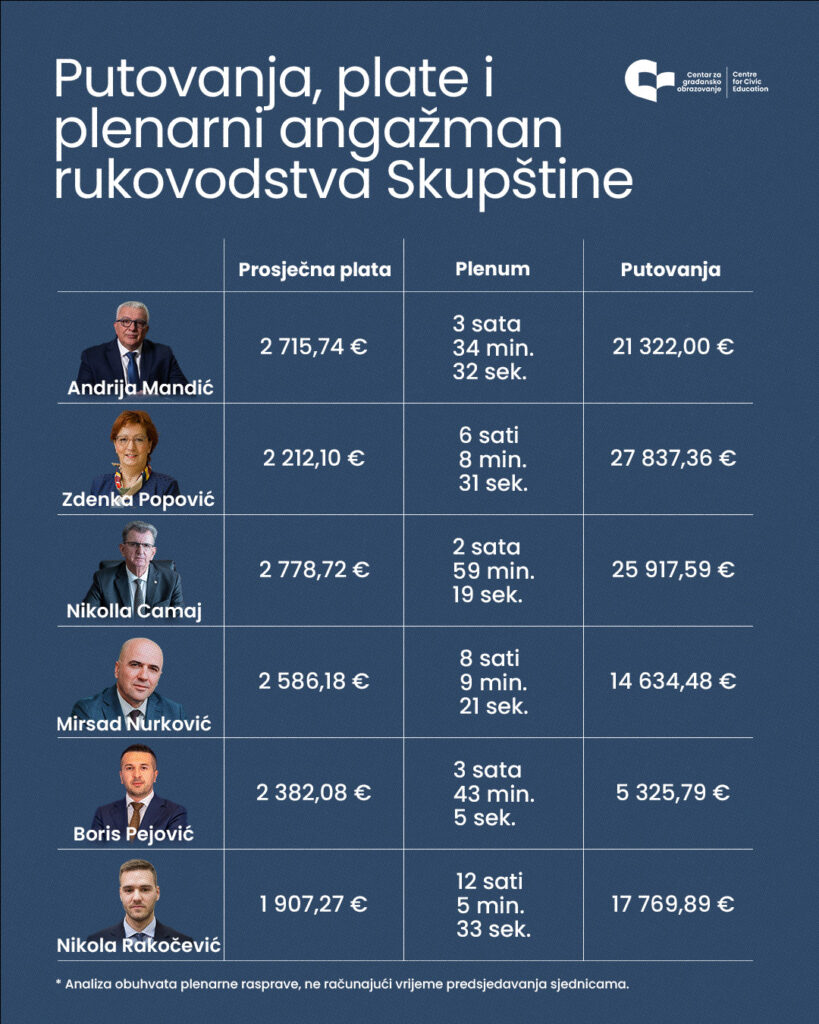
Among the Deputy Speakers, in terms of the number of trips, Nikolla Camaj stands out with 26 official trips, of which 25 were abroad, for which €25,917.59 was allocated. He spoke in plenary for 2 hours, 59 minutes and 19 seconds, while his average salary amounted to €2,778.72, which was also the highest average salary among the analysed members of the leadership.
Mirsad Nurković undertook 13 official trips, including one domestic and 12 international journeys, at a cost of €14,634.48. At the same time, he was among the more active participants in plenary debates among members of the leadership, with a total speaking time of 8 hours, 9 minutes and 21 seconds. His average salary amounted to €2,586.18.
The lowest number of official trips was recorded by Boris Pejović – a total of four, all abroad, for which €5,325.79 was allocated. He spoke in plenary for 3 hours, 43 minutes and 5 seconds, while his average salary amounted to €2,382.08.
Although he no longer holds the office of Deputy Speaker, Nikola Rakočević was, during the analysed period, the most active in plenary debates among all covered members of the Parliament leadership, with 12 hours, 5 minutes and 33 seconds of speaking time. He undertook 13 official trips, including one domestic and 12 international journeys, at a cost of €17,769.89. His average salary for the period from August 2023 to April 2026 amounted to €1,907.27.
The data on plenary contributions indicate varying levels of engagement among members of the Parliament leadership, while they share a predominance in international travel. Although the functions of the Speaker and Deputy Speakers of Parliament include organisational, protocol, and international responsibilities, the public interest requires that their work be assessed through accessible and comparable indicators – from participation in plenary debates, through official travel and its purpose, to salaries and other benefits arising from public office.
CCE recalls that the transparency of Parliament is not exhausted by the mere publication of data, but by its usability, clarity and accessibility in a form that enables citizens to understand how public resources are being used and what results their elected representatives are achieving, all with the aim of encouraging a more accountable approach to public office.
Nikola Đurašević, Programme Associate