
A memorial gathering held in front of the Herceg Novi police building today at noon marked the 34th anniversary of the war crime of the deportation of Bosnian-Herzegovinian refugees.
The gathering, organised by the Human Rights Action (HRA), the Centre for Civic Education (CCE) and ANIMA – Centre for Women’s and Peace Education, was attended by family members of the victims of the crime, representatives of the Government of Montenegro, the Deputy Ombudsman, Members of Parliament of the Parliament of Montenegro, councillors of the Municipal Assembly of Herceg Novi, a representative of the Special State Prosecutor’s Office (SSPO), the Ambassador of Bosnia and Herzegovina to Montenegro, representatives of the Bosniak Council, the Islamic Community, political parties, non-governmental organisations, the media, and citizens of Herceg Novi.
This anniversary, too, has not been marked by the reopening of the criminal investigation, the erection of a memorial, or the establishment of an official day of remembrance for the victims of deportation.
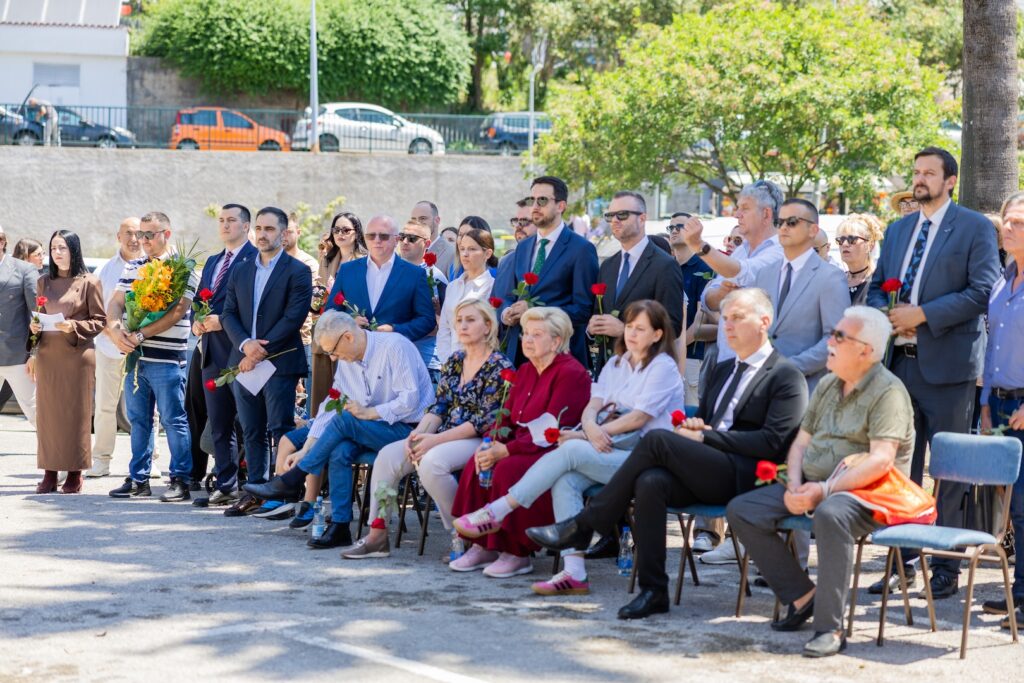
Nevertheless, in April this year, an important step was taken towards the institutional commemoration of the crime. At a meeting with councillors of the Municipal Assembly of Herceg Novi and the Minister of Culture and Media, Tamara Vujović, readiness was expressed to support the initiative to erect a memorial to the victims of deportation. The establishment of a working group was also proposed, which would agree upon the wording of the future memorial, to permanently preserve the memory of the victims and pay tribute to those who suffered.
Tea Gorjanc Prelević, Executive Director of HRA, opened the gathering by saying that this renewed gathering was not only because of the past, but also because of a responsible attitude towards the future. “We are encouraged by the fact that a new time appears to have come in Herceg Novi – a time in which political actors, at a joint meeting a month ago, expressed an almost unanimous commitment that such crimes should never happen again and, in that spirit, to support the permanent and dignified commemoration of the suffering of innocent people. A monument cannot bring anyone back, but it can preserve the memory of the victims and warn future generations. A monument can express nobility – that in Montenegro and in Herceg Novi, devotion to truth and a humane attitude towards the innocent victim are chosen,” said Gorjanc Prelević.
Ernad Suljević, Minister of Regional-Investment Development and Cooperation with NGOs, stated that, while paying tribute to those who suffered, an important truth should be remembered – that every innocent victim, regardless of the religion or nationality to which they belonged, deserves equal respect, equal sorrow and equal human compassion. “Today, with sorrow, we remember innocent people who came to Montenegro seeking safety, believing that they would find peace and refuge from war, and instead became victims of injustice and suffering. We remember their families, their pain, the waiting, the silence and the emptiness that never disappeared. Let the memory of these innocent people not divide us but bring us closer together in a shared desire to become a better society. And let it always remind us that the greatest victory of a society is when it succeeds in preserving humanity within human beings,” concluded Suljević.
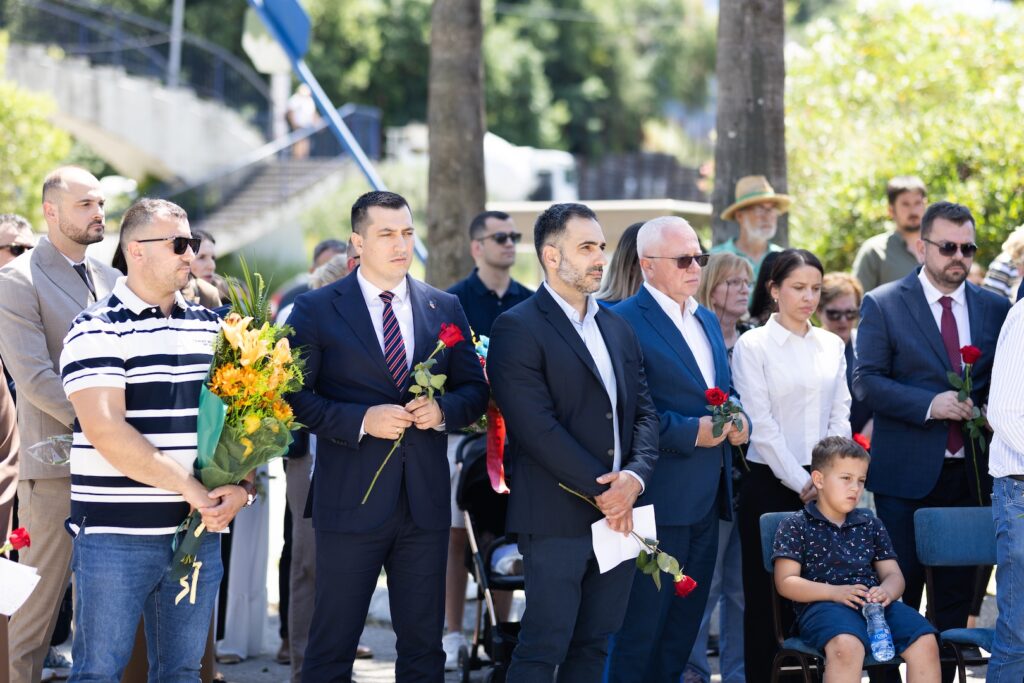
Mensur Bošnjak, Deputy Ombudsman for the Area of Protection against Discrimination, Vulnerable Groups and Gender Equality, emphasised that the issue of erecting a memorial is not a matter of form or symbolism without substance. “It is a question of the relationship of the state and society towards truth, towards the victims and towards future generations. It is important that the culture of remembrance does not live only from anniversary to anniversary, but that it becomes permanently and visibly woven into the space and conscience of Montenegro,” said Bošnjak.
Kenana Strujić Harbić, Member of Parliament of the Bosniak Party in the Parliament of Montenegro, stated that the building of the Herceg Novi Security Centre was not any symbol of safety, but rather a collection centre for people who gathered there only to be taken to a place designated for them to be killed, because of their names. “I call upon the competent authorities to remove the stain from the name of Montenegro, the Police of Montenegro and the Herceg Novi Security Centre through an appropriate memorial, and for the prosecution to finally bring the criminals to justice – because crime is a reason for condemnation, not a name,” stated Strujić Harbić.
Jovan Sabotić, a Member of Parliament of the Europe Now Movement in the Parliament of Montenegro and a councillor of the Novska Lista in Herceg Novi, stated that new generations have matured who are ready to confront the crime of deportation and commemorate it in a dignified manner, through the erection of a memorial and the fostering of a culture of remembrance. “Those people came to our town and other towns in Montenegro believing that they would find refuge there. It is our obligation to preserve the truth about what happened and not allow such evil ever to happen again,” said Subotić, warning that “many of those evil people are still living among us today” and that some of them “still deny what happened”. He stated that Herceg Novi and Montenegro must be places of refuge and safety, “and by no means the final stop for our loved ones”.
Tanja Vujičić, a councillor of the European Alliance in Herceg Novi, stated that the erection of a memorial would not bring back lost lives, but it would show that they have not been forgotten, that mistakes have been acknowledged, so that something similar would never happen again. “We owe them truth, respect and lasting remembrance,” stated Vujičić.
Alen Bajrović, son of Osmo Bajrović, stated that he expects the state finally to identify those responsible and determine who the perpetrators of the crime are, to bring to justice those who were the instigators, the direct perpetrators and all those who, from their armchairs, pointed with their fingers and selected the targets. “It is necessary for the state to take care of the mortal remains of the victims as well, and, with the help of new generations of politicians and people of goodwill, to build a monument that will clearly point to the brutal and horrific war crime that took place with the signature of the State of Montenegro,” emphasised Bajrović.
Jasenka Perović, sister of the late Alenko Titorić, emphasised how much it means to her that the initiative to erect a memorial has finally been launched. “We know how tectonically devastated our lives have been and how difficult it has been to build a normal life for more than three decades, to build our family and our future, and in some way protect our children from transgenerational trauma. The erection of a memorial would enable me to turn towards my future life and finally breathe, at least to some extent. I would propose that the memorial plaque include the names and surnames of the missing and murdered people but also leave room for some names to be added later, since the exact number of victims has still not been established,” stated Perović.
Elsan Kalač, representative of the Islamic Community, stated that this gathering shows that our souls have not died, because the worst state into which a soul can fall is indifference. “Indifference means that we are essentially dead, and through this gathering we are showing that we are not indifferent to the crime. Because when we are indifferent to evil, it repeats itself,” said Kalač.
Dženana Kuč, representative of the Bosniak Council, once again appealed to the SSPO to revisit this crime. “We believe that both the instigators and all those responsible for the deportation and sending to death of dozens of refugees should be prosecuted. We also believe that it is high time for state and local authorities to create the administrative and technical conditions for a memorial to be erected within the grounds of the Ministry of the Interior building in Herceg Novi. We also demand that school textbooks finally include content so that children in schools may have knowledge of this and other war crimes that took place in Montenegro,” emphasised Kuč.
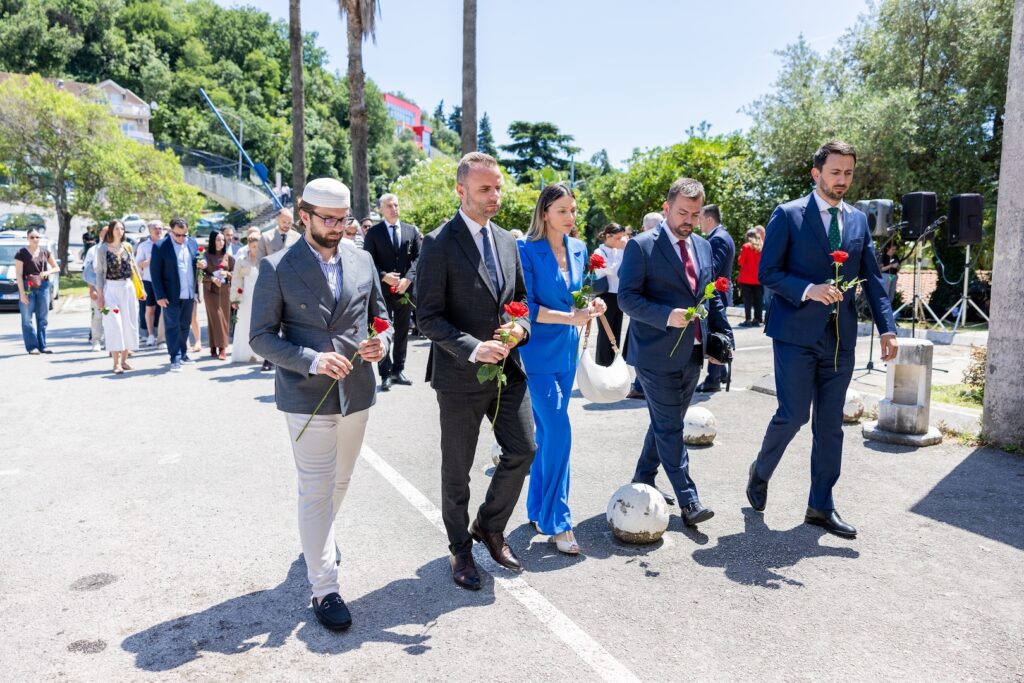
Šeki Radončić, journalist and publicist, stated that he regrets that former Member of the Montenegrin Parliament Ćazim Lukač, following whose speech in the Parliament of Montenegro the operation of arresting and deporting refugees from Bosnia and Herzegovina was halted, did not live to hear the news of support for the initiative to erect a memorial. He added that, as a man who has researched this case for 34 years, he proposes that a memorial plaque bearing the names and surnames of the missing and murdered people be placed on the building of the Ministry of the Interior of Montenegro. “That memorial plaque should serve as a reminder that this was a state crime and recall who governed the state at the time, namely the Ministry of the Interior directly, who the deputies were and who the perpetrators were. And, of course, we should demand that the archives be opened. Archives exist for everything that was done,” concluded Radončić. He also recalled the initiative that he and Jasenka Perović submitted to the President of Montenegro for the awarding of a posthumous recognition to Herceg Novi police officer Milan Jokić, who released two arrested Bosniaks, brothers Nedžib and Nermin Sijerčić, thereby saving their lives. Regarding that initiative, as he stated, they have not received a response to this day.
Luka Radović, a citizen of Herceg Novi, stated that at the time of the crime he was 10 years old, but also that he knew one of the victims – the late Osmo Bajrović. “Thank you to everyone who, throughout all these years, despite the passage of time, has preserved the memory of the innocently killed people,” stated Radović.
Aleksandar Božović, a citizen of Herceg Novi, who, as he states, by a twist of fate saw the buses in which the victims were taken away, recalls that there were two buses. However, he emphasised that the victims were not taken away by buses, but by people with names and surnames. “Each of them has their own responsibility, and it must be named. Cities are not guilty, but those who made the decisions and committed the crime. I expect a monument and lasting remembrance, because those people came to Montenegro believing in it, and did not find what they were looking for,” said Božović.
Petar Đukanović, Programme Director of CCE, stated that remembrance alone is not sufficient to achieve true justice for these victims. “True justice is, above all, the prosecution and adequate punishment of all those who were the instigators and perpetrators of this crime. We will continue to advocate for the erection of a monument, for the marking of 25 May as the day of remembrance for this crime, but also for the further prosecution of those responsible,” concluded Đukanović.
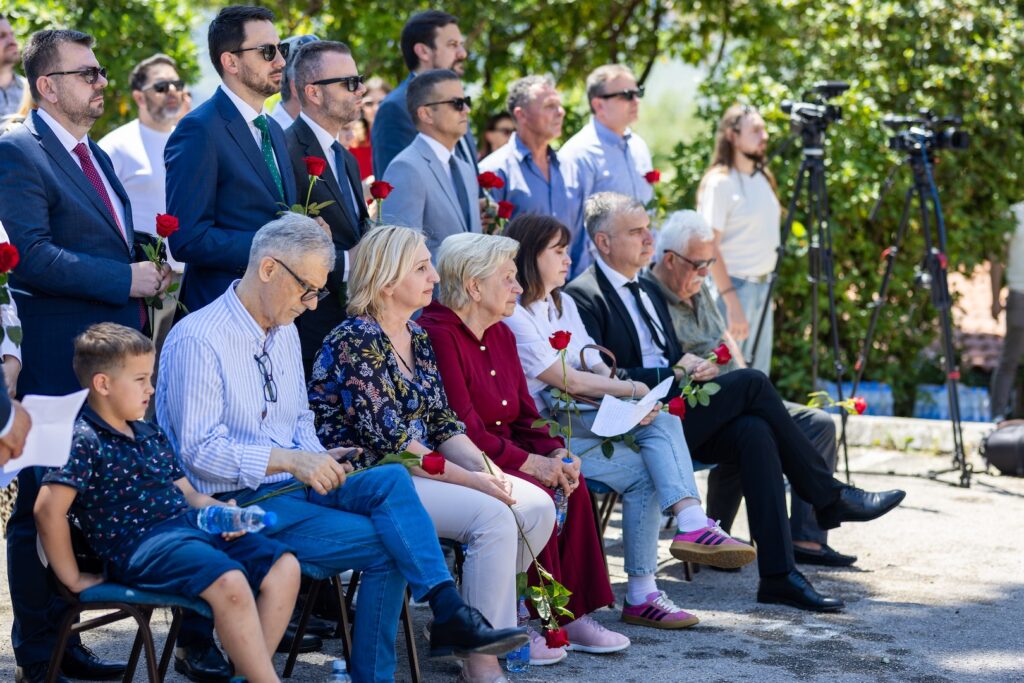
The gathering was attended by family members of the victims of deportation, Sanina Krdžalija, Alenko Titorić and Osmo Bajrović. The mortal remains of Bajrović and Titorić have still not been found.
Also in attendance were Members of Parliament of the Parliament of Montenegro Amer Smailović, Jasmin Ćorović and Adel Omeragić, State Secretary in the Ministry of Culture and Media Luka Ilić, as well as the Head of the Herceg Novi Security Department Miodrag Knežević together with police officers.
The gathering was also attended by the Ambassador of Bosnia and Herzegovina to Montenegro, Branimir Jukić, while the SSPO was represented by Legal Adviser Branko Vujisić. On behalf of the Municipality of Herceg Novi, Municipal Manager Dušan Vuković attended, together with councillors of the local parliament.
Among the participants in the gathering were also representatives of the Bosniak Council, non-governmental organisations and political parties – URA, the European Alliance, DPS, the Democrats, the Novska Lista, and the Boka Forum for Herceg Novi. The list of participants is available here.
Human Rights Action (HRA)
Centre for Civic Education (CCE)
Centre for Women’s and Peace Education – ANIMA
FACTS
According to available official documents, in May and June 1992, the Montenegrin police unlawfully arrested at least 66 Muslim-Bosniaks from Bosnia and Herzegovina (i.e. persons of presumed Muslim nationality), who had fled to Montenegro from the war in Bosnia and Herzegovina, and then handed them over to the army of the Serbian Republic in Bosnia and Herzegovina, which was hostile to them. Fifty-four of them were killed, while only 12 survived being handed over to concentration camps. Thirty-three Serbs and three Croats were also deported from Herceg Novi, but it is not known whether any of them suffered as a consequence of the deportation. The Croats were released immediately, as were a significant number of Serbs, who were not even mobilised
According to the findings of the researcher of this war crime, Šeki Radončić, many more refugees were deported. In his book “Fatal Freedom”, he cites the figure of 143 deported refugees, of whom 105 were Bosniaks.
On 25 May 1992, one group of arrested refugees was transported by bus from the collection centre in Herceg Novi to the Foča Correctional and Penal Institution, which already at that time had all the characteristics of a concentration camp for the non-Serb population (a fact established by the judgement of the Hague Tribunal against the governor of that camp, Milorad Krnojelac). Two days later, on 27 May 1992, another group of arrested refugees from Herceg Novi was transported by bus to the territory of Republic Srpska “where they were supposed to become part of a group of Muslims for exchange for captured Serbian territorial troops”. All Bosniaks were killed in the vicinity of Bratunac.
In 2008, Montenegro paid compensation to 200 family members of the victims, following a four-year trial and on the basis of a court settlement, for damages caused by the unlawful actions of the Montenegrin police which led to tragic consequences. That they were unlawfully arrested and handed over as hostages was also established by a final criminal judgement in Montenegro, as well as by the judgement of the Hague Tribunal in the Krnojelac case (governor of the camp in Foča). However, in the criminal proceedings conducted in Montenegro, all defendants were acquitted because the court arbitrarily introduced the requirement that the accused “had to belong to an organisation of a party to the conflict or act in the service of a party to the conflict in order to be responsible for a war crime”, concluding that Montenegro had not been a party to the conflict in Bosnia and Herzegovina and that the accused had not acted in the service of the Bosnian Serbs, which is contrary to the established facts (judgement Ks. 6/12).
In 2025, the victims of the Deportation were granted the status of civilian victims of war through amendments to the Law on Veterans’ and Disability Protection. The Government of Montenegro also adopted a decision to pay one-off compensation in the amount of 100,000 euros to the family of Osmo Bajrović, who was killed in this crime, whose wife and children are Montenegrin citizens. This act represents an important step towards acknowledging responsibility and correcting a long-standing injustice.
THREE INITIATIVES
HRA, CCE, ANIMA and the then member of the Council for Civilian Control of Police Work, Aleksandar Saša Zeković, 14 years ago, in 2011, submitted three initiatives:
- to proclaim a Day of Remembrance for the Victims of the Crime of the Deportation of Refugees in 1992;
- to erect a memorial to the victims of the deportation of refugees in 1992 in front of the Police Directorate building in Herceg Novi, thereby supporting the wish of the families of the victims;
- for the Montenegrin police to issue an apology for the unlawful arrest and handing over of refugees to the army of the Serbian Republic in Bosnia and Herzegovina, which was hostile to them.
We have been repeating these initiatives for years.
Last year, on the occasion of marking 33 years since the Deportation, a meeting was held for the first time with the President of the Municipality of Herceg Novi, Stevan Katić, and the President of the Municipal Assembly, Miloš Konjević, attended by the families of the victims, as well as representatives of HRA, CCE and ANIMA. On that occasion, representatives of the Municipality of Herceg Novi expressed readiness to support the initiative to erect a memorial to the victims of the deportation of refugees. This year, on 25 April, a meeting was also organised with councillors of the Municipal Assembly of Herceg Novi from Democratic Montenegro, the Novska Lista, the Democratic Party of Socialists, the European Alliance, the Civic Movement for Herceg Novi “Idemooo”, and the Civic Movement URA, as well as with the Minister of Culture and Media, Tamara Vujović. Readiness was expressed for the presidents of councillors’ clubs to support the initiative and submit it to the Municipal Assembly of Herceg Novi, in order permanently and institutionally to commemorate the memory of the victims and pay tribute to those who suffered. The formation of a Working Group at the level of the collegium of the President of the Municipal Assembly was also proposed, which would agree upon the wording of the future memorial.
The third initiative is the only one officially accepted and implemented in 2022, when the Director of the Police Directorate, Zoran Brđanin, and the Minister of the Interior, Filip Adžić, during a memorial gathering in Herceg Novi marking the thirtieth anniversary of the crime, issued a public apology to the victims and their families for the actions of the Montenegrin police. Additionally, in August 2023, the President of Montenegro, Jakov Milatović, issued an apology on behalf of Montenegro for this crime at a meeting with Alen Bajrović, son of Osmo Bajrović, a victim of the Deportation, and representatives of HRA, CCE and ANIMA.