
Centre for Civic Education (CCE) points to the weak positioning of the University of Montenegro (UCG) on relevant international rankings that assess higher education institutions based on various academic and research criteria.
CCE notes that rankings do not necessarily reflect the actual quality of a university, but they do provide students and academic staff with insight into the international standing of institutions. Given the potential for data manipulation for promotional purposes, it is important to look at the broader picture and consult multiple sources.
Most often, the Montenegrin public is presented with UCG’s position on the Webometrics ranking, primarily when progress is recorded. In this way, by overlooking other relevant rankings, only a limited insight into the university’s actual global standing is provided. On the latest Webometrics ranking from January 2026, UCG ranked 1,893rd, marking a decline compared to the previous period, as it was ranked 1,737th a year earlier and 1,633rd in 2019. This ranking, which covers 30,000 universities, evaluates three dimensions: visibility (the number and impact of external networks linking to the institution’s website), transparency/openness (citations of leading researchers through Google Scholar profiles), and excellence (the number of papers among the top 10% most cited in 27 scientific fields). For comparison, on the same ranking, the University of Belgrade is ranked 336th, the University of Zagreb 438th, and the University of Ljubljana 310th.
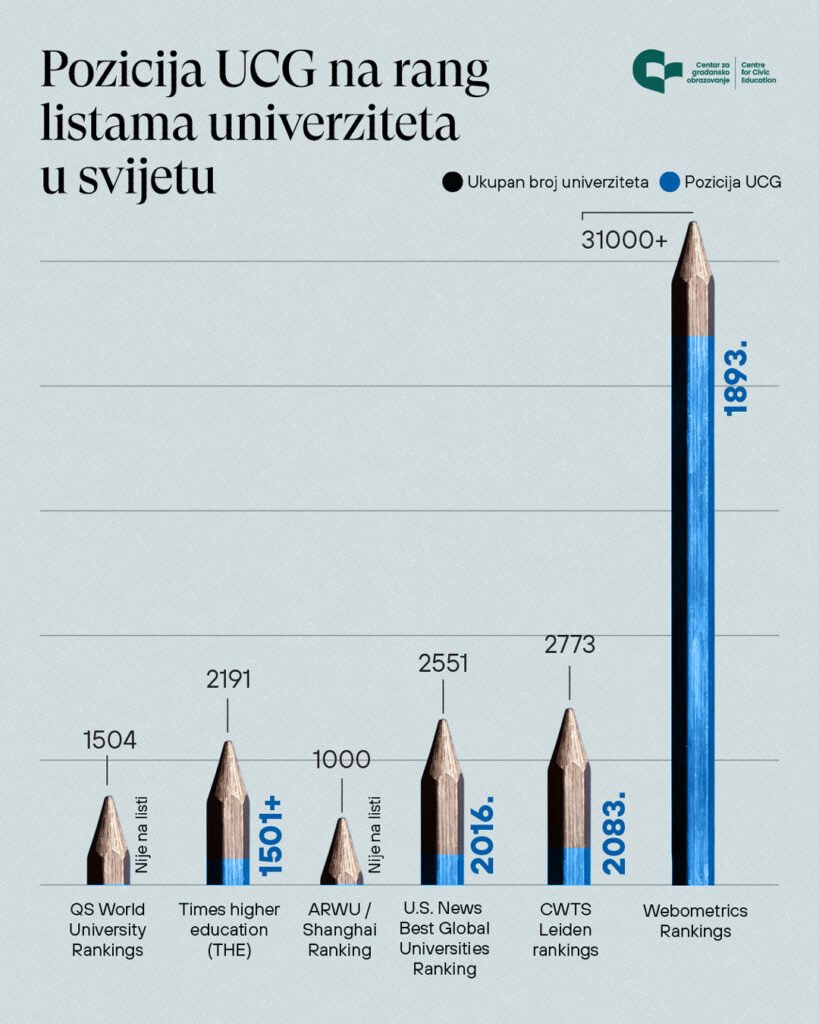
Although there is no broad consensus on the relevance of international rankings assessing universities, some enjoy greater trust within the academic community. One of them – QS University Rankings – evaluates universities based on research quality and academic reputation, as well as the reputation and impact of graduates in the labour market. The latest global edition, published in June 2025, included 1,507 universities, among which UCG was not listed. However, on the European ranking, which includes 959 universities, UCG was placed near the bottom – within the 701–900 range.
UCG also did not earn a place on the Academic Ranking of World Universities, a list of the world’s top universities compiled by the Shanghai Ranking Consultancy, which includes a total of 1,000 institutions. Ranking on this list is based on the quality of education/achievements of alumni, the quality of academic staff, research output, and overall academic performance adjusted to the size of the institution.
Times Higher Education (THE) is another relevant international ranking, whose criteria include the quality of the teaching and research environment, overall research quality, the level of internationalization, and contributions to industry. This ranking covers around 3,000 universities, with UCG positioned in the lower tier, ranked below 1,501 without a precise numerical position.
On the international ranking of top universities titled US News Best Global Universities, UCG is ranked 2,016th out of a total of 2,551 universities worldwide. This ranking evaluates institutions based on 13 indicators related to reputation in the regional and global research space, the volume and type of scientific publications, citation and scientific impact of papers, as well as the level of international research collaboration.
CWTS Leiden Ranking is a list created by a research team from Leiden University, with rankings based on the analysis of publications and their citations. In the latest edition of this ranking, UCG placed 2,083rd out of a total of 2,773 universities.
CCE believes that these data clearly point to the need for a significantly different approach in the work of UCG. Although UCG’s budget for 2026 amounts to a record EUR 40.5 million, and the academic staff are well paid, the results on relevant international rankings show that this does not translate into adequate academic and research performance. This suggests that it is necessary to focus on improving the quality of teaching, research work, and international cooperation, while fostering rather than suppressing pluralism and critical thinking, in order to improve UCG’s global position and ensure greater recognition and competitiveness at the international level.
Ivan Kašćelan, Project Assistant