
Centre for Civic Education (CCE) warns that certain portals registered in Montenegro continue to publish articles with an explicit note stating that the content has been reproduced in full from Sputnik Serbia. This raises serious questions about compliance with the international obligations Montenegro has assumed through alignment with the European Union’s Common Foreign and Security Policy, the effectiveness of the Decision that transposes those obligations into the domestic legal framework, and, ultimately, about who is actually competent and willing to react to this issue.
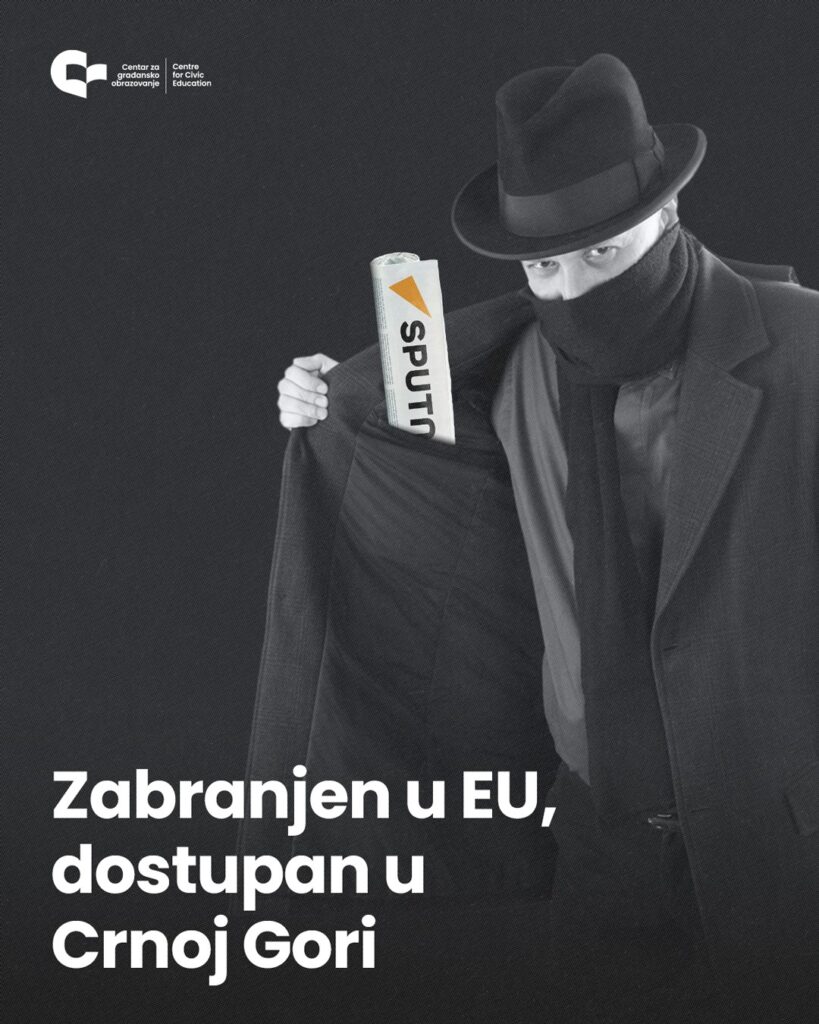
CCE recalls that, by the Council of the European Union Decision of 1 March 2022, the broadcasting, distribution and any indirect contribution to the distribution of content produced by Sputnik and RT, including all their subsidiaries and language versions, was prohibited. Sputnik Serbia is not an independent media outlet, but rather a regional version of the same state propaganda apparatus operating from Belgrade, taking advantage of the fact that Serbia has not joined the EU’s restrictive measures against Russia.
“Furthermore, the Government of Montenegro adopted the Decision on the Introduction of International Restrictive Measures precisely in order to ensure that EU sanctions would also be applicable within our legal order. Portals in Montenegro that reproduce Sputnik content in full, regardless of whether it originates from Moscow or Belgrade, are doing exactly what is prohibited by that Decision – disseminating the propaganda of a media outlet that the EU has sanctioned for its role in the disinformation war accompanying Russia’s aggression against Ukraine.
CCE requested information from the Ministry of Culture and Media regarding the specific measures it had undertaken to implement this Decision, but the response we received is more concerning than the problem itself. Namely, the Ministry rejected the request on the grounds that it did not possess the requested documentation. In other words, the body designated by law as solely responsible for supervising the operation of online publications has no document whatsoever demonstrating that it has undertaken any activity to implement a binding decision of the Government of Montenegro.
The reason is not negligence, but a normative omission. Specifically, among the bodies responsible for implementing the Decision are the Ministry of Finance, the Ministry of the Interior, the National Security Agency, the Agency for Audiovisual Media Services and other bodies, but not the Ministry of Culture and Media. On the other hand, Article 59 of the Media Law stipulates that supervision over the operation of online publications and print media is exercised exclusively by the Ministry of Culture and Media, while the Agency for Audiovisual Media Services has jurisdiction exclusively over electronic media – television and radio broadcasters. The fact that the Ministry did not see fit to point out the irregularity of its exclusion from the Government Decision also indicates that the institution has taken the position of deliberately not dealing with this matter.
The consequence is that Sputnik’s propaganda circulates freely within Montenegro’s media space, while the system is structured in such a way that no institution capable of reacting is formally obliged to do so.
CCE therefore calls on the Government of Montenegro to urgently amend the Decision and include the Ministry of Culture and Media among the competent authorities, in accordance with the responsibilities entrusted to it under the Media Law. At the same time, we call on the Ministry, without waiting for amendments to the Decision, to use the mechanisms already at its disposal and take concrete steps towards portals that disseminate Russian propaganda, while also informing the public about those actions. We further expect all bodies already covered by the Decision to approach the issue of distributing prohibited propaganda content in a coordinated manner.
Montenegro cannot credibly advocate its European path while simultaneously allowing the content of a propaganda service sanctioned by the EU for its role in spreading disinformation and supporting Russia’s aggression against Ukraine to circulate freely within its media space. It is even less acceptable that this is happening because of legal and institutional gaps created by the state itself. If the Government of Montenegro has undertaken European obligations, then it must implement them consistently. Otherwise, the question remains whether this is a matter of insufficient capacity, lack of political will, or something else entirely.
Željka Zvicer, Programme Associate