
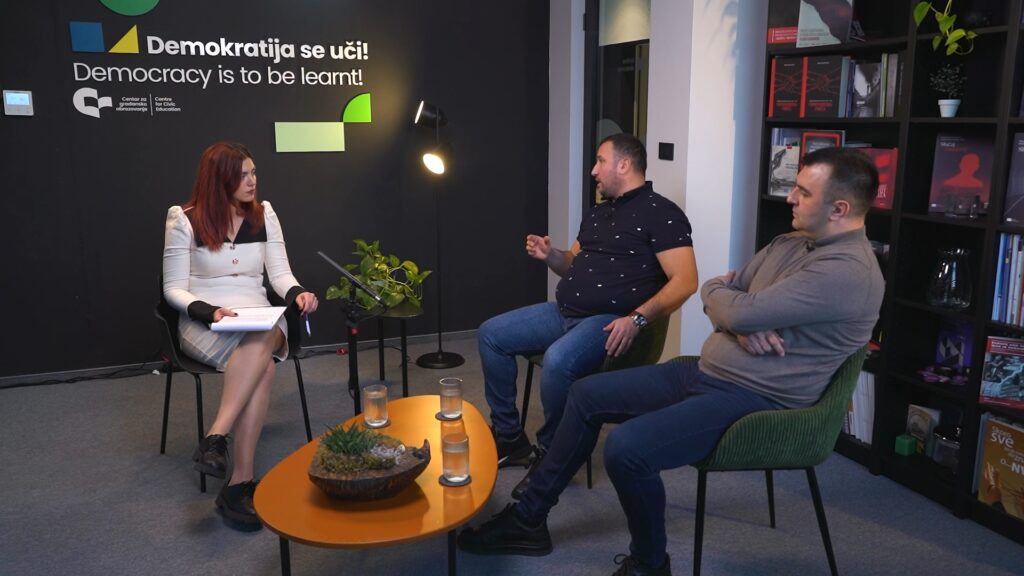
When the state commits a crime, answers usually fail to come. Our struggle is a struggle for remembrance, because truth is a precondition for the future and a mechanism for preventing crime, say Alen Bajrović, son of Osmo Bajrović, a victim of the Deportation war crime, and Demir Ličina, son of Iljaz Ličina, a victim of the Štrpci war crime. They spoke about their personal struggles, the search for truth and justice and the importance of a culture of remembrance in PROUDCAST of the Centre for Civic Education (CCE), hosted by Željka Zvicer, Programme Associate.
Both were children when these war crimes occurred – Alen was four, and Demir three years old. Recalling the time when their fathers were killed, they testify to experiences that permanently marked their lives.
“Two uniformed police officers stormed into our home and captured my father. My sister and I were in his arms. As it was already warm weather and the house was not locked, they simply entered and literally grabbed him from our embrace. Without any explanation, they took him away. They put him into a Zastava 101 police vehicle and drove him to the premises of the Ministry of the Interior in Herceg Novi,” Bajrović recalls.
His mother went to the police station for days, trying to find out where her husband was, but she encountered threats and a wall of silence. “They told her: ‘Don’t ask anything, leave this place, or you will end up where he did.’ She had no one with her, we did not know anyone, the atmosphere was tense, filled with war-mongering rhetoric in the media,” Bajrović adds, reminding that they also wrote to the then Minister of the Interior, but received no response there either.
Demir Ličina remembers very few details from the time of the abduction from the train in Štrpci, but he clearly recalls the feeling of uncertainty that entered their home. “What I can say with certainty is that the news of the abduction, broadcast in the evening news, brought anxiety into our house. At first, we had no confirmation that my father was among those abducted, but as time passed, we became aware of that fact,” he says.

His father Iljaz was a worker travelling by train to Belgrade to finalise his sick leave. “He wanted to return to his family. Like all those abducted in Štrpci — ordinary people, family breadwinners. Their only ‘crime’ was the crime of their name. It is not surprising that answers were absent at the time, because when the state commits a crime, accountability mostly disappears,” Ličina stresses. He received confirmation of his father’s death only three years later, when the then President of the country, Momir Bulatović, sent a telegram of condolence. “In the beginning, information was manipulated. Officials at the time claimed that these people had not been killed, but that they would probably be used in an exchange, as the war in Bosnia and Herzegovina was raging. The truth was different – they were killed immediately and their bodies were thrown into the Drina River. What hurts me today, as a family member, is the fact that at 36 years old I cannot fully form the image of my father. I do not remember enough of him, and I preserve his memory only through photographs,” Ličina says.
Photographs are also the only memory Alen Bajrović has of his father. Both testify that growing up without fathers was marked by a constant sense of loss and a struggle for basic survival.
“Whatever burden or problem we had – you miss him… You lack a father’s attention, support, security… We were left without material existence. My mother struggled to earn a living, doing the hardest jobs because she had no other choice. Everything was extremely difficult. You are left alone to fight life,” Bajrović explains.
Demir’s story is similar. “My childhood was not the childhood a child should have. We did not choose to fight; we were forced into it. When you lose the family breadwinner, with four underage children, you lose income, security, support. My father worked and supported the family. The moment he was abducted from the train at the station in Štrpci, we were left without any income… I honestly do not know how my mother managed,” Ličina says.
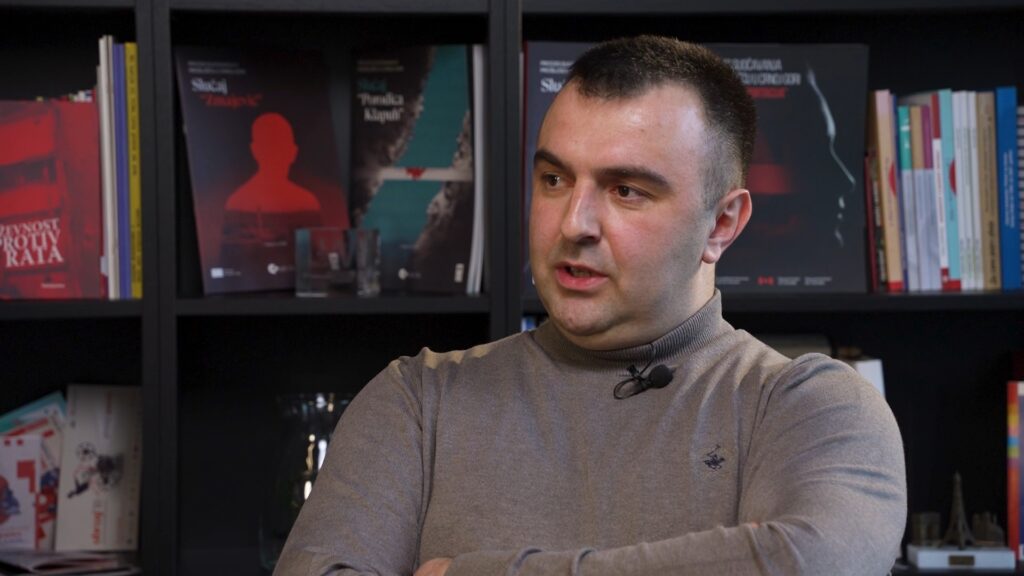
They assess that the state’s conduct at the time was not directed toward assisting the families of victims, but rather toward deepening insecurity and encouraging them to leave Montenegro, which a significant number of families eventually did.
“We are the only family from the Deportation war crime that remained living in Montenegro. And the only family that continued legal proceedings against the state of Montenegro. I will never give up the fight; one must always fight for justice,” Bajrović states firmly. “The state masterfully applied regulations when it was necessary to limit the rights of families. But when it came to making life easier for those people, they tried to make it harder. That is a fact, and I will always say it publicly,” Ličina adds.
Speaking about judicial outcomes, Ličina assesses that the Štrpci case is legally the most completed, but emphasises that the search for mortal remains must be a priority, because without the full truth there can be no closure. “The state is not doing enough to ensure that all mortal remains are found. We know where they are located; what is needed is intensified inter-state cooperation so that they can be found and buried in the way they deserve,” Ličina underlines.
Bajrović emphasises that in the Deportation case there are still no full answers and no final accountability. “I believe that more than 150 people were victims, but it is the state that must provide answers. On the other hand, we have no one who has been finally convicted for this war crime. We know who participated in it, yet we have no one officially found guilty,” he explains.
They also reflected on the law that granted their fathers the status of civilian victims of war and established a framework for compensation for the families of the deceased. “I do not agree with certain provisions, but that law carries enormous symbolic value. It is institutional confirmation that my father had no guilt other than his name. He received the status he should have been granted long ago – the status of a civilian victim of war,” Ličina notes. “Although it comes late, the law is important because of the status. However, what personally affected me most is that it is tied to war military invalids. My father was killed by a rifle, yet he is placed under the same law,” Bajrović points out.
Both Ličina and Bajrović want young people to know the truth about these crimes, believing that this is the only path forward. “It matters to us that young people know what those before them did. At the core of our struggle is also the desire to leave behind facts,” Ličina says. “The truth must remain for the young, and I believe citizens of Montenegro need it even more than I do, because I have already turned to stone somewhere inside. Truth is the foundation to ensure that crime does not repeat itself,” Bajrović concludes.
The full PROUDCAST is available at the following link: https://youtu.be/gsZkUMoUl0I.
This PROUDCAST was produced within the CCE project “Understanding the Past to Build Trust and Transitional Justice”, through the regional programme “EU Support to Confidence Building in the Western Balkans”, funded by the European Union and implemented by the United Nations Development Programme (UNDP). The content of this episode is the sole responsibility of the interlocutors and does not necessarily reflect the views of CCE, the EU or UNDP.
Maja Marinović, Programme Associate