
Centre for Civic Education (CCE) strongly protests the rejection of the initiative to erect a monument to Joka Baletić, a seventeen-year-old partisan from the Nikšić area and a heroine of the anti-fascist struggle. This decision once again confirms that anti-fascism in Montenegro is too often reduced to declarative references, without a genuine willingness to uphold these values through concrete and consistent actions. It sends a message that even the most basic symbols of the anti-fascist legacy are not beyond day-to-day political calculations.
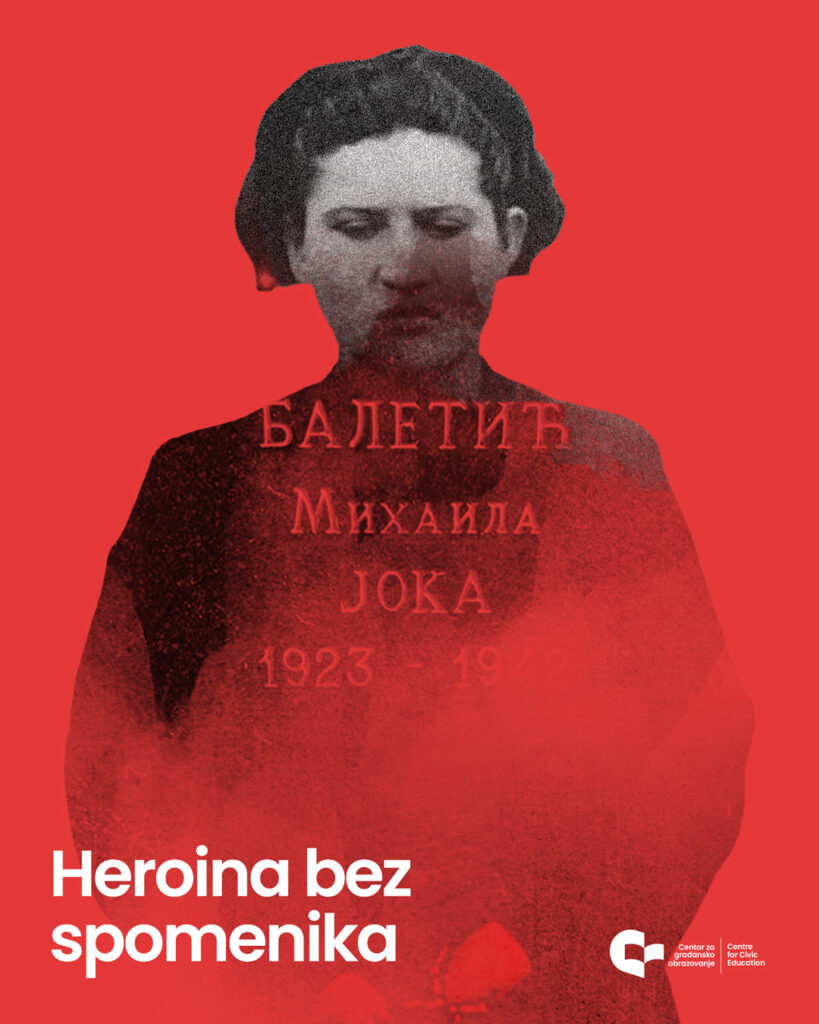
Joka Baletić is not only part of Nikšić’s history, but also a powerful symbol of resistance, courage, and sacrifice in the fight against fascism. She also represents a reminder of the role of women in the anti-fascist movement, which remains marginalised and insufficiently recognised. This is precisely why the treatment of such initiatives carries additional weight, as it reflects the readiness of society to acknowledge women who made an immeasurable contribution to the struggle for freedom. We recall that monuments dedicated to women in Montenegro are rare, while in Nikšić only four streets bear women’s names: Milica Vučinić, Dragica Pravica, Joka Baletić, and Jela Andrijašević.
Anti-fascism is not a matter of selective remembrance, but a cornerstone of Montenegro’s contemporary democratic and European identity. The lack of support for initiatives that affirm this legacy, particularly those that restore visibility to women, opens space for the relativisation of historical facts and further weakens the culture of remembrance, which is already not at a satisfactory level in Montenegro.
At the same time, such an approach leaves room for unscientific historical revisionism, while universal values are reduced to the subject of political contestation. We recall that the monument to Chetnik commander Pavle Đurišić, although subject to criminal proceedings, has still not been removed, while there have been recorded instances of his public glorification by political and religious actors.
Joka Baletić was executed by Nikšić Chetniks, while representatives of the New Serbian Democracy and Democratic Montenegro – parties which, alongside the Europe Now Movement, did not support this monument initiative in Nikšić – have attended, in the previous period, various memorial services and events glorifying the Chetnik movement.
The situation is further problematised by the fact that political actors who most loudly advocate European values in practice act contrary to those principles, reducing them to political opportunism. This undermines the very process of European integration, which implies not only the formal adoption of standards but also the genuine cultivation of values, including gender equality and the visibility of women in public and historical spaces.
Nikšić, as a city holding the title of European Capital of Culture for 2030, has an additional responsibility to nurture a culture of remembrance and to promote the most significant figures from its history. By rejecting this initiative, an opportunity to enhance the city’s cultural offering has been missed.
CCE emphasises that the culture of remembrance is a key element of democratic development, and the approach to anti-fascist heritage represents an important test of societal maturity. Ignoring initiatives that promote these values, particularly those that contribute to the visibility of women, does not strengthen social cohesion but instead deepens divisions and weakens trust in institutions.
CCE calls on decision-makers to demonstrate greater responsibility, consistency, and a genuine commitment to applying the values they publicly advocate.
Nikola Obradović, Programme Associate