
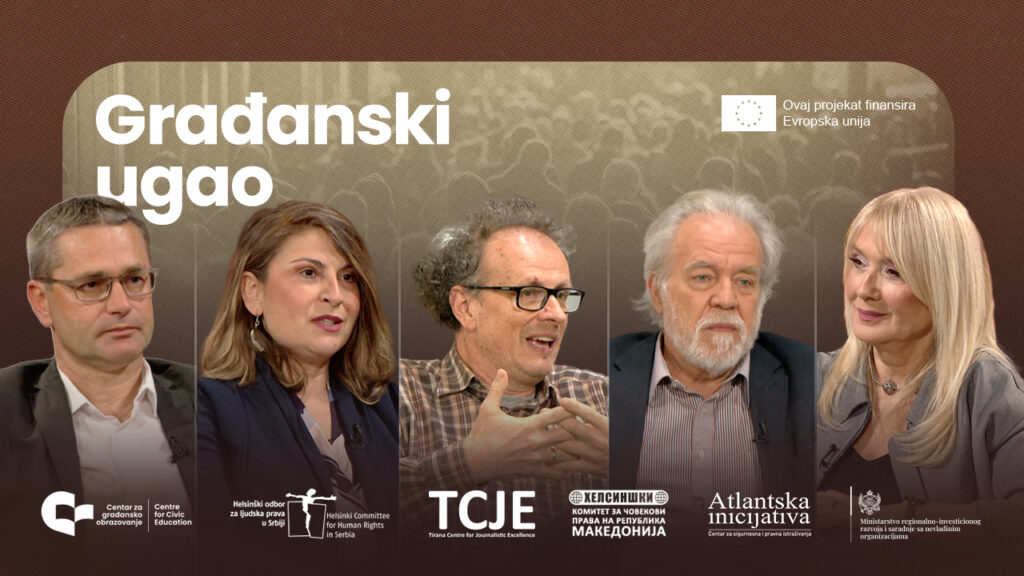
Journalism in the region is going through a serious period of change, but despite numerous challenges, it still has the potential to be an important societal corrective if it remains true to its core mission – accurate, responsible, and professional informing of the public, it was noted in the TVE program Civic Angle, produced by the Centre for Civic Education (CCE). Zvezdana Kovač, CCE Outreach and Communication Director, discussed this topic with Neđeljko Rudović, journalist from Montenegro; Silvana Žežova, journalist from North Macedonia; Srđan Puhalo, psychologist and journalist from Bosnia and Herzegovina; and Milan Nedeljković, Director of the Novi Sad School of Journalism in Serbia.
“The media scene in Montenegro is complex and diverse. The key question is whether the media in Montenegro allow us to be fully and truthfully, that is, comprehensively informed. I believe they do,”said Neđeljko Rudović.
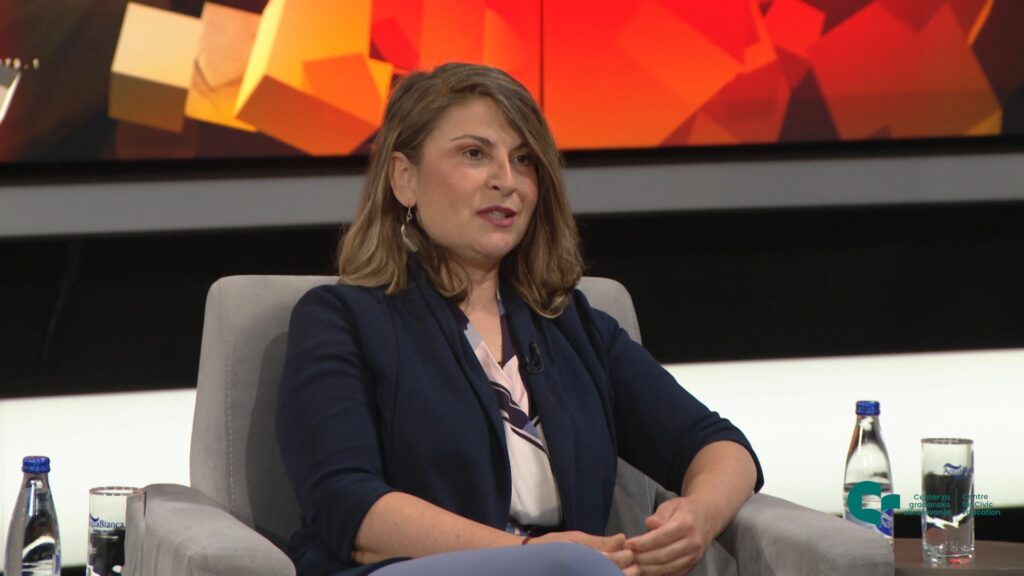
Silvana Žežova emphasized that journalism cannot be separated from the social context in which it operates. “Journalism today is the same as society today. Those who are professional strive to remain professional and to impose their standards, to enable citizens to be properly informed and maintain quality,” Žežova said.
Srđan Puhalo reminded of the complex relationships between journalists, media, and political power. “It seems to me that journalism has always had the same problem – you have a very small number of journalists and a large number of media outlets. These journalists stand on the side of ordinary people, citizens, society, while the media are very often on the side of the authorities,” he said.
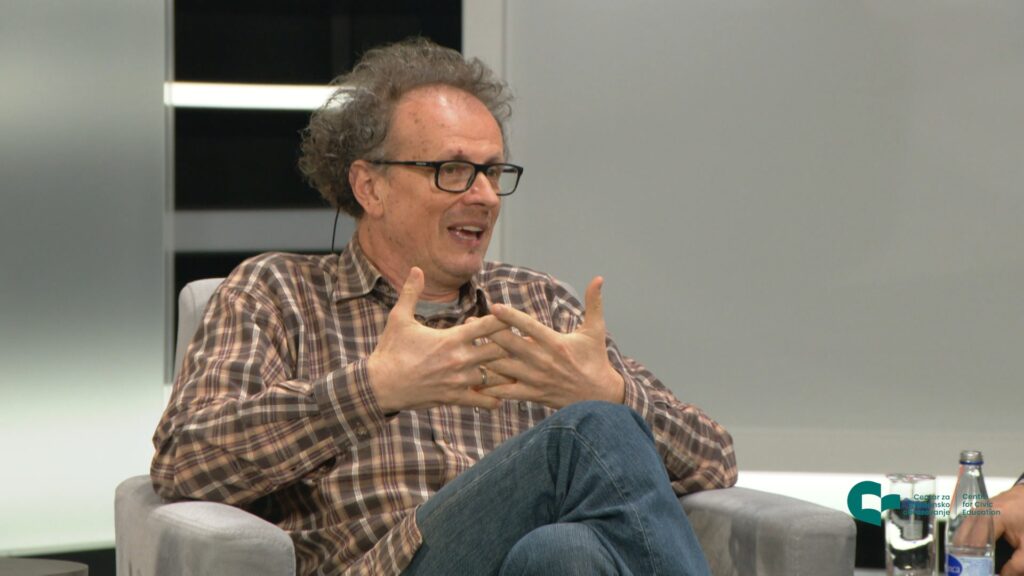
He stressed the importance of distinguishing professional journalism from propaganda, but also noted that this is not a new situation. “Since communism, we had socio-political workers, ‘journalists,’ and a few real journalists. Today, we similarly have some serious media and serious journalists, and a bunch of media that I’m not sure we can even call journalists or media,” he assessed.
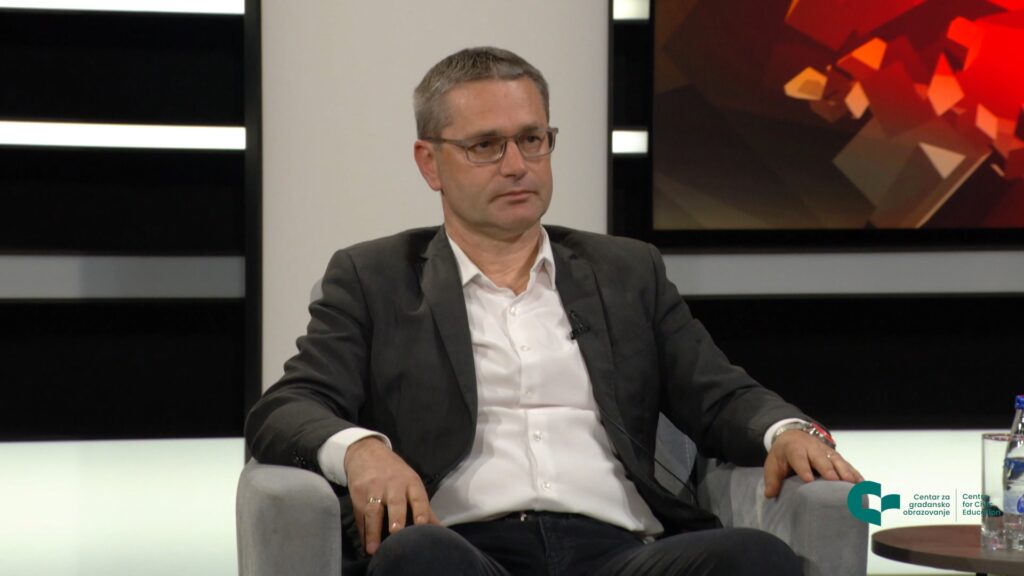
“Journalism in Serbia today is in a state of war,” Milan Nedeljković said in his review of the media situation in Serbia. According to him, divisions between media outlets are extremely deep. “Journalists and media houses are so divided that we are just waiting for something to break,” he explained, adding that it is an open conflict between different media blocs. “Essentially, there is a war between pro-government media and independent media, and I really don’t know how it will end,” Nedeljković warned.
Rudović believes that, despite numerous challenges, journalism remains a valuable profession. “When you look at the number of media outlets in Montenegro, that number today, if we talk about registered media, is over two hundred. That should mean we have quantity that ensures quality. However – not,” he said. “The vast majority of these media are either party publications or outlets of certain interest groups, large or small, while professional media are in the minority,” Rudović noted. Still, he believes there is a positive specificity in the Montenegrin media scene. “A fortunate circumstance for Montenegro, despite all the flaws we may find, is that professional media are the most influential, and although there are far fewer of them than these quasi-media, they predominantly shape public opinion,” he said. Rudović considers this an important difference compared to some other countries in the region. “The most read, watched, and listened-to media in Montenegro are the so-called mainstream media that adhere to the Montenegrin Journalists’ Code,” Rudović said.
The participants agreed that political pressures and economic dependency are among the key problems of media in the region, but that professional journalists still strive to maintain the standards of their profession.
Žežova highlighted that professional journalists, despite changes in the media environment, aim to preserve the core principles of the profession. “Those who are professional strive to remain professional and to impose that standard on society,” she said.
Nedeljković also raised the issue of terminology in public discourse. “It seems to me that patriotism is often misused in political discussions about the media. I believe that the journalists who criticize the state today are much greater patriots than those who support it,” he added.
Puhalo warned that one of the biggest problems is blurring the line between journalism and propaganda.“It is very important to distinguish journalism from everything behind those media whose goal is to promote the authorities,” he emphasized.
Regarding how the digital environment brings new pressures to journalists, Silvana Žežova pointed out the growing influence of speed and social media logic on media work. “Media today are faced with a constant race for speed and clicks,” Žežova said. “The pressure to publish information as quickly as possible is enormous. In such circumstances, fact-checking can easily be shortened or skipped, which then affects the quality of journalism. Professional journalists try to find a balance between new technological opportunities and responsibility to the public. Technology has brought many good things, but also great responsibility. If we want to maintain audience trust, we must uphold professional standards and cannot allow speed to become more important than truth,” she said.
Srđan Puhalo believes social media has fundamentally changed the way audiences access information. “Today anyone can be an information source, but that doesn’t mean everyone is a journalist,” Puhalo said. “Previously, you knew—there was a journalist, an editor, and an editorial team behind the information. Today, anyone can post something on social media, and it quickly becomes news. This further complicates the job of professional journalists. Journalists today not only have to report but often must also refute or fact-check information that has already gone viral on social media,” Puhalo said.
“In such a situation, the only way for media to maintain trust is to insist on facts and information verification. The professional responsibility of journalists today may be even greater than before. If a journalist publishes incorrect information today, it spreads much faster than before and is much harder to correct later,” Rudović said.
Milan Nedeljković pointed out that social media further complicates the relationship between the audience and journalism. “Social media have completely changed the way people consume information. Today, audiences often access information outside professional media. Many citizens see information first on social media, and only later in the media,” he said. He believes this makes it even more important for professional media to remain consistent with standards. “If media start behaving like social media, they lose their fundamental role,” he said.
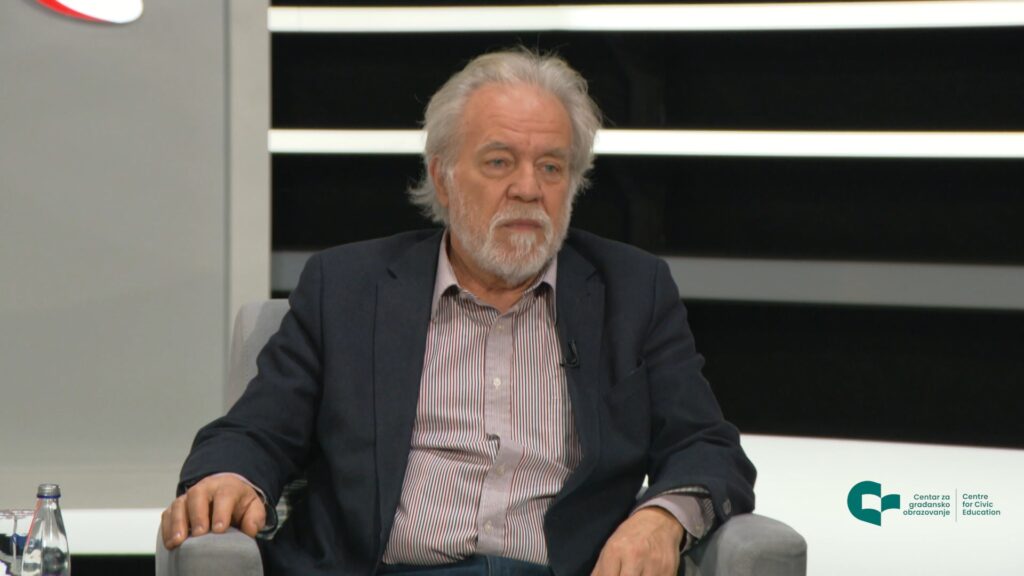
Žežova believes professionalism and consistency can play a key role in restoring public trust in the media. “If we maintain professional standards and stick to the facts, citizens will recognize that,” she said. “It’s a process that takes years. Trust is built over years but can be lost very quickly if media deviate from professional principles,” Žežova added.
Puhalo believes that the fight for professional journalism will be a long-term process. “There will always be media that work in the interest of authorities and those who try to work in the public interest,” he said. “The key is for the audience to learn to recognize the difference between journalism and propaganda. As long as citizens are willing to read critically and verify information, there will be space for professional journalism,” Puhalo concluded.
The full episode is available at: https://www.youtube.com/watch?v=mgGgWnjqNpw
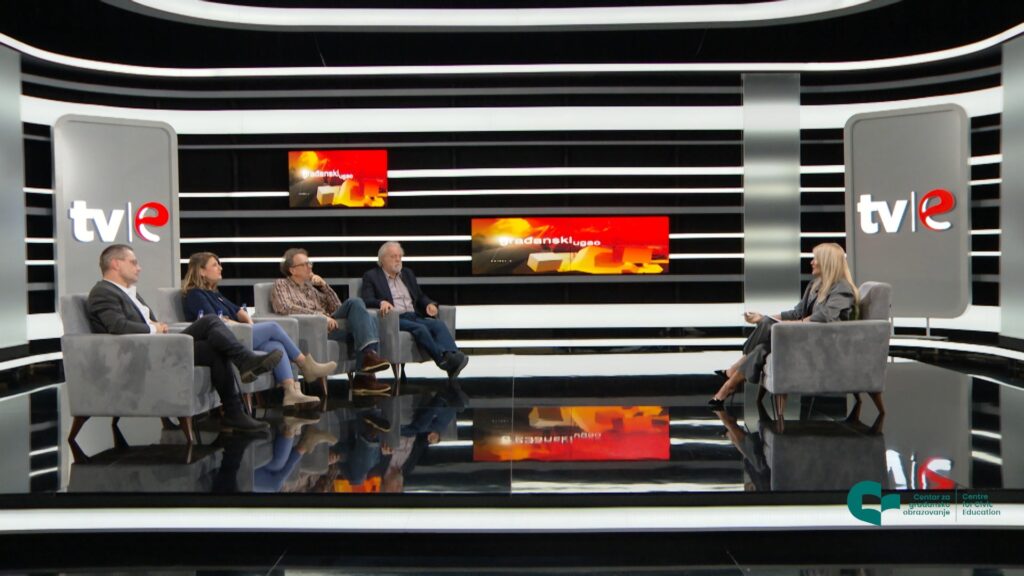
The episode is part of the project “Improving Media and Information Literacy for Democratic Engagement – MedIA-Lit”, implemented by CCE, in partnership with the Helsinki Committee for Human Rights in Serbia (HCHRS), the Helsinki Committee for Human Rights in North Macedonia (MHC), the Tirana Center for Journalistic Excellence in Albania (TCJE), and the Atlantic Initiative (AI) in Bosnia and Herzegovina, with financial support from the European Union and co-financing from the Ministry of Regional Investment Development and Cooperation with NGOs of the Government of Montenegro.
Maja Marinović, Program Associate