
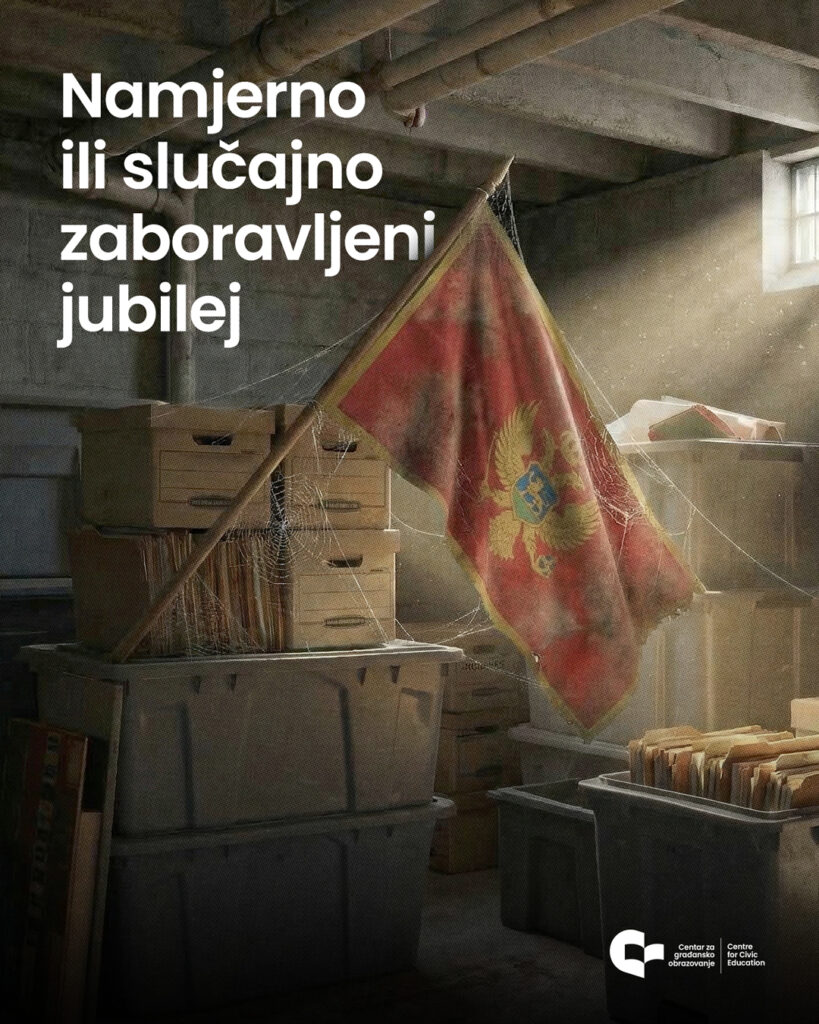
The Centre for Civic Education (CCE), on the occasion of May 21 – Independence Day, marking the 20th anniversary of the restoration of Montenegro’s independence, has gathered data from state institutions and municipalities on how they plan to commemorate this jubilee, with the findings indicating a concerning level of systemic neglect of this important date.
The majority of municipalities have not planned any activities to mark the 20th anniversary of independence. Of the 25 municipalities, only the Municipality of Kolašin has allocated specific budget funds (€30,000), and this was initiated by opposition councillors, with the support of part of the ruling majority. However, even there, the organisation is still in its early stages, as the commission for preparing the celebration is only now being formed. The Municipality of Žabljak has appointed a working group, but without defined activities or a budget. Andrijevica, Berane, Plužine, Zeta, Tivat, Herceg Novi, Pljevlja and Mojkovacexplicitly state that they have no programmes or funds for this purpose, while Bar reports that its programme has not yet been finalised, providing no further details. Nikšić has stated it will “follow the state programme”, without its own initiatives, indicating a lack of local initiative. A particular example is the Municipality of Tuzi, which is not planning local celebrations but is instead focused on supporting an event in Tirana, in cooperation with the Embassy of Montenegro in Albania. As many as 11 municipalities failed to provide the requested information, indicating a lack of planning and transparency.
The Office of the Mayor of the Capital City Podgorica stated that it forwarded CCE’s request to the Podgorica Tourist Organisation, which never responded. No official response was received from the Royal Capital Cetinje, which holds a special place in Montenegro’s statehood history. However, according to publicly available information, Mayor Nikola Đurašković announced that on May 21 a large concert by one of the biggest regional music stars will be held at Dvorski Square, without specifying the performer.
The situation is no better at the state level. Although the Committee and Coordination Body were formed as early as December 2025, concrete results are lacking. The Committee has met only once, just a few days ago, while the organisation of the celebration has effectively been left to external contractors through public calls published only in mid-March. The programme remains unclear, with a ceremonial event announced for May 20 at the “Plantaže 13. jul” location, along with a three-day programme in Podgorica, but without precise information on content, budget or organisers.
A similar pattern is observed across ministries – some have no plans, while others claim to have no information, even though their representatives are members of the bodies responsible for marking the jubilee, highlighting a lack of central coordination.
For example, the Ministry of Culture and Media has not adopted an activity plan but noted that the minister is a member of the Committee for marking the anniversary. The Ministry of Tourism and the Ministry of Education, Science and Innovation have not planned any activities, despite the Minister of Education also being a member of the same Committee. However, in cooperation with the German Konrad Adenauer Foundation (KAS), the Ministry of Education has launched a competition for high school and university students to mark the 20th anniversary of independence.
The Office of the President of Montenegro, Jakov Milatović, did not respond to inquiries about plans to mark two decades of restored statehood. No responses were received from the General Secretariat of the Parliament of Montenegro or from the public broadcaster RTCG.
The University of Montenegro (UCG) will not have a dedicated programme for this jubilee, stating that activities will be integrated into existing academic and scientific formats, without specifying any of them. The rector, Vladimir Božović, who signed the response, is a member of the Coordination Body for marking the anniversary. The Faculty of Political Science plans to organise events, but without providing details.
Positive examples do exist. The Faculty for Montenegrin Language and Literature (FCJK) submitted a detailed plan and cost breakdown, as did Matica crnogorska, which provided a comprehensive plan of activities along with a developed visual identity, all funded from its own budget. This demonstrates that, with commitment and timely planning, much more could have been organised by other institutions as well.
The Montenegrin National Theatre (CNP), as part of its activities marking the anniversary, announced two performances of previously produced plays in May, participation in the implementation of one project, the marking of 10 years of one of its productions, as well as a premiere in November and a book promotion. This gives the impression that existing activities were incorporated into a special programme only after CCE’s inquiry.
On the other hand, although the public competition for the visual identity of the 20th anniversary of Montenegro’s independence was announced twice, the Government has still not published a decision or presented the visual identity. The first competition was accompanied by significant criticism from professionals.
CCE first raised this issue publicly on February 24, when it called on the Montenegrin Academy of Sciences and Arts (CANU) to publish its activity plan, noting that even the highest institution in science and arts had overlooked the jubilee. In the meantime, CANU has dedicated a concert cycle “Young Montenegrin Composers”, which began on March 11, to both this anniversary and its own 50th anniversary – something CCE sees as a result of public pressure and criticism.
CCE emphasises that marking 20 years of independence must not be reduced to ad hoc and fragmented activities.Unfortunately, an opportunity has been missed to design this jubilee as a year-long programme involving various social actors and promoting civic values.
The lack of organisation does not diminish the importance of this anniversary, but it undermines public trust in institutions and the commitment to the state among those who lead them. Therefore, CCE calls on the competent authorities to urgently present clear, substantive and transparent plans, improve coordination and ensure a dignified marking of this significant jubilee.
Rozana Vuljaj, Project Assistant