
Centre for Civic Education (CCE) assesses that the subsequently published programmes by municipalities, institutions and other actors marking the 20th anniversary of the restoration of Montenegro’s independence confirm that public pressure was crucial in ensuring this jubilee was not met with institutional silence and improvisation.
The CCE welcomes every activity that contributes to a dignified celebration of this jubilee. However, the fact that concerts, exhibitions, panel discussions, competitions, formal academies, school initiatives, murals, regattas, tree-planting actions, screenings, public forums, and other events only began to appear following public warnings demonstrates that the problem was not an inability to mark the jubilee, but rather that many had failed to plan it on time and with the necessary seriousness.
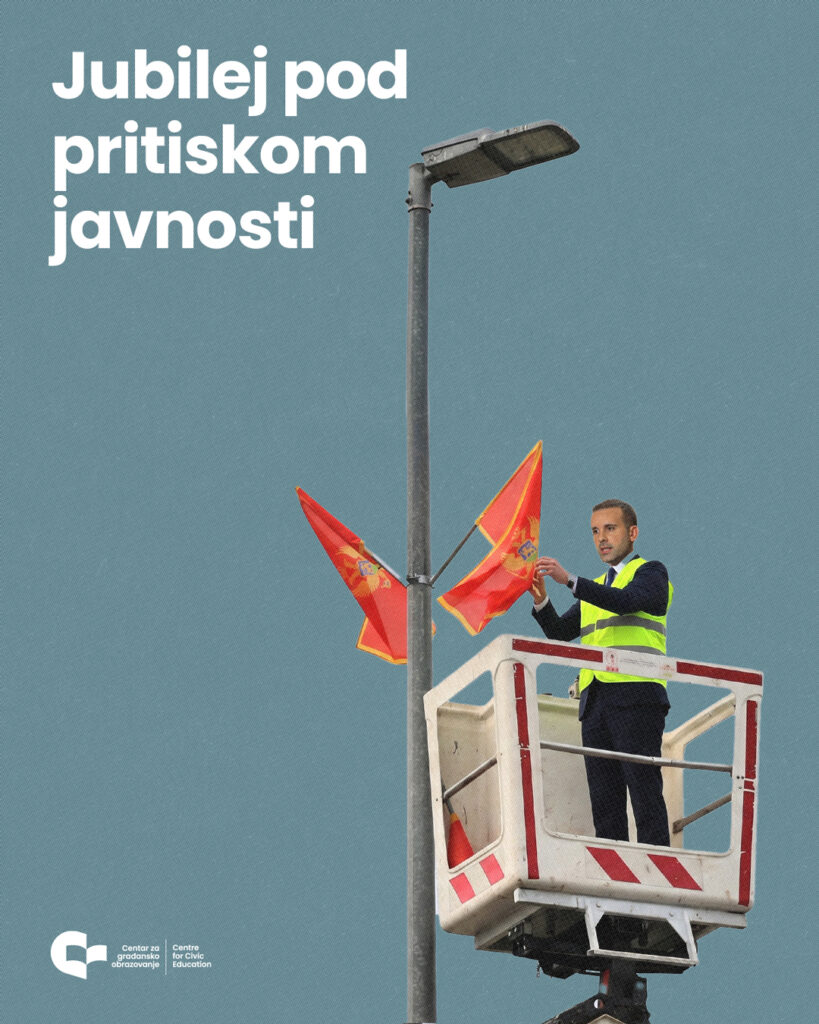
The CCE opened this topic as early as 24 February, when it called upon the Montenegrin Academy of Sciences and Arts (MASA/CANU) to publish its plan of activities for the jubilee.
In mid-March, the CCE presented findings gathered from a sample of state authorities and institutions at the national level, as well as from local self-governments. These findings revealed a concerning picture—ranging from a complete absence of programmes and budgets, through the silence of a number of municipalities and institutions, to unclear coordination at the state level and a jubilee visual identity that had still not been presented at the time.
In the meantime, the situation has changed, becoming at least formally more substantial. According to CCE records, subsequent activities were published or finalized in Kolašin, Ulcinj, Bar, Gusinje, Rožaje, Bijelo Polje, Plav, Šavnik, Tivat, Kotor, Tuzi, Petnjica, Žabljak, Mojkovac, Berane, Danilovgrad, as well as in the Capital City of Podgorica. These include exhibitions, concerts, and other cultural programmes, formal academies, panels, and various public events. In Herceg Novi and Pljevlja, where local authorities showed no willingness to mark the jubilee themselves, activities were initiated by other actors, including UBNOR, STEGA, citizens and Montenegrin Cultural Network. Concurrently, in Andrijevica, Plužine, Zeta, and Nikšić, there is still no publicly available information regarding planned activities.
It is particularly significant to note that activities emerged even in municipalities that had previously explicitly stated they had no programme or funds, such as Tivat, Mojkovac, or Berane. Mojkovac subsequently published a programme on the initiative of the Civic Movement URA councilors’ club, including cultural events and the tree-planting campaign “20 for the Future.” Tivat announced a concert through its local tourist organization, while Berane published a concert announcement for May 21, albeit without a detailed description, stronger promotion, or a clear connection to the independence jubilee. Additionally, the municipality of Tuzi had previously stated it did not plan a local programme but would rather support an event in Tirana, only to subsequently announce its own activity – the National Exhibition of Fine Arts.
A shift from initial, poorly defined ideas to concrete programmes is also visible among a portion of local self-governments. Kolašin progressed from an initial organizational phase to establishing a commission and a multi-day programme; Bar went from an unfinalized plan to a multi-day celebration encompassing cultural, scientific, educational, sports, and musical content. Žabljak moved from a working group with no defined activities or budget to an announced celebration, and Rožaje advanced from mere city decorations and supporting a single feuilleton to a broader cultural and entertainment programme titled “To My Homeland.” In Danilovgrad, following the absence of a visible municipal programme, the Public Utility Company, in cooperation with the Municipality, implemented an action of planting 20 saplings to mark the jubilee.
A distinct contrast between the previous stance and the subsequently presented programme is also evident in the Capital City. Although there had been no concrete response regarding the celebration of the jubilee previously, an extensive May programme has since been announced, featuring concerts by the Čegi Band, Nina Badrić, and Matija Cvek, folklore and children’s events, the European Graduates’ Promenade, and a three-day central celebration on Independence Square.
At the state level, the delayed finalization of the programme further underscores the same issue. Although the Committee and the Coordination Body were formed back in December 2025, the public was left for a long time without a clear picture of what the official state programme entailed, who was spearheading it, how much it cost, and what criteria were used to select the events. Instead of the visual identity being among the first elements of the celebration – timely presented and utilized throughout 2026 as a shared framework for state bodies, municipalities, schools, and public programmes – the public witnessed delays, repeated procedures, and inadequate communication, which also sparked numerous controversies surrounding the final design solution. Within the central celebration programme in Podgorica, performances by Montenegrin artists have been announced alongside major international names such as Ricky Martin and DJ Robin Schulz, with funds for these activities allocated from the budget reserve.
The Ministry of Culture and Media, which had previously stated it had no activity plan, subsequently presented a calendar of programmes for cultural institutions and a public competition for the selection of an original musical composition in cooperation with PAM CG. The Ministry of Education, Science, and Innovation launched the campaign “20 Saplings for 20 Years since the Restoration of Montenegro’s Independence” in schools. In the meantime, activities have also been announced by the State Archives of Montenegro, the Montenegrin Cinematheque, the Central Bank of Montenegro, the Ministry of Defence in cooperation with the Embassy of the Federal Republic of Germany, the Faculty of Sport and Physical Education of the University of Montenegro, the Ministry of Diaspora, the “Slobodan Škerović” Gymnasium, the Tourist Organisation of the Municipality of Budva, and other actors.
Furthermore, although no information regarding the President’s programme had been submitted previously, it was subsequently published and proved to be highly substantive and comprehensive.
The CCE believes that if programmes could appear within a short timeframe across numerous municipalities and public sector bodies, it is clear that the obstacle was not an inability to organize, but rather the absence of a timely decision to approach the jubilee with the required seriousness. State jubilees cannot depend on whether someone will publicly remind institutions and decision-makers of their obligation to the state.
The jubilee of the restoration of independence does not belong to any single party, government, municipal authority, or individual, but to Montenegro and all its citizens. In 2006, Montenegro restored its statehood as a civic, European, and anti-fascist state, and these very values should have been at the center of the jubilee celebrations. Twenty years of independence should not have been a reason for improvisation and afterthought management, but for a serious, dignified, and transparent state approach. The state is respected not only through ceremonial programmes, but through a timely and responsible relationship of its institutions toward its past, present, and future.
Rozana Vuljaj, Project Assistant