
Interculturalism in the Western Balkans is not merely a political concept, but also a historical experience of shared life, as well as a space of continuous reflection. This was assessed in the programme Civic Corner on TVE, produced by the Centre for Civic Education (CCE). On interculturalism throughout history and today, its social and political dimensions, as… »

February 2026
Significant Interest from CSOs in Youth-Focused Call for Proposals
Ideas, questions, discussions, and specific clarifications regarding the call aimed at strengthening youth-focused initiatives, accompanied by significant interest from civil society organizations (CSOs), marked today’s information sessions held at the European House in Bijelo Polje and at the premises of the Centre for Civic Education (CCE) in Podgorica. The sessions were organized within the framework… »
Concerning Verdict in the Case of the Attack on Journalists in Gornje Zaostro
The Centre for Civic Education (CCE) is taken aback by the verdict of the Higher Misdemeanour Court in Bijelo Polje in the case concerning the attack on Vijesti photojournalist Boris Pejović, Pobjeda photojournalist Stevo Vasiljević, and Vijesti journalist Balša Rudović, who were reporting on the unlawful erection of a monument to war criminal Pavle Đurišić… »
Public Trust Does Not Reflect the Authorities’ Approach Toward the NGO Sector
On the occasion of World NGO Day, the Centre for Civic Education (CCE) highlights a serious gap between declarative support and the actual conditions in which non-governmental organisations operate in Montenegro. Although the NGO sector has for years been recognised as an important actor in processes of democratisation, Europeanisation, and the protection of the public… »
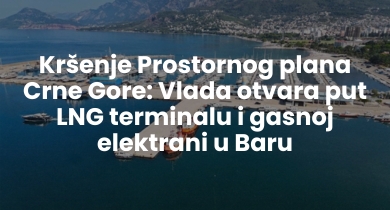
Violation of the Spatial Plan of Montenegro: Government Opens the Way for an LNG Terminal and Gas Power Plant in Bar
More than 40 non-governmental organizations, together with a large number of activists, intellectuals, and experts, as well as interested citizens from the coastal region, following the public debate on the Draft Spatial Plan of Montenegro and the open parliament session in Bar, have clearly taken a position against the construction of an LNG terminal in… »
Peer Violence Requires Systemic Solutions, Not Delayed Reactions
On the occasion of the International Day Against Bullying, the Centre for Civic Education (CCE) warns that peer violence in Montenegro remains a serious and pressing issue that must not be viewed solely through individual incidents, but rather as a deeply rooted social and institutional challenge requiring a continuous, systemic, and coordinated response. Findings from… »
Party Interests Prevail Over Public Interest in the Selection of the Council of RTV Podgorica
Centre for Civic Education (CCE) expresses concern over the fact that, at the latest session of the Committee for Elections and Appointments of the Capital City of Podgorica, the list of candidates for members of the Council of RTV Podgorica was not established, leaving the selection process of the key governing body of this local… »
20 Years Since the Restoration of Independence Is Not a Priority for CANU
Centre for Civic Education (CCE) notes that the Montenegrin Academy of Sciences and Arts (CANU) has not included any activities marking the 20th anniversary of the restoration of Montenegro’s independence in its 2026 Work Programme. CCE submitted several requests for free access to information to CANU regarding the marking of Montenegro’s Independence Day, including all… »
Inadequate and legally problematic epilogue of the “deportation” case
“The case of the deportation of Bosnian and Herzegovinian refugees in 1992 remains one of the most serious unresolved issues in Montenegro’s process of dealing with the past. The judicial epilogue to date, marked by a disputed legal qualification, has left open questions of responsibility and failed to ensure full legal and social redress for… »
Crime Without Consequences, Victims Without Justice
Centre for Civic Education (CCE), on the occasion of 22 February – the European Day for Victims of Crime, draws attention to the serious and long-standing shortcomings in the work of competent institutions in the areas of prevention, detection, prosecution and adequate sanctioning of criminal offences. An insufficiently effective institutional response weakens the rule of… »