
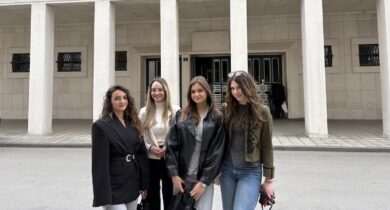
Anđela Popović, Marta Borović, and Ena Božović, students of the Kotor Gymnasium and winners of the debate competition on the topic of peer violence organized by the Centre for Civic Education (CCE), stayed in Novi Sad from 20 to 22 March as part of a study visit awarded for winning first place. During the three-day… »

March 2026
Responsible Journalism on Exam in the Era of Clicks and Growing Pressures
Journalism in the region is going through a serious period of change, but despite numerous challenges, it still has the potential to be an important societal corrective if it remains true to its core mission – accurate, responsible, and professional informing of the public, it was noted in the TVE program Civic Angle, produced by… »
Nikšić as European Capital of Culture Must Remember Its Heroines
Centre for Civic Education (CCE) strongly protests the rejection of the initiative to erect a monument to Joka Baletić, a seventeen-year-old partisan from the Nikšić area and a heroine of the anti-fascist struggle. This decision once again confirms that anti-fascism in Montenegro is too often reduced to declarative references, without a genuine willingness to uphold… »
Election of the APC Director Reduced to a Farce with a Single Candidate
Centre for Civic Education (CCE) notes that the appointment of the Director of the Agency for Prevention of Corruption (APC) represents a challenge that the competent body – the APC Council – has failed to resolve for nearly two years. Unfortunately, this comes as no surprise to either the expert community or the broader public,… »
Institutions Without a Plan to Mark the 20th Anniversary of Montenegro’s Restored Independence
The Centre for Civic Education (CCE), on the occasion of May 21 – Independence Day, marking the 20th anniversary of the restoration of Montenegro’s independence, has gathered data from state institutions and municipalities on how they plan to commemorate this jubilee, with the findings indicating a concerning level of systemic neglect of this important date.… »
Professional conduct of the police towards LGBTIQ+ persons is a test of institutional maturity
A professional and responsible approach by the police towards LGBTIQ+ persons is a systemic obligation. Therefore, it is particularly important that future police officers, already during their education, develop the knowledge, sensitivity, and professional standards necessary for appropriate action in cases motivated by hatred and/or homophobia and transphobia. An effective institutional response does not rest… »
News Programme as a Service to Institutions, Not a Check on Government
Center for Civic Education (CCE) continuously points out that the public broadcaster RTCG does not fulfill its role as a check on government and a source of comprehensive and critical public information. This is further supported by the findings of monitoring the central news programme Dnevnik 2, which CCE conducted over the past year in… »
The Zmajević Case Demonstrates That Accountability for War Crimes Is Possible
The verdict in the Zmajević case serves as an example that, despite the passage of time, it is possible to establish accountability for war crimes. It also serves as an important reminder that investigations must be conducted decisively and without prolonged delays, as emphasized during the fourth of seven educational webinars, this time on the… »
Nearly One Million Euros for the Encyclopedia of Montenegro, While the Public Has No Access to Results
Centre for Civic Education (CCE) considers that the public is insufficiently informed about the Encyclopedia of Montenegro project, implemented by the Montenegrin Academy of Sciences and Arts (CANU), particularly regarding the use of public funds as well as the selection of engaged collaborators. The Encyclopedia of Montenegro is defined by the Law on the Montenegrin… »
Growing Social Distance Signals the Risk of Islamophobia
Centre for Civic Education (CCE), marking 15 March – the International Day to Combat Islamophobia, highlights the importance of actively safeguarding interreligious and interethnic harmony and trust in Montenegro. Although the Constitution and laws prohibit discrimination on any grounds, everyday practice shows that a stronger and more systemic response to discrimination and hate speech is… »